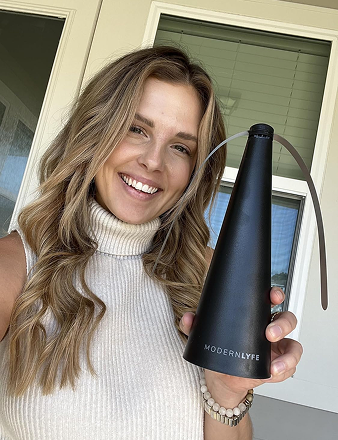
Fly traps all work on a few simple principles: stickiness, light, bait, or containment. Some, like sticky traps, are passive, waiting for a fly to land. Others, like UV light traps, are active, drawing flies in. Then you have bait and container traps, which use scent to lure flies into a one-way trip.
A Quick Guide to Common Fly Traps
The pest control aisle can be confusing. Dozens of traps promise to be the ultimate solution. The key is to understand how each one works. Some are designed for discreet use where guests gather, while others are heavy-duty tools for back-of-house or outdoor use.
This breakdown covers the main fly-fighting tactics. Each method has pros and cons, making it a better fit for a quiet dining room versus a busy commercial kitchen.
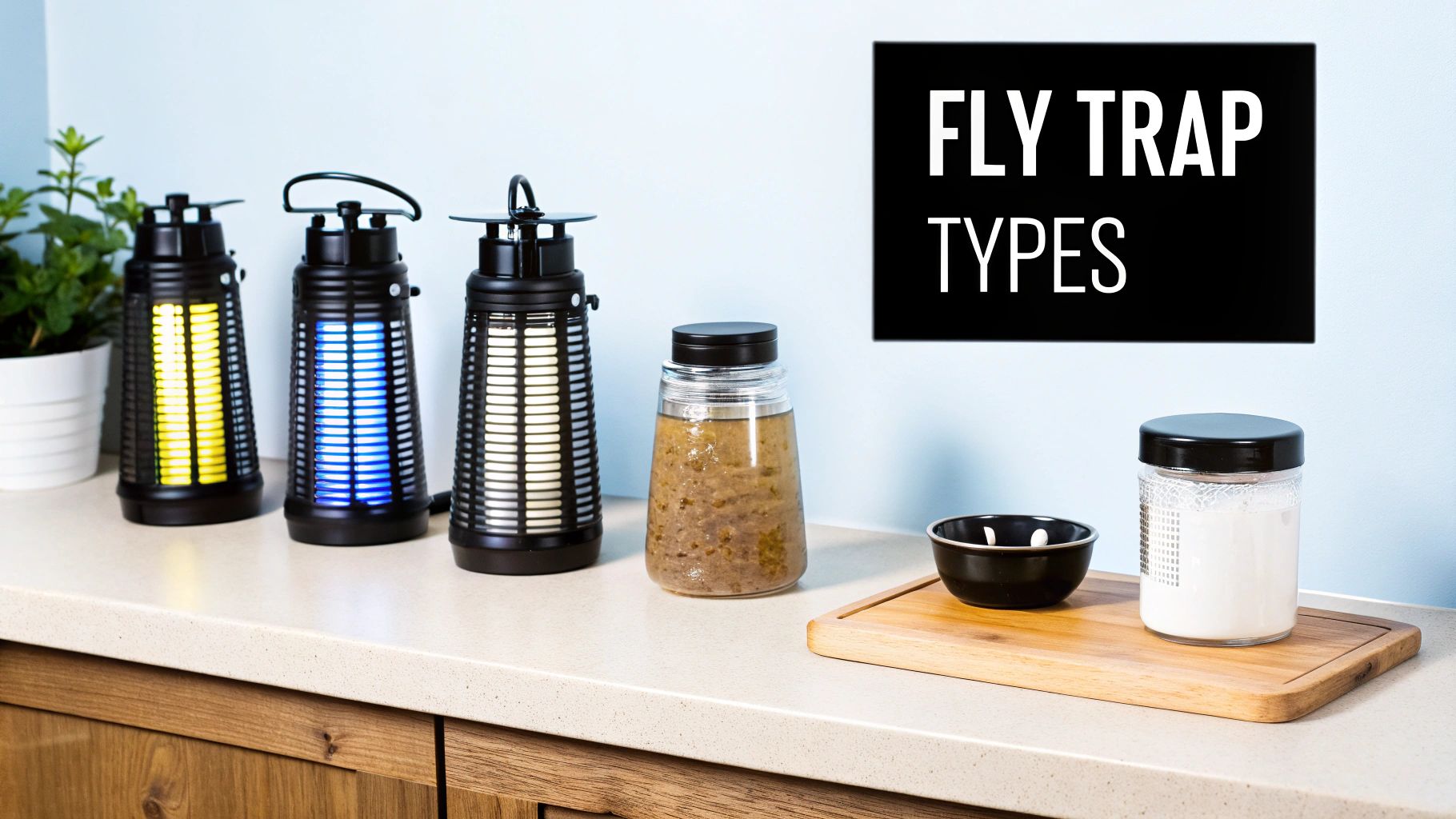
Comparing The Main Categories
Let's break down the most common options. Think of this as your starting point before we dive deeper into each type. Understanding these fundamentals is the first step toward an effective pest control plan. To get a head start, you can learn more about how a liquid fly trap works and what makes its bait so powerful.
Effective fly management rarely relies on a single tool. A layered approach is almost always better. Combining a discreet indoor trap with a robust outdoor one creates a comprehensive defense that stops flies before they become a nuisance.
The following table breaks down the key differences between the major categories of fly traps on the market.
Fly Trap Types at a Glance
This quick comparison table highlights common fly traps, how they work, and their best use cases. Use it as a cheat sheet to narrow down your options.
| Trap Type | How It Works | Best For | Key Advantage | Key Disadvantage |
|---|---|---|---|---|
| Sticky Traps | Uses an adhesive surface to physically ensnare flies that land on it. | Low-traffic indoor areas where discretion is not a primary concern. | Simple, silent, and requires no power. | Becomes unsightly once covered in insects. |
| UV Light Traps | Emits ultraviolet light to attract flies, capturing them on a glue board or electrocuting them. | Kitchens, service areas, and commercial spaces away from guest view. | Highly effective at attracting a wide range of flying insects. | "Zapper" models are noisy and can create airborne particles. |
| Bait Traps | Lures flies with a potent attractant into a container they cannot escape. | Outdoor areas, patios, and spaces with heavy fly populations. | Extremely powerful; can capture a large volume of flies. | The bait often has a strong, unpleasant odor. |
| Container Traps | A simple jar or container with a funnel entry and bait inside, trapping flies that enter. | Home use, small patios, and DIY setups for minor fly issues. | Inexpensive, easy to make, and non-toxic with natural bait. | Limited capacity and ineffective for large infestations. |
This table helps you quickly identify which trap type aligns with your needs, whether you're dealing with a few stragglers or a full-blown invasion.
A Closer Look at Traditional Fly Control Methods
Traditional methods like sticky traps and baited containers have been used for generations because they work by exploiting a fly's basic instincts. They rely on straightforward mechanics rather than advanced technology.
Think of these traps as passive opportunists. A sticky trap is like quicksand on a fly's flight path—they land and can't escape. A baited trap is more cunning, luring them in with the promise of a meal that leads to their demise.
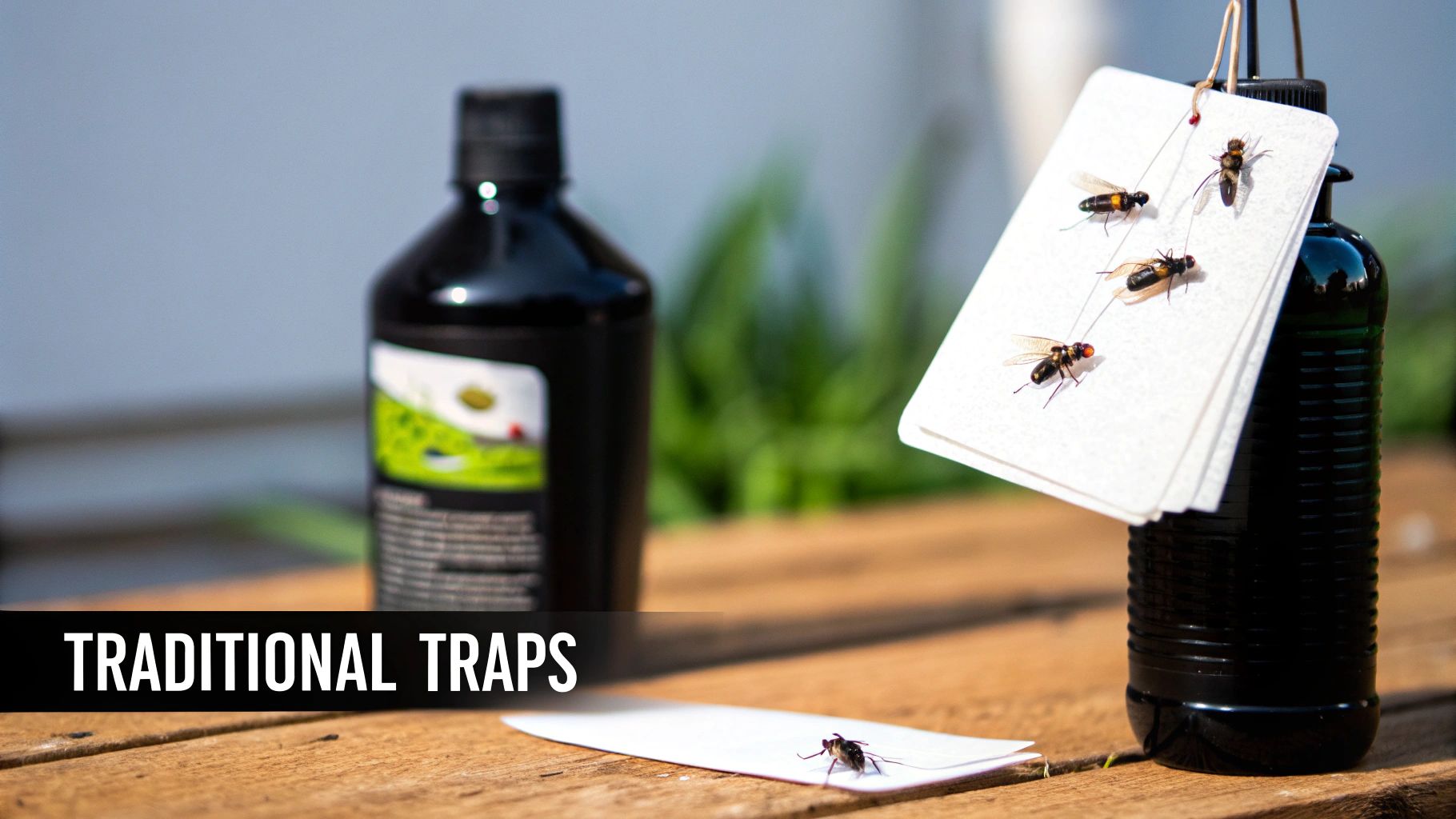
The Unwavering Appeal of Sticky Traps
Sticky traps—from classic flypaper ribbons to flat glue boards—are brilliantly simple. They have no moving parts, need no electricity, and use no complex chemicals. Their entire strategy is a powerfully adhesive surface.
Flies naturally land on edges and high-contrast surfaces. The moment they touch a sticky trap, the glue holds them fast, making escape impossible.
Of course, this simplicity is both their biggest strength and their biggest weakness, especially in a professional setting.
-
Pros of Sticky Traps:
- Completely Silent: They make no noise, ideal for quiet environments.
- No Power Needed: Place them anywhere without needing an outlet.
- Inexpensive: They are one of the most budget-friendly options available.
-
Cons of Sticky Traps:
- Highly Visible: A strip covered in dead flies is unsanitary and unprofessional, a major problem for restaurants and hotels.
- Limited Capacity: Once the surface is full, the trap is useless and must be replaced.
- Non-Selective: Outdoors, they can trap beneficial insects, small birds, or other animals.
The visual element is the real deal-breaker. No customer wants to see trapped insects while they’re eating. This makes sticky traps a better fit for back-of-house areas, away from the public eye.
Baited Traps and The Science of Scent
Baited container traps are more proactive. They use a potent scent to actively draw flies in from a distance. The design is typically a container, jug, or bag with a one-way funnel entrance.
Once a fly enters, the funnel makes it nearly impossible to fly back out, and the fly often drowns in the liquid bait. The real power is the bait itself.
The attractants in baited traps mimic decaying organic matter like rotting fruit or meat. To a fly, this odor is an irresistible invitation to a feast and a prime spot to lay eggs.
This approach is highly effective for reducing large fly populations, especially outdoors. But the strong, unpleasant smell means they must be placed far from guests, like near dumpsters or at the property's edge. For anyone interested in the details, understanding how to make your own fly trap with bait highlights what makes these lures so powerful.
Simplicity as a Double-Edged Sword
For both sticky and baited traps, their greatest strength—simplicity—is also a fundamental weakness in a professional environment. They are designed to capture and hold flies, meaning the dead pests remain on full display. This creates an obvious sanitation issue and a negative impression that is unacceptable in most guest-facing areas.
Furthermore, their capacity is limited. A busy patio or commercial kitchen can easily overwhelm a single trap, requiring constant monitoring and replacement. While these traditional tools have a place in a larger pest management plan, they fail to meet the aesthetic and performance standards modern businesses require. They solve one problem by creating another: an ugly, unhygienic collection of dead insects.
A Closer Look at Modern Electric Fly Traps
While traditional fly traps have their place, modern businesses need solutions that are both powerful and discreet. Technology turns fly control from a reactive chore into a proactive strategy. Electric and UV light traps are a major leap forward, using science to exploit a fly's natural instincts cleanly, quietly, and effectively.
This technology is based on a biological principle called phototaxis—the natural instinct of creatures like houseflies to move toward light. Flies are especially drawn to specific wavelengths in the ultraviolet (UV-A) spectrum. To us, it's invisible; to a fly, it's a homing beacon.
The Pull of UV Light
Modern electric traps use phototaxis with high efficiency. Instead of a smelly bait, they use UV bulbs that emit light at the perfect wavelength—usually around 365 nanometers—to pull flies in from across a room. It's a silent, odorless lure that works 24/7.
Once drawn in, the fly is neutralized. How that happens is where different types of electric traps diverge. This distinction is critical in a restaurant or hotel where atmosphere and sanitation are top priorities.
Zappers vs. Glue Board Traps
The two main types of electric fly traps are "zappers" and glue board traps. Both use UV light to attract pests, but their capture methods are completely different.
- Bug Zappers: These traps produce a loud "ZAP!" when a bug hits their high-voltage grid. While effective, they create a major sanitation issue called the "sneeze effect." Insect parts can be aerosolized and scattered up to 7 feet away, making them unsuitable for any space near food prep or dining areas.
- Glue Board Light Traps: This is the more sophisticated and sanitary option. These traps use UV light to lure flies toward a sticky board hidden from sight. The flies are trapped silently and securely. There's no zap, no airborne debris, and no noise. They are the preferred choice for indoor commercial spaces.
The difference is simple: a zapper is a loud executioner, while a modern glue board trap is a silent, sanitary prison. For any business focused on customer experience, the choice is clear.
The demand for these cleaner, quieter solutions is rising. Electric and UV fly traps dominate the market, especially for commercial use. The commercial sector—restaurants, hotels, and hospitals—prefers designs that blend into the environment while remaining effective. You can read the full research on fly trap market trends to see how hospitality venues are driving this change.
Beyond Light: Chemical and Airflow Solutions
While UV light is a powerhouse, it's not the only modern technology available. Two other advanced methods offer more targeted or preventative control.
Pheromone Traps: The Targeted Approach
Pheromone traps are specialists. Instead of a general lure like light or a food scent, they use synthetic versions of chemical signals insects use to communicate. This makes them incredibly specific, targeting only certain species without harming beneficial insects.
These traps are ideal for monitoring and controlling particular pest populations—like pantry moths or fruit flies—with precision.
Airflow Traps: The Ultimate Deterrent
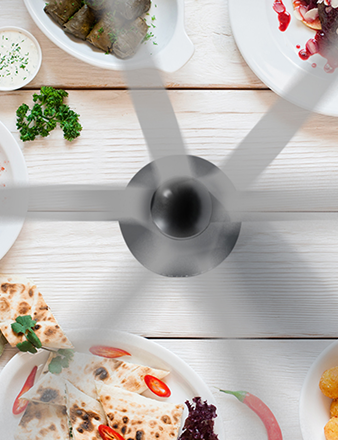
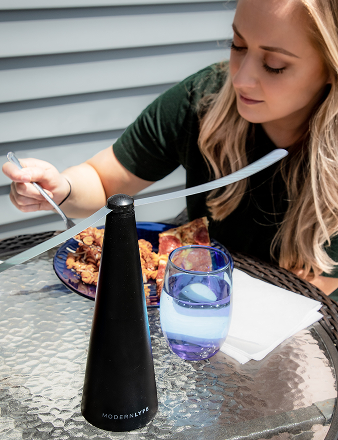
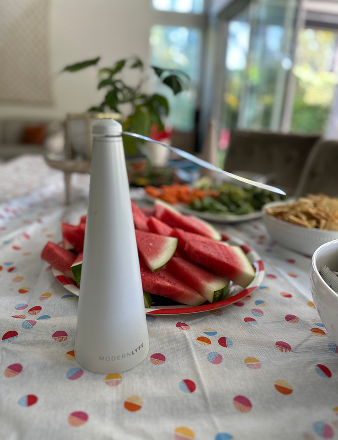
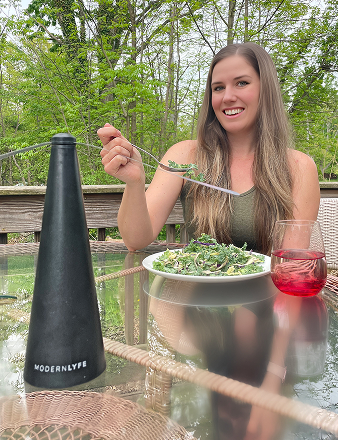
Some of the smartest modern solutions don't trap flies at all—they keep them out. Airflow devices, like fly fans, use a gentle current of air to disrupt a fly's flight path. This simple method creates an invisible barrier flies cannot cross. For a deeper dive, check out our guide on how a fly trap fan offers a chemical-free deterrent.
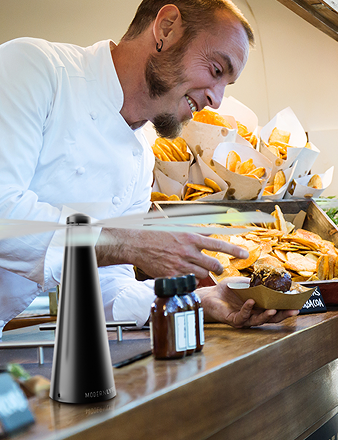
This approach is perfect for protecting open-air patios, buffet lines, and entryways. There's no zapping, sticking, or chemicals involved—just a pest-free experience for your guests.
How to Choose the Right Fly Trap for Your Space
With so many options, the question isn't just "what works?" but "what works for my space?" There is no single best fly trap for every situation. A potent outdoor bait trap would be a disaster in a dining room, just as a discreet indoor light trap would be useless next to a dumpster.
Choosing the right tool means balancing effectiveness with the demands of your space. It's less about the trap and more about where and how you use it.
Key Factors to Consider
Before buying, think through your specific needs. A few simple questions will narrow down your choices and prevent you from buying a trap that creates more problems than it solves.
- Location: Inside or outside? This is the first and most important question.
- Proximity to People: Will the trap be near guests or customers? If so, aesthetics and noise are top priorities.
- Proximity to Food: Is it for a kitchen, patio, or dining area? Sanitation and odor control are non-negotiable.
- Visual Impact: Does the trap need to be discreet, or is it for a back-of-house area where looks don't matter?
- Maintenance: How much effort are you willing to put in? Consider the time needed for cleaning, replacing glue boards, or refilling bait.
Answering these questions helps you build a profile of your ideal solution. A restaurant patio demands a silent, odor-free, and visually appealing device. A horse barn can easily accommodate a smelly but effective bait trap.
The decision between a modern or traditional fly trap often comes down to aesthetics and advanced features. This chart helps visualize that choice.
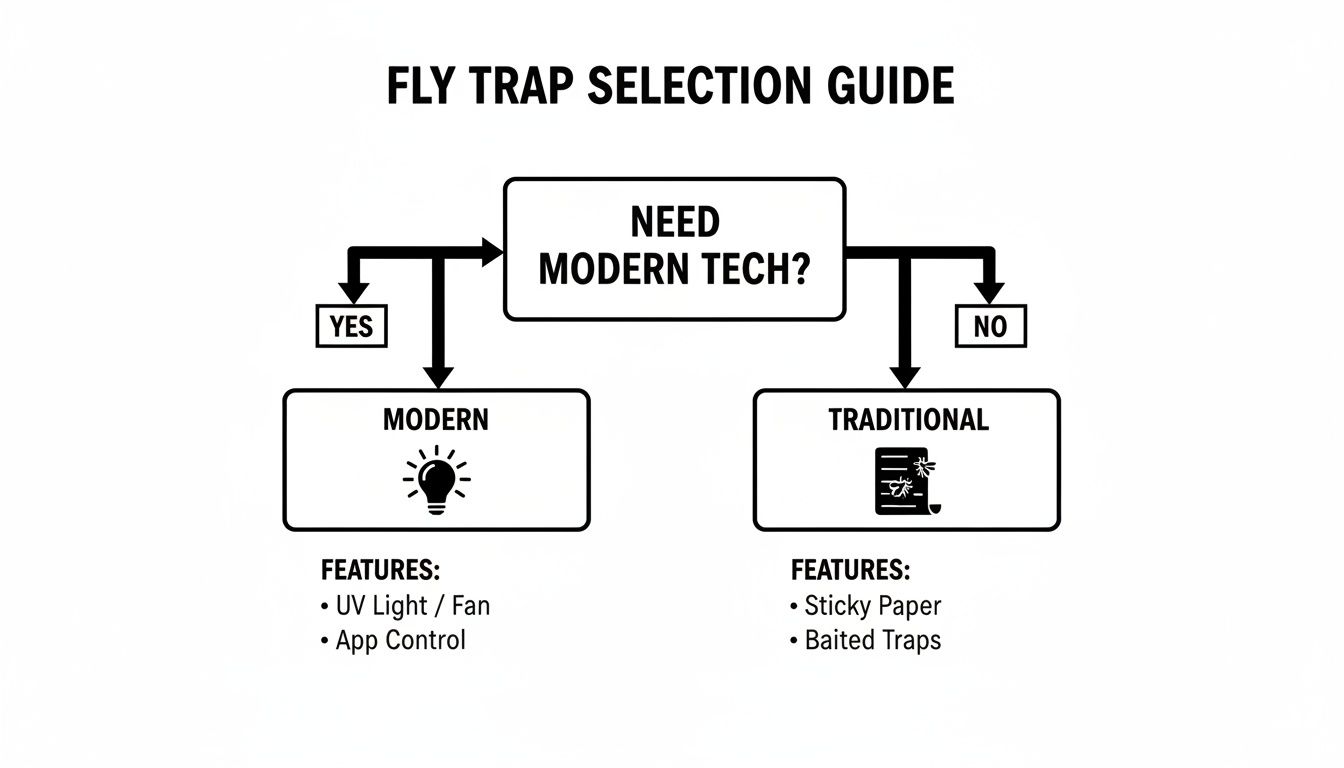
As the flowchart shows, if a quiet, discreet design is important, start your search with electric or airflow-based solutions.
Matching the Trap to the Task
Once you know your requirements, you can find the right technology. A common mistake is using a powerful trap in the wrong place, like putting a pungent bait trap near an outdoor seating area.
Instead, think strategically. A UV light trap with a hidden glue board is perfect for a kitchen entryway—it’s sanitary, silent, and effective. A loud bug zapper, however, is a poor choice for any space where people gather. It's startling, and the risk of airborne insect parts is a major concern.
When choosing a trap for your home, especially with pets, safety is paramount. Always review general considerations for pet safety to make an informed decision.
A layered approach often works best. Use a powerful, odor-based trap on the far perimeter of your property to intercept flies, then place a discreet UV trap indoors to catch any that manage to sneak past.
Hospitality Fly Control Decision Matrix
For the hospitality industry, the stakes are higher. A single fly can ruin a customer's experience, so your choice must prioritize their comfort.
This matrix scores different fly control methods based on criteria that matter most in restaurants, hotels, and event spaces.
| Fly Trap Type | Guest Proximity (Safety) | Aesthetic Impact | Noise Level | Maintenance Needs | Best Use Case |
|---|---|---|---|---|---|
| Sticky Traps (Ribbons) | 1/5 (Very Low) | 1/5 (Very Poor) | 5/5 (Silent) | 3/5 (Moderate) | Storage rooms, basements |
| Bait Traps (Outdoor) | 2/5 (Low) | 2/5 (Poor) | 5/5 (Silent) | 2/5 (High) | Near dumpsters, property edge |
| Bug Zappers | 2/5 (Low) | 3/5 (Moderate) | 1/5 (Very Loud) | 3/5 (Moderate) | Loading docks, away from people |
| UV Glue Board Traps | 4/5 (High) | 4/5 (Good) | 5/5 (Silent) | 4/5 (Low) | Kitchens, hallways, entryways |
| Fly Fans (Deterrent) | 5/5 (Excellent) | 5/5 (Excellent) | 5/5 (Silent) | 5/5 (Very Low) | Dining tables, patios, buffets |
The takeaway is clear: solutions designed for guest-facing areas, like UV glue board traps and fly fans, are the winners for aesthetics, silence, and safety. They get the job done without disrupting the customer experience.
Rethinking Fly Control Beyond Traps
We've focused on how to catch flies once they're already inside. But what if you could stop them from ever becoming a problem? This requires a shift from a reactive to a proactive mindset—creating a fly-free space from the start.
Instead of relying on baits, zappers, or sticky paper, this approach uses simple science to build an invisible barrier flies don't want to cross. It’s a clean, modern solution perfect for areas where guest comfort and your business's image are top priorities.
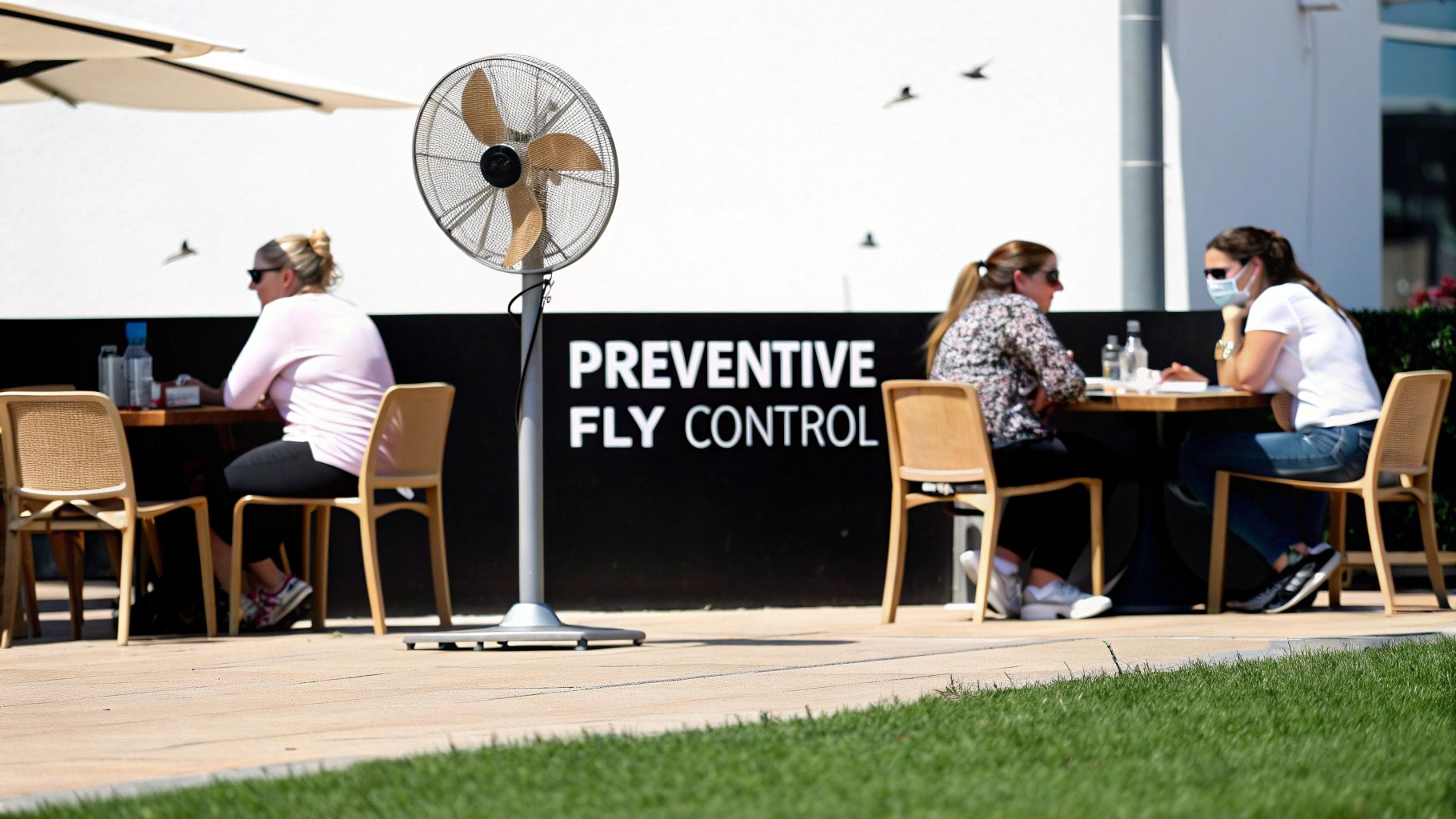
The Science of Deterrence
At the center of this preventive strategy are tools like specially designed fly fans. These devices subtly change the environment to confuse and deter flies, making your tables and buffet lines unappealing landing spots.
The key is airflow. A fly’s flight is surprisingly fragile. Even a gentle, consistent breeze makes it incredibly difficult for them to navigate and land. This air movement creates an invisible shield over a table or food station that flies find nearly impossible to breach.
This simple principle is the foundation of a new way to manage fly control.
More Than Just Air
It doesn’t stop with moving air. The smartest fly fans add another layer of defense: visual disruption. The blades on these devices often feature reflective, holographic patterns that catch and scatter light as they spin.
To a fly's compound eyes, which are made of thousands of lenses, this flashing, ever-changing light is completely disorienting.
This visual chaos scrambles a fly's perception, making it nearly impossible to focus on a target. It’s a harmless and silent deterrent that leverages a fly's own biology against it, encouraging it to fly elsewhere without physical contact.
This dual-action approach of air currents and visual confusion creates a powerful, multi-sensory barrier. It sends a clear message to flies: "This area is unstable and unsafe for landing." They are forced to find an easier target, far from your food and guests. The result is a pest-free zone without the noise, smells, or unsightly mess of traditional traps.
This move toward cleaner, preventative measures is seen across the industry. The global fly trap market has grown significantly, pushed by hospitality and food businesses prioritizing chemical-free solutions. To get a better sense of this shift, you can explore detailed insights on the growing fly trap market.
Answering Your Top Questions About Fly Traps
After exploring the different types of fly traps, you likely have some practical questions. Knowing what a trap does is one thing; knowing how to use it safely and effectively is another. Let's tackle the most common questions.
Choosing the right solution is about more than just getting rid of flies. It’s about protecting the health and comfort of your guests and staff.
Are UV Light Traps Actually Safe for Kitchens?
Yes, as long as you choose the right model. The key is to avoid old-school "bug zappers" that electrocute insects with a loud zap. That zap creates the "sneeze effect," which can blast insect parts up to 7 feet away—not something you want near a prep station.
The modern, safe alternative is a UV light trap that uses a hidden glue board.
- They're Silent: These traps draw flies in with UV light and capture them quietly on an internal sticky board. No zapping, no noise.
- They're Sanitary: Flies are trapped whole, eliminating the risk of airborne contamination. This makes them perfectly safe for commercial kitchens, server stations, and buffet lines.
- Placement is Key: Install them away from windows where they'd compete with sunlight. A height of about 4-6 feet off the floor is ideal, right in the flies' typical flight path.
How Often Do I Really Need to Maintain My Fly Trap?
This depends on the trap type and the severity of your fly problem. However, a trap that isn't serviced is just a wall ornament; it quickly stops being effective.
A full trap is no longer a trap. Regular maintenance is the single most important factor in ensuring your fly control system actually works.
Here’s a quick maintenance guide:
- UV Glue Board Traps: Check glue boards weekly. Replace them at least once a month, or sooner if they fill up quickly. UV bulbs also lose their effectiveness over time, so replace them annually, even if they still light up.
- Outdoor Bait Traps: These are the most high-maintenance. Refresh the bait every 2-4 weeks as it evaporates or is consumed. You'll also need to empty and clean the container once it's full.
- Sticky Traps (Ribbons/Boards): These are single-use. Once they're covered, throw them away. In a busy area, you might change them every few days.
Can I Use More Than One Type of Trap at a Time?
Not only can you, but you absolutely should. A layered approach using different types of traps is the secret to a successful Integrated Pest Management (IPM) plan. Relying on just one method leaves gaps in your defense.
Think of it like home security. You don't just lock the front door; you might also have an alarm and motion-activated lights. Each element serves a specific purpose, creating a much stronger defense together.
For a restaurant, a smart, multi-layered strategy could look like this:
- Perimeter Defense: Place a heavy-duty outdoor bait trap near your dumpsters to intercept flies at the source.
- Entryway Guardian: Mount a discreet UV glue board trap inside the kitchen's back door to catch any stragglers.
- Guest-Facing Protection: Use a deterrent like a fly fan on patio dining tables to create a fly-free zone for guests.
This integrated system works by attacking the problem from every angle, ensuring your space stays clean, comfortable, and professional.
Ready to create a truly fly-free experience without unsightly traps or chemicals? The Modern Lyfe fan offers an elegant, effective deterrent perfect for any dining setting. Discover how Modern Lyfe can protect your tables and impress your guests.