Using fans for mosquito control is a brilliantly simple strategy that works for one key reason: mosquitoes are weak flyers. A steady breeze makes it nearly impossible for them to navigate and land, creating an effective, chemical-free barrier for your outdoor spaces.
This method works in two ways: it disrupts their flight and scatters the carbon dioxide from our breath that they use to find us.
The Power of Airflow in Pest Control
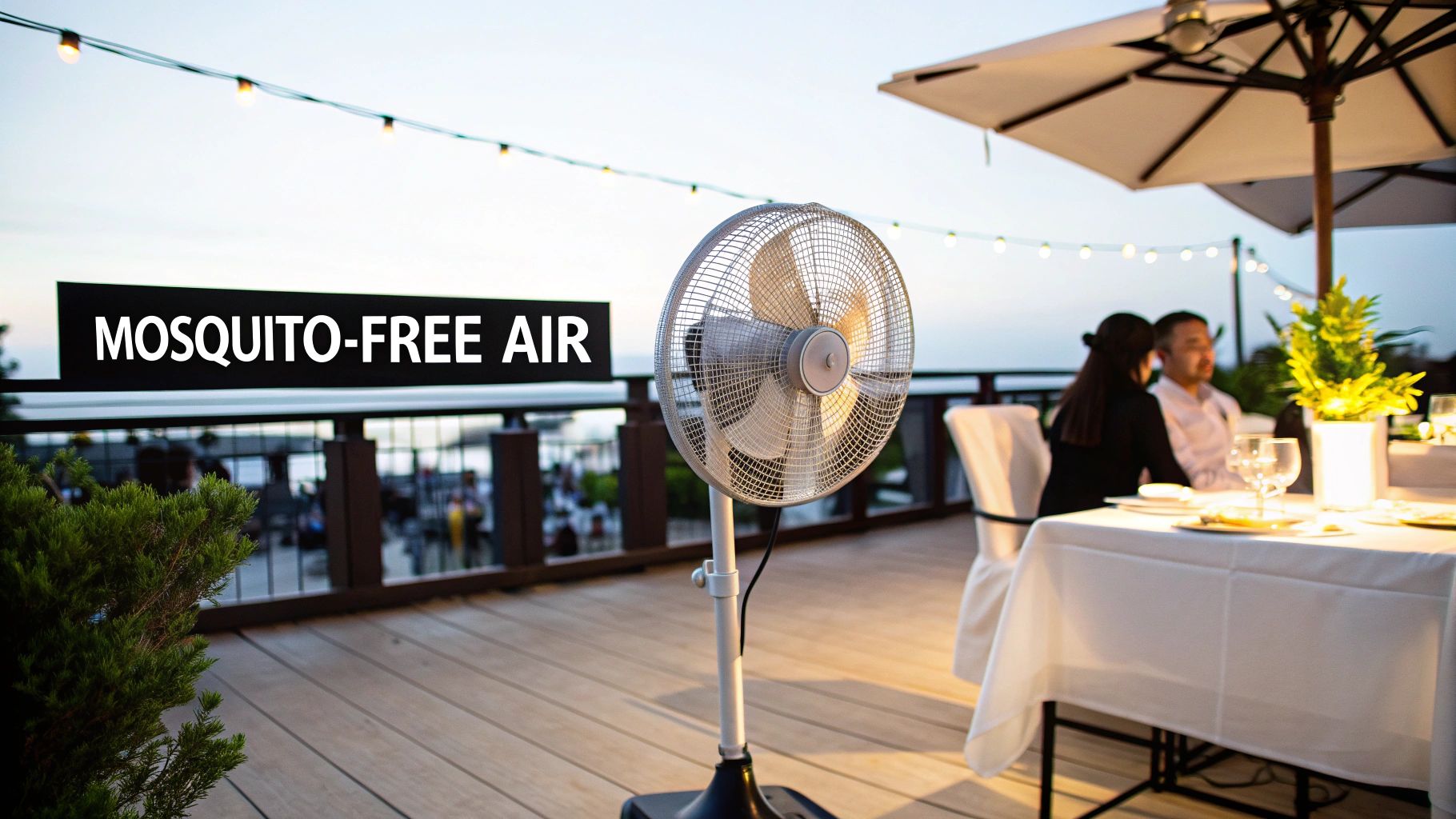
Forget smelly sprays, sticky citronella candles, and loud zappers. Well-placed fans offer a superior, guest-friendly alternative that improves the outdoor experience while solving a persistent problem.
The concept is straightforward. First, the airflow physically stops mosquitoes from reaching your guests. These pests are practically weightless, so a consistent breeze of just a few miles per hour blows them off course. It’s an invisible shield for your seating areas.
Second, fans dilute and disperse the signals that attract mosquitoes. They hunt by detecting the plumes of carbon dioxide (CO2) we exhale and sensing our body heat. A strong fan scrambles these signals, effectively cloaking your guests from nearby pests.
A Game-Changer for Patios and Events
This approach is especially powerful for hospitality businesses—restaurant patios, rooftop bars, and outdoor venues—where guest comfort is paramount. Instead of chemical repellents that can have overpowering odors or cause skin irritation, fans provide silent, odorless protection.
The real advantage of using fans for mosquito control is that you're enhancing the environment, not detracting from it. You add a comfortable, cooling breeze while deploying a highly effective pest deterrent.
The demand for better solutions is clear. The global mosquito control market was valued at USD 4.5 billion in 2023 and is projected to grow significantly, showing that people are actively seeking better ways to manage this issue.
Why Strategic Airflow Deters Mosquitoes
Here’s a breakdown of the science behind why a simple breeze is a mosquito's worst enemy.
| Mechanism | How It Stops Mosquitoes | Impact on Guest Experience |
|---|---|---|
| Flight Disruption | Mosquitoes are weak flyers and cannot navigate in wind speeds over a few MPH. | Creates a protected, bug-free zone without chemicals or noise. |
| CO2 Dilution | Fans disperse the carbon dioxide we exhale, which mosquitoes use to locate targets. | Guests become "invisible" to mosquitoes, preventing them from being targeted. |
| Cooling Effect | The breeze cools skin, reducing the body heat and sweat signals that attract pests. | Adds to physical comfort on warm days, making the space more inviting. |
This multi-pronged attack relies on physics rather than harsh chemicals, creating a much more pleasant atmosphere.
A Natural and Sustainable Approach
Airflow is a powerful, natural defense. It's a sustainable choice that avoids introducing pesticides into your environment—a major benefit for eco-conscious businesses and customers. This fits perfectly with a holistic approach to pest management, similar to other forms of natural pest control for lawns.
This simple yet powerful method lets you reclaim your outdoor areas from pests. To explore your options, our guide on outdoor fans to keep bugs away is the perfect place to start.
Choosing the Right Fans for Your Outdoor Space
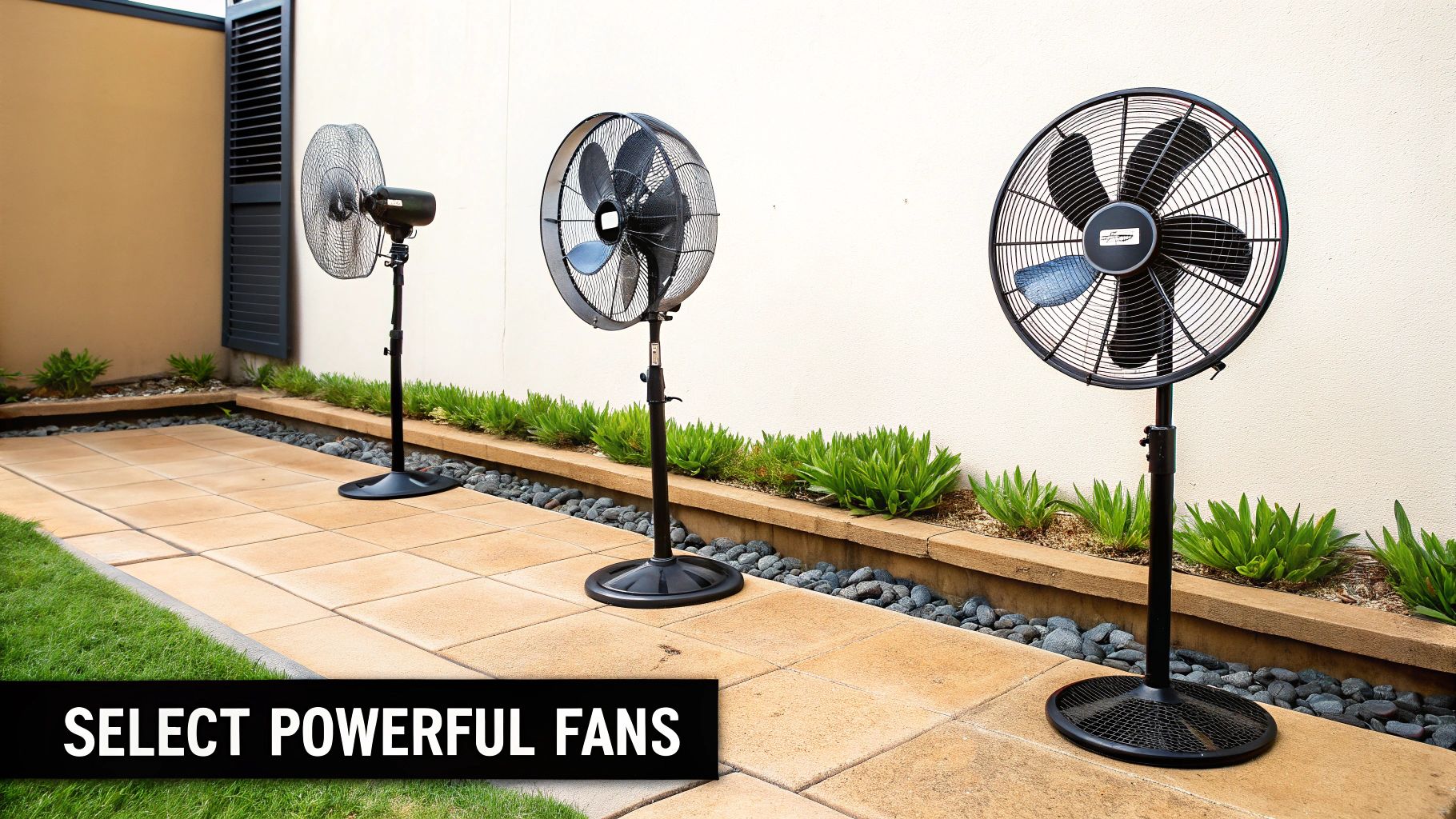
When using fans for mosquito control, not just any fan will work. A flimsy indoor model can't push enough air to create the protective barrier you need outdoors. You need to look past the price tag and focus on performance.
The most important metric is the CFM rating—Cubic Feet per Minute. It measures how much air a fan can move, and for outdoor use, higher is better. A high CFM creates a strong, consistent wind barrier that mosquitoes cannot penetrate.
As a baseline, look for fans with a CFM of at least 2,000. For a larger patio or a space with unpredictable cross-breezes, aim for 5,000 CFM or higher. That level of power creates a genuinely pest-free zone.
Key Features for Commercial Use
Beyond raw power, several features distinguish a decent fan from a commercial-grade workhorse. These units run for hours and are exposed to the elements, so durability is non-negotiable.
- Weather Resistance: Only buy fans specifically rated for outdoor use. They have sealed motors to keep out moisture, rust-resistant grills, and UV-protected plastic that won’t crack after one season in the sun.
- Oscillation: A fan that sweeps back and forth covers a much larger area than a static one. This is highly efficient for protecting bigger seating areas or an entire patio with just a few units.
- Adjustable Height and Tilt: Precision is critical. You need to aim the airflow where mosquitoes congregate—around guests' legs and ankles.
These features provide the flexibility to adapt your setup for different events, seating arrangements, or wind conditions. It's no surprise the market for these tools is booming; sales of mosquito control products jumped 21% in two years, from 4.3 billion units in 2022 to an estimated 5.2 billion in 2024.
Matching the Fan to Your Space
The type of fan you choose should depend on the layout and use of your outdoor area. A permanent patio with a fixed seating plan has different needs than a grassy area used for weekend events.
The goal is to integrate the fans naturally into the environment. They should enhance guest comfort without being an eyesore or a tripping hazard.
Here are common scenarios and the fans that work best:
- Wall-Mounted Fans: Ideal for permanent patios or covered decks. They save floor space and can be positioned above diners to create a broad breeze that keeps bugs away without blowing napkins off tables.
- Pedestal Fans: The most flexible option. A high-velocity pedestal fan can be moved exactly where you need it, making it perfect for targeting problem spots or reconfiguring for a private party.
- Floor Fans: Also known as "blower" fans, these low-profile units create a strong barrier of air at ground level. They are less visually intrusive and highly effective at stopping mosquitoes before they get close.
By selecting the right mix of power, features, and fan type, you can build a robust system. To start shopping, see our guide on the best outdoor fan for mosquitoes for top picks and detailed reviews.
Strategic Fan Placement for Maximum Defense
Powerful, high-CFM fans are a great start, but placement is just as critical. The goal isn't just to move air—it's to build an intentional "wind barrier" that mosquitoes cannot cross.
Think of it as an invisible fence protecting your patio. By placing fans strategically, you can generate a continuous wall of moving air that shields the areas where your guests are relaxing and dining. This approach turns a simple appliance into a sophisticated defense system.
This isn't just about comfort. With the mosquito control service market expected to hit USD 2,633 million by 2033, it's clear people take mosquito-related health concerns seriously. Fans are a smart, non-chemical first line of defense to show patrons you're looking out for them.
Creating the Wind Barrier
The best method is to line the fans up along the perimeter of your patio or seating area, with all of them aimed outward. This creates a persistent pressure of air moving away from your guests, pushing any incoming mosquitoes back before they get close.
For a rectangular patio, place a fan at each corner. For a rounder space, three or four fans spaced evenly should suffice. The key is ensuring their air streams connect, leaving no gaps for pests to sneak through.
The core principle is simple: always blow air away from the protected area. Pointing fans directly at guests often creates a wind-tunnel effect and can push mosquitoes from one side of the patio to the other.
Targeting Mosquito Hotspots
Mosquitoes are clumsy flyers that usually stay close to the ground. They are drawn to ankles and lower legs, which emit the scents and heat they seek. This is where you can be precise with fan placement.
Adjust your fans so the strongest airflow hits the lower zone—from the ground up to about three feet high. This disrupts them in their primary hunting ground.
- For Dining Tables: A pedestal or floor fan placed a few feet from the table, aimed low to sweep the air underneath it, works perfectly.
- For Lounge Seating: Position fans to create a gentle cross-breeze over couches and chairs, focusing on the space where guests' legs will be.
- For Entrances: A fan blowing outward across a doorway is a brilliant way to stop mosquitoes from following people inside.
Achieving Overlapping Coverage
A single fan creates a cone-shaped stream of air. The secret to a bug-proof barrier is to make these cones overlap, which eliminates any calm "dead zones" where mosquitoes could land.
If you’re using oscillating fans, set their sweep so that each fan’s path crosses slightly into its neighbor's. This creates a moving, interlocking grid of air that mosquitoes cannot handle, providing total protection without blasting any single spot with too much wind.
Mastering placement is a huge part of using fans for mosquito control. To ensure you have the right tools for the job, check out our guide on selecting the best outdoor fans for mosquitoes.
Operations and Maintenance: Maximize Fan Effectiveness
An effective fly and mosquito fan system isn't a "set it and forget it" solution. A smart operational plan and a simple maintenance routine are essential to protect your investment and maintain a strong wind barrier.
The most common mistake is waiting too long to turn the fans on. Don't wait until guests are swatting away the first mosquitos. Be proactive. Power the system on at least 15-30 minutes before opening the patio or starting an event. This lead time allows the fans to establish a stable, protective air barrier.
Remember to run your fans consistently during peak mosquito hours—typically dusk and dawn—to keep everyone comfortable and bite-free.
A Simple Maintenance Checklist
Keeping your fans in prime condition is straightforward. A simple, repeatable checklist ensures maximum airflow and protects your equipment.
Here’s a practical routine:
- Wipe Down Blades Weekly: Dust and grime build up quickly on fan blades, reducing their efficiency. A quick weekly wipe-down helps them move the most air possible.
- Check Cords and Connections: Before each shift, visually scan power cords for frays, cracks, or loose connections to prevent safety issues and outages.
- Secure the Base: For pedestal or floor fans, ensure the base is stable to prevent them from getting knocked over in high-traffic areas.
A well-maintained fan is a powerful fan. Clean blades cut through the air efficiently; dirty blades struggle to do the job.
This simple process flow breaks down the core strategy behind effective fan placement.

As the graphic shows, a successful setup requires establishing a perimeter, targeting low-flying zones, and ensuring overlapping air coverage. When you combine these placement tactics with consistent timing and basic maintenance, you create a robust defense system that becomes a core part of your pest management strategy.
Gauging Success and Scaling Your System
How do you know if your fan strategy is working? Success comes down to simple observation and feedback from your staff and guests.
Your team is your first line of intelligence. Train them to watch for any lingering mosquito activity, especially around dusk. A simple shift log with notes on pest levels in different seating zones can quickly highlight what's working and what isn't.
Guest feedback is invaluable. A server asking, "Is the breeze comfortable for you?" is a great service touchpoint that often prompts guests to comment on how pleasant it is to dine without swatting at pests. That’s your confirmation of success.
Eliminating Dead Zones
Even with a good setup, you may find "dead zones"—pockets of still air where mosquitoes find refuge. These are typically behind large planters, next to walls, or in corners blocked by furniture. Find them by walking the space and feeling for gaps in the airflow.
Your goal is a continuous shield of air. A dead zone is a breach in that shield and the first place to investigate if mosquitoes reappear.
Once you find a weak spot, the solution is usually simple: adjust a fan's angle, widen its oscillation, or add a small floor fan. It's a process of tweaking and observing until the entire space is protected.
Troubleshooting Common Airflow Issues
When problems arise, the fix is usually quick. Here’s a rundown of common issues and their solutions.
| Problem You Notice | The Likely Cause | How to Fix It |
|---|---|---|
| Mosquitoes at one specific table. | A dead zone, likely from a pillar, large plant, or other obstruction. | Adjust a nearby fan to aim at the spot or add a small floor fan for targeted coverage. |
| Bugs arrive early in the evening. | Fans were turned on too late. The wind barrier wasn't established before guests arrived. | Power on all fans at least 30 minutes before seating your first guests. |
| The system seems less effective. | Dirty fan blades are the number one cause. Dust and grime buildup reduces airflow (CFM). | Make a quick wipe-down of all fan blades part of your weekly cleaning routine. |
Getting these details right makes a massive difference in keeping your defenses strong all season long.
Expanding Your Fan Strategy
As your business grows, your fans mosquito control plan must adapt. This means thinking strategically and layering your defenses, not just buying more of the same fans.
Start mixing different fan types. Use powerful, wall-mounted fans for main ambient airflow, and use portable pedestal fans for flexible, targeted protection for private parties or pop-up events.
You can also supplement your fans with other non-chemical deterrents. Consider landscaping with mosquito-repelling plants like lemongrass, citronella grass, or lavender around your perimeter. The fans create the primary barrier, and these elements add reinforcing layers to your pest-free bubble.
Answering Your Questions About Using Fans for Mosquito Control
Switching to a fan-based system for mosquito control often brings up questions about power, noise, cost, and effectiveness. Let's tackle these common queries so you can move forward with confidence.
The first question is always, "How strong does the fan need to be?" Research and field experience confirm that a gentle breeze of just 2-3 miles per hour is enough to stop a mosquito from flying straight. To create a reliable bug-free zone, you need fans that can push a steady stream of air, especially at lower levels.
Power, Noise, and Performance
When comparing fans, the key metric is CFM (Cubic Feet per Minute). For a commercial outdoor space, a fan rated at a minimum of 2,000 CFM is your starting point. For large, open patios, don't hesitate to go higher.
Of course, power can create noise. High-quality outdoor fans, however, are designed for quiet operation. Look for models with a decibel (dB) rating under 60 dB, which is about the level of a normal conversation and will fade into the background.
The goal is to create a breeze your guests feel without a fan they hear. The best systems enhance comfort by keeping people cool and protected, not by creating a noisy distraction.
Cost and Compatibility Concerns
"What will this do to my electricity bill?" Modern, energy-efficient fans are light on power. A typical high-velocity outdoor fan draws about the same electricity as a 100-watt light bulb. Running several fans all evening will have a minimal impact on your utility costs.
Another common question is about mixing methods. While you can technically use fans with citronella candles or tiki torches, the fan's airflow will scatter the smoke and scent, rendering them ineffective. It’s better to let the physical barrier of the fans do its job alone.
Do Fans Work on Other Bugs?
While our focus is mosquitoes, a fan strategy is effective against other flying pests as well.
- Flies: Houseflies are clumsy flyers and stand no chance against a steady breeze.
- Gnats and No-See-Ums: These tiny pests are even weaker than mosquitoes and are easily overwhelmed by the airflow.
- Wasps and Bees: As stronger flyers, a fan can disrupt them, but a determined wasp might still push through the breeze.
Getting these practical details right is key to setting up a system that is powerful, quiet, and cost-effective. It's how you create a genuinely pleasant outdoor experience that keeps guests coming back.
For an elegant and effective solution to keep flies away from your tables, explore the innovative fly fans from MODERN LYFE. Find the perfect addition to your hospitality setup at https://modernlyfe.com.