The 1.5 V alkaline battery is the power source for countless everyday gadgets. It's the standard voltage that electronics—from TV remotes and smoke alarms to toys—are designed around. That’s why it's the most common battery in any home.
What Is a 1.5 V Alkaline Battery?
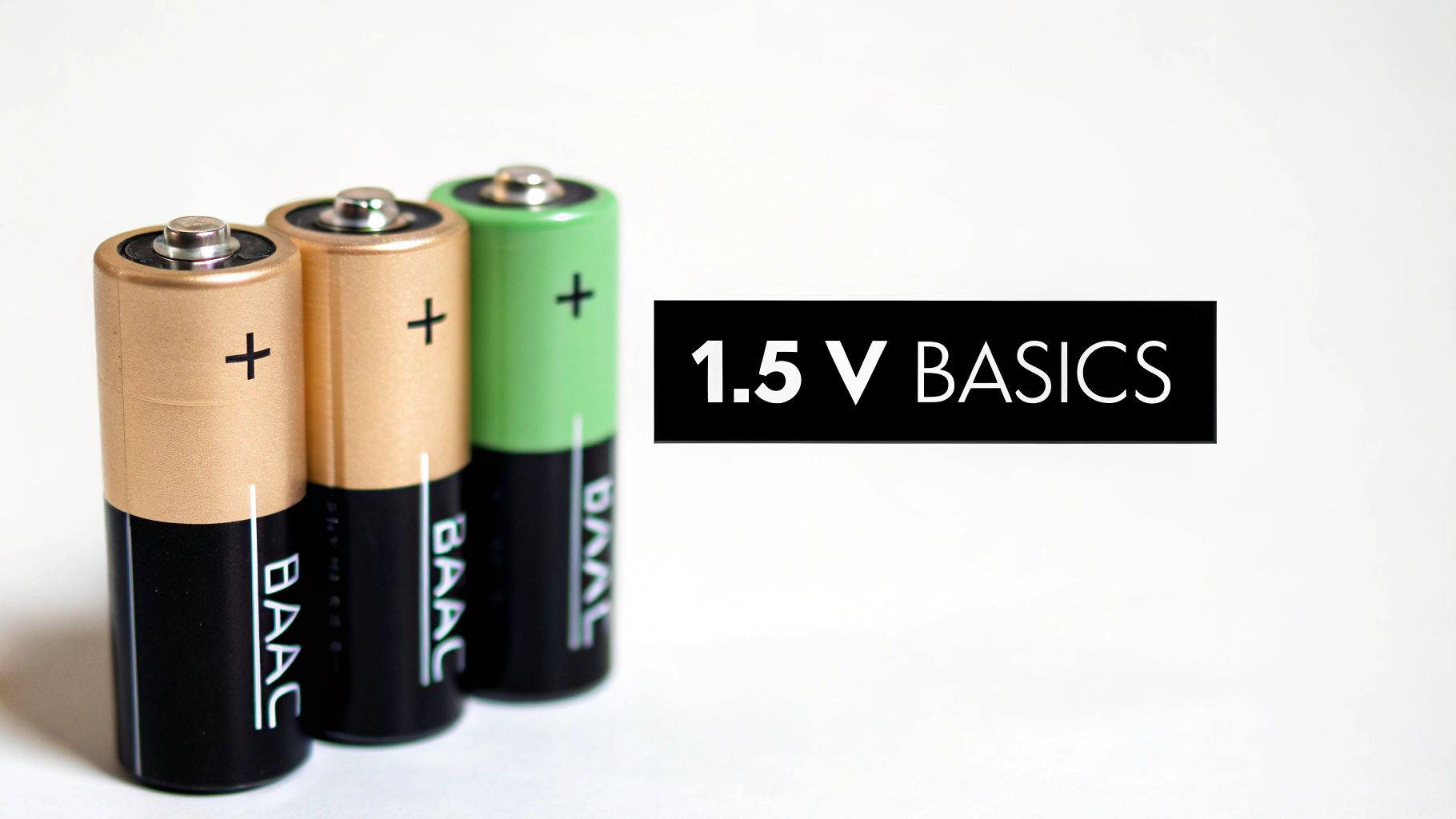
Think of "1.5 V" as the electrical pressure a battery delivers. It’s the industry sweet spot for small, portable electronics. This standardization is incredibly convenient. It means you can grab a pack of AA batteries and know they'll work in everything from your kitchen scale to a Modern Lyfe Fly Fan.
The "alkaline" part refers to the internal chemistry that creates electricity. It’s a reliable, time-tested formula known for a long shelf life and consistent power, making it a trusted choice for decades.
Different Sizes, Same Power
While the 1.5-volt output is standard, these batteries come in various physical sizes. The size doesn’t change the voltage; it changes the battery's capacity—how much energy it can store. Think of it as having different-sized fuel tanks for different jobs.
- AAA: The slimmest of the group, designed for small, low-drain devices like remote controls where space is tight.
- AA: The undisputed champion of battery sizes. It offers the perfect balance of size and power for toys, wireless mice, and flashlights.
- C: A bigger, beefier option with more energy for longer runtimes in devices like large flashlights or some motorized toys.
- D: The largest standard cylindrical battery, built for high-drain devices that need to run for a long time.
Here's the key takeaway: An AA, AAA, C, and D battery all deliver the exact same 1.5 volts. The size difference isn't about power but about stamina. A bigger battery holds more "fuel," letting it run a device longer. Understanding this simple concept makes choosing the right battery easy.
The Chemistry Powering Every Alkaline Cell
Every 1.5 V alkaline battery is a tiny, self-contained power plant. It’s not magic—it's clever chemistry. A controlled chemical reaction turns stored potential into electrical energy.
The process relies on three key parts. First is a zinc powder anode (the negative terminal). On the other side is a manganese dioxide cathode (the positive terminal). They are separated by a gel called an alkaline electrolyte, usually potassium hydroxide. Think of the electrolyte as a highway for charged particles, letting them move between the two ends.
The action starts when you pop the battery into a device. Completing the circuit allows the chemistry to begin. Zinc on the anode side oxidizes, releasing a stream of electrons. These electrons rush out of the battery, travel through your device to power it, and flow back into the cathode, where the manganese dioxide accepts them. This constant, orderly flow is what we call electricity.
Why This Chemistry Works So Well
Alkaline chemistry is perfect for everyday gadgets. This chemical reaction delivers a stable voltage, holding steady at around 1.5 volts for most of its life before slowly tapering off. That reliability is crucial for electronics that need consistent power.
This setup is also incredibly efficient for storage. Alkaline batteries have an amazing shelf life, with many brands promising they'll hold their charge for up to 10 years. Their self-discharge rate is very slow, so you can stash a pack in a drawer and trust it will be ready to go years later.
Think of it like a sealed energy bar. The ingredients (chemicals) are all there, but they do nothing until you "open the wrapper" by putting the battery in a device. This is why a new alkaline battery can sit for a decade and still be ready for action.
This dependable, cost-effective chemistry explains why the alkaline battery has been a household staple for decades. It's a huge industry—the global alkaline battery market was valued at around USD 9.28 billion in 2024 and is projected to hit USD 15.1 billion by 2034. That growth shows just how essential the humble 1.5 V alkaline battery still is. You can read more about the alkaline battery market forecast on Precedence Research.
Choosing The Right Battery Size For Your Device
When you open a device's battery compartment, you’ll see familiar choices: AA, AAA, C, or D. While they all deliver the standard 1.5 V alkaline battery power, they are not interchangeable. The real difference isn't voltage, but capacity—how long they last.
This is measured in milliampere-hours (mAh).
Think of voltage as the pressure of the electricity, while capacity (mAh) is the size of the fuel tank. A tiny AAA battery and a chunky D battery both push out energy at the same 1.5 V pressure. The D cell, however, has a much bigger tank, meaning it can keep a device running far longer.
Matching The Tank To The Task
This "fuel tank" concept is key. It explains why your TV remote uses AAs while a large camping lantern needs Ds. It’s all about matching the battery's stamina to the device's energy needs.
- Low-Drain Devices: Gadgets like remote controls, wall clocks, or a wireless mouse sip a tiny amount of power over months or years. They only need a small fuel tank, making the compact AAA or AA battery a perfect fit.
- High-Drain Devices: On the other hand, things with motors—like toys, high-powered flashlights, or our Modern Lyfe fly fans—are the gas-guzzlers. They use energy quickly and need the larger fuel tanks found in C or D batteries to operate for a reasonable amount of time.
Using a small AAA battery in a high-drain device is like trying to power a truck with a scooter's gas tank. It’ll work, but not for long.
It's a common myth that bigger batteries are "more powerful." In reality, they just hold more energy. An AA battery delivers the same 1.5 volts as a D battery; it just can't supply it for as long under the same load.
A Quick Guide To Common Alkaline Battery Sizes
To make things clear, here’s a quick rundown of the most common alkaline battery sizes. Think of this as your cheat sheet for matching the right power source to the job.
| Battery Size | Typical Capacity (mAh) | Best For (Device Type) | Performance Profile |
|---|---|---|---|
| AAA | 700–1,200 | Remote Controls, Small Electronics, Wireless Keyboards | Ideal for low-drain devices where a slim profile is key. |
| AA | 2,000–3,000 | Toys, Wireless Mice, Flashlights, Fly Fans | The most versatile size, balancing capacity and footprint. |
| C | 4,000–8,000 | Large Flashlights, Motorized Toys, Portable Radios | A step-up in longevity for moderate-to-high-drain items. |
| D | 8,000–18,000 | High-Lumen Flashlights, Large Lanterns, Boomboxes | The ultimate choice for maximum runtime in power-hungry gear. |
As you can see, the jump in capacity from one size to the next is huge. That’s why getting the size right is so critical for performance.
Capacity By The Numbers
The difference in "fuel tank" size is dramatic. A standard AA battery holds between 2,000–3,000 mAh. In comparison, a smaller AAA battery has only 700–1,200 mAh because there's less room inside for the active chemical materials.
This capacity difference directly impacts the market. The AAA battery segment alone was valued at USD 2.31 billion in 2024, thanks to its use in countless small electronics. You can see more details on the AAA alkaline battery market from Fortune Business Insights.
This chart shows just how essential alkaline batteries are, with strong growth projected across the board.

The numbers show a clear upward trend, with the market expected to grow by over 60% in the next decade. For devices like our battery-operated table fans, which need to run reliably for hours, choosing the right battery size is the secret to dependable, all-day performance.
Alkaline vs. Rechargeable vs. Lithium Batteries
Walking down the battery aisle can be overwhelming. Instead of asking which battery is "best," ask which one is best for the job. Let's break down the three main players: the standard 1.5V alkaline, the rechargeable NiMH, and the premium lithium battery.
Each is built for a different mission. Matching the battery to the device is the secret to great performance without wasting money.
Alkaline: The Everyday Workhorse
The classic 1.5V alkaline battery is the champion of convenience. It's the perfect "set-it-and-forget-it" power source for gadgets that sip power slowly over a long time.
- Best for: Wall clocks, TV remotes, smoke detectors, and other low-energy devices.
- Why it wins: You can't beat the low upfront cost and incredible shelf life. Alkaline batteries can sit in a drawer for up to 10 years and still be ready. They provide a steady, reliable trickle of power perfect for devices you don't want to think about for months or years.
For these simple jobs, spending more on a fancy battery doesn't make sense. Alkaline is the smart, economical pick.
NiMH Rechargeable: The Long-Term Value Play
Nickel-Metal Hydride (NiMH) batteries are your go-to for anything that chews through disposables. They're the eco-friendly and budget-conscious choice for power-hungry electronics. You'll spend more upfront on batteries and a charger, but they pay for themselves fast.
People often notice their voltage. NiMH batteries run at 1.2 volts, which sounds low compared to a fresh 1.5V alkaline. Don't worry. Most modern electronics are designed to work perfectly on this slightly lower voltage. In fact, a "dead" alkaline battery is usually around 0.9V, so a fully charged NiMH at 1.2V has plenty of juice. To dig deeper, check out our detailed guide to the 1.2 volt rechargeable battery.
- Best for: Gaming controllers, digital cameras, wireless mice, and motorized toys.
- Why it wins: You can recharge a single NiMH battery hundreds of times, saving a mountain of disposables from the landfill. This drastically cuts down on both waste and spending over the long haul.
If you find yourself buying new batteries for the same device every few weeks, switching to NiMH rechargeables is a no-brainer. The savings add up quickly.
Lithium: The High-Performance Champion
When you can't compromise on performance, lithium batteries are in a league of their own. They're engineered for extreme conditions and high-drain gear where powerful, consistent output is non-negotiable.
- Best for: High-powered flashlights, outdoor gear for freezing temperatures, and critical medical equipment.
- Why it wins: Lithium batteries are lightweight and hold their voltage well even when a device is pulling a lot of power. They also work in a massive temperature range, from freezing cold to scorching heat, where an alkaline battery would fail. They are the most expensive option, but for mission-critical gear, that superior performance is worth it.
Smart Storage and Responsible Disposal
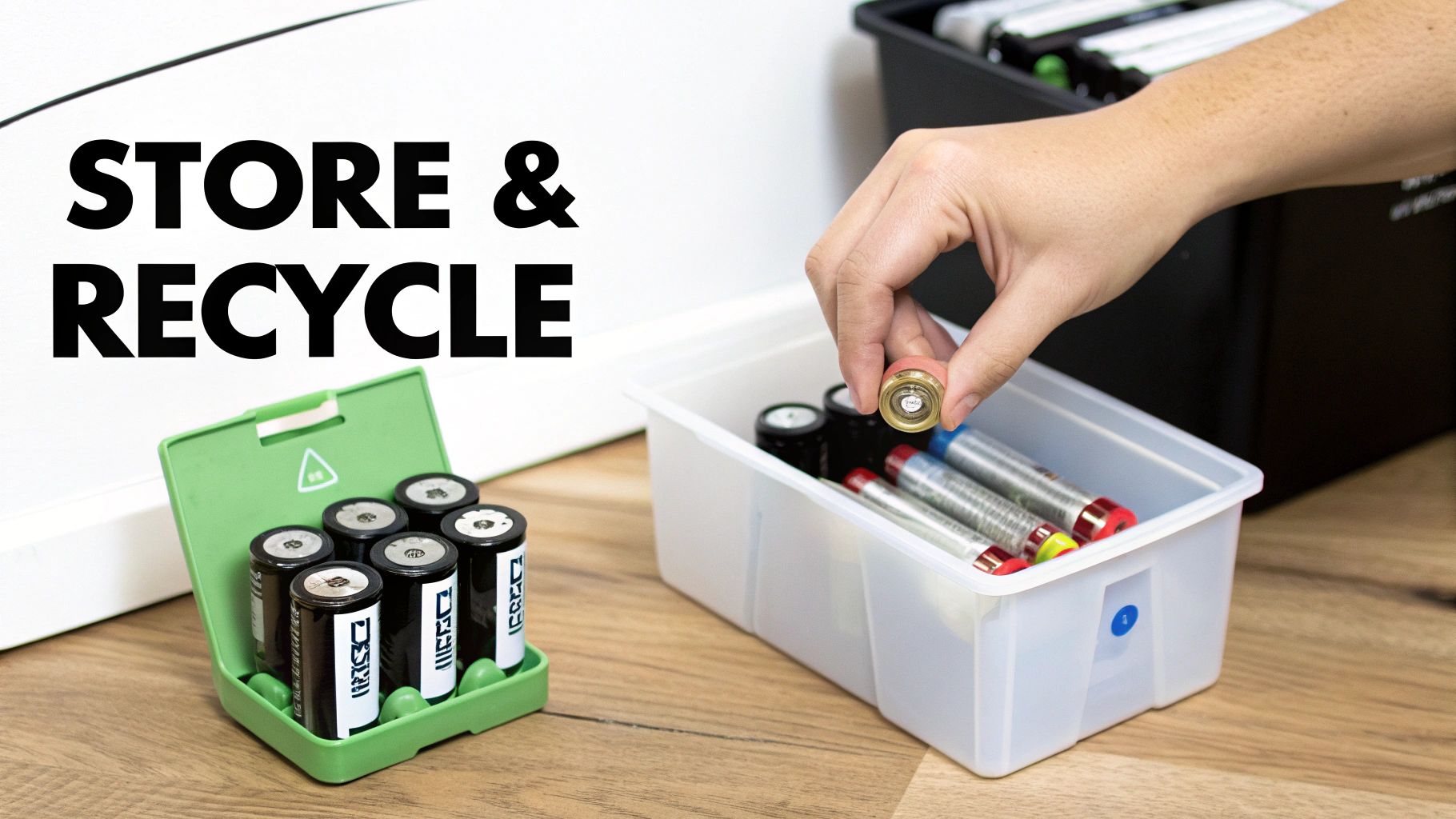
A battery's life doesn't end when your remote dies. How you store new batteries and dispose of old ones is crucial for safety, performance, and the environment. Getting this right means you get every bit of power out of the 1.5 V alkaline battery you paid for.
Think of a battery as a sealed can of energy. Your job is to keep that can in good shape until you use it. A few good habits make all the difference.
Best Practices for Battery Storage
Storing your alkaline batteries correctly is the easiest way to prevent them from losing charge or leaking. It's simple, but it requires a little thought.
Here’s how to keep your batteries fresh:
- Find a Cool, Dry Spot: Heat is the enemy of battery life. Keep them at room temperature, away from direct sunlight or damp places like a steamy bathroom. This maintains the chemical balance inside.
- Keep Them in the Pack: The original packaging is your best friend. Leave batteries in it until you're ready to use them. It's designed to stop the terminals from accidentally touching anything that could drain them.
- Avoid the Junk Drawer Nightmare: Tossing loose batteries into a drawer with keys, coins, or paper clips is a bad idea. If metal bridges the positive and negative ends, it can create a short circuit. This not only drains the battery fast but can also become a fire hazard.
Storing a 1.5 V alkaline battery correctly is like keeping bread in a breadbox. The right environment keeps it fresh, ensuring it delivers full power when you need it.
The Modern Rules of Disposal and Recycling
Getting rid of old batteries is less of an environmental headache than it used to be.
In the past, alkaline batteries contained mercury. But manufacturers moved away from that in the late 1990s, and today's batteries are mercury-free. Still, with more battery-powered gadgets than ever, recycling is a big deal.
So, what should you do? While many local rules now say it's okay to toss regular alkaline batteries in the trash, recycling is always the better move. When you recycle them, valuable materials like steel and zinc are recovered. This cuts down on the need for new mining and keeps waste out of landfills. It’s a small step that makes a real difference.
Answering Your Top 1.5 V Alkaline Battery Questions
We've covered the basics of 1.5 V alkaline batteries, but the real questions pop up when you're searching through a drawer for AAs.
This section is your personal cheat sheet. We're tackling the most common questions, from mixing battery types to understanding what those expiration dates really mean.
Can I Use a 1.2 V Rechargeable in a 1.5 V Device?
In short: yes, almost always. This is a frequent question with a simple answer.
Most gadgets aren't designed to run on a precise 1.5 V. They're built for a range of voltages. As a standard alkaline battery is used, its voltage naturally drops from 1.5 V to 1.2 V and lower. Your device already expects this.
So, when you pop in a fully charged 1.2 V NiMH rechargeable, your device just sees it as a partially used alkaline. It will work perfectly in remote controls, computer mice, and most toys. The only time you might see an issue is in high-demand electronics like a professional camera flash, or you might notice the battery meter doesn't show "100%" right away.
Why Do Batteries Leak and How Do I Stop It?
That crusty, white stuff that ruins your favorite flashlight is battery leakage. It's almost always caused by leaving dead batteries in a device.
As a battery completely discharges, its chemistry can produce hydrogen gas. This gas builds pressure until it ruptures the seals, letting the corrosive potassium hydroxide electrolyte escape. It’s a messy, gadget-destroying problem.
Preventing it is easy. First, remove batteries from anything you won't use for a few months. Second, avoid mixing old and new batteries or different brands. This can cause one battery to drain faster, making it a prime candidate for a leak.
A great rule of thumb: treat batteries like food. If you're putting a device into storage, take the batteries out first. That one simple habit will save you a lot of headaches.
Are Name-Brand Batteries Really Better Than Generic Ones?
This depends on what you're powering. For low-drain devices that sip power—like your TV remote or a wall clock—you’re unlikely to notice a difference. Here, generic store brands are a great way to save money.
But for anything that needs a lot of juice quickly, the answer changes. High-performance flashlights, digital cameras, and motorized toys put a heavy strain on batteries. This is where premium brands like Duracell or Energizer shine. Their chemistry is fine-tuned to deliver more power under load, so they'll last longer.
A good motto: save on the slow stuff, spend on the fast stuff.
What Does the Expiration Date on a Battery Actually Mean?
Think of it less as a "use by" date and more of a "best before." It's the manufacturer's promise that the battery will still hold most of its original power (usually 80-85%) up to that date, as long as it's stored properly.
Alkaline batteries self-discharge very slowly. An expired battery isn't dead—it just won't have the stamina of a fresh one. It'll still work in a remote control, but for something critical like a smoke detector, you'll want to use fresh ones to get the performance you paid for.
At Modern Lyfe, we know reliable power is key to creating a comfortable, pest-free space. That’s why our fly fans are engineered for efficiency with standard AA batteries, giving you hours of uninterrupted peace. Explore our collection today and see the difference for yourself.