You’ve probably encountered 100% food grade diatomaceous earth more often than you realize. It's a fine, chalk-like powder used everywhere from food production to natural pest control, all thanks to its unique physical properties—not chemical ones.
What Exactly Is It?
Imagine countless microscopic, fossilized sponges, and you have a good idea of what food-grade diatomaceous earth (DE) is. Mined from the beds of ancient freshwater lakes, it consists of the fossilized remains of tiny aquatic organisms called diatoms.
These diatoms had skeletons rich in silica. When milled into a fine powder, they retain a unique structure. Under a microscope, each particle is covered in tiny pores and sharp edges, making it incredibly absorbent and mildly abrasive on a microscopic level.
The powder itself is almost entirely amorphous silica, the natural, non-crystalline form of silicon dioxide—a common compound found in nature.
From Ancient Algae to Modern Powder
The process of turning ancient lakebed material into the product you buy is minimal: the raw material is simply mined, milled, and purified. Critically, food-grade DE is uncalcined, meaning it isn't treated with extreme heat. This keeps the silica in its safe, amorphous state.
This clean, natural profile is a key reason businesses and homeowners choose DE for effective, chemical-free solutions.
Market trends reflect this preference. Valued at around $250 million, the global food-grade diatomaceous earth market is projected to reach $350 million by 2030. This growth is driven by its use as a natural anti-caking agent and filtration aid in the food and beverage sectors. You can explore the market growth for food-grade DE for more details.
In short, food-grade DE is a purified natural substance. Its effectiveness comes from its physical structure, not a chemical reaction, making it a trusted tool for decades.
Now that we know what it is, let's look at how to use it safely and effectively.
Food Grade vs. Filter Grade: A Critical Distinction
It’s easy to assume all diatomaceous earth is the same, but the difference between grades is a critical safety issue. Using the wrong type can be dangerous.
The two main types are 100% food grade diatomaceous earth and filter grade (or pool grade) DE. The key difference is the processing method, which alters their chemical structure and safety.
Think of it this way: food-grade DE is like raw, sun-dried clay left in its natural state. Filter grade DE is like that same clay fired in a kiln at extreme temperatures. This heating process, called calcination, transforms the safe, amorphous silica into a sharp, crystalline structure.
The Dangers of Crystalline Silica
Filter grade DE is heated to over 1,800°F (1,000°C). This intense process makes it an excellent filter for pools but also converts a large amount of its amorphous silica into crystalline silica.
Crystalline silica is a known carcinogen and a serious respiratory hazard when inhaled. It is not safe for consumption or any application where people, pets, or food could be exposed. Never use filter grade DE for pest control, in your garden, or in a food service environment.
This concept map illustrates the minimal, natural journey of true food-grade DE from ancient diatoms to the final powder.
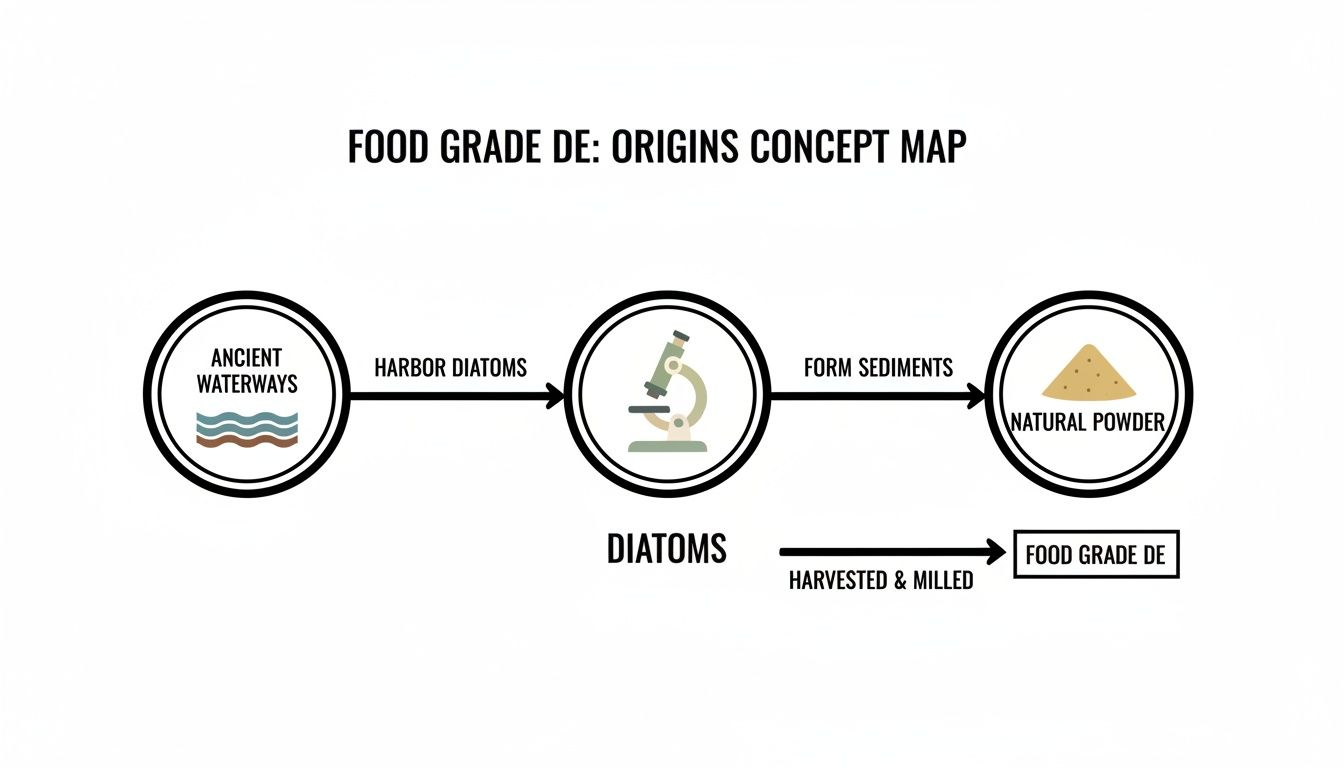
As you can see, the key is preserving its natural, non-crystalline state without high-heat processing.
Because of its safety and versatility, food-grade DE is the market leader, making up about 60% of all DE sold. The entire DE market was valued at $1.0 billion and is projected to hit $3.0 billion by 2034, as more industries seek natural solutions for applications like food and beverage filtration. You can learn more about trends in the diatomaceous earth market.
A Clear Comparison
This straightforward table breaks down the essential differences between the two types.
Food Grade DE vs. Filter Grade DE Comparison
| Attribute | 100% Food Grade DE | Filter Grade DE (Non-Food Grade) |
|---|---|---|
| Crystalline Silica | Contains less than 1% | Contains over 60% |
| Processing Method | Mined, milled, and dried (uncalcined) | Mined, milled, and super-heated (calcined) |
| Safety | Safe for human and animal consumption (FDA GRAS rated) | Toxic if inhaled or ingested; a known respiratory hazard |
| Common Uses | Pest control, anti-caking agent, food & beverage filtration | Pool and industrial filtration only |
| Certifications | Look for OMRI Listed for organic use, FDA compliant | Not applicable for food or agricultural uses |
The chart tells the whole story. For any application in a restaurant, business, or home, 100% food grade diatomaceous earth is the only safe and responsible choice.
Mastering Safe Handling and Application
Although 100% food grade diatomaceous earth is non-toxic, it requires sensible handling. Treat it like flour: you wouldn't hesitate to bake with it, but you also wouldn't want to inhale a large cloud of it. The same logic applies here.
The main concern is airborne dust, especially when using it in large spaces like a restaurant storeroom or kitchen. Any fine powder can irritate the lungs if inhaled in significant amounts.
Essential Safety Protocols
For small applications, you likely don't need special gear. But for larger jobs, a few simple precautions are wise.
- Wear a Dust Mask: This is the most important step. A basic dust mask prevents you from inhaling fine particles when applying DE over a large area.
- Use in Ventilated Areas: Open a window or turn on a fan. Good airflow helps the dust settle faster.
- Keep It Dry: DE is a desiccant, meaning it works by absorbing moisture. Store it in a sealed, airtight container in a dry place to maintain its effectiveness.
The core principle is simple: keep the dust out of the air you breathe. Once the powder has settled, the respiratory risk is gone.
Understanding Certifications
When shopping for DE, look for labels from organizations like the FDA and OMRI. These certifications guarantee the product meets high safety and quality standards.
- FDA Compliant: The FDA lists food-grade DE as "Generally Recognized As Safe" (GRAS), meaning it’s safe for use as an anti-caking agent in both human food and animal feed.
- OMRI Listed®: This certification from the Organic Materials Review Institute means the product is approved for use in certified organic operations.
These labels confirm you are getting a product that meets rigorous purity standards. While food-grade DE is primarily amorphous silica, it's always smart to be mindful of dust. For more context on why avoiding dust inhalation is important, read about understanding the risks of respirable crystalline silica.
Proper handling is just one piece of the puzzle. See how this fits into a broader strategy in our guide on how to prevent food contamination.
Practical Uses for Your Business and Home
Let's get into the practical applications of 100% food grade diatomaceous earth. Its real power lies in the problems it solves—both in a professional kitchen and at home. This simple, natural powder offers surprisingly effective, chemical-free solutions.
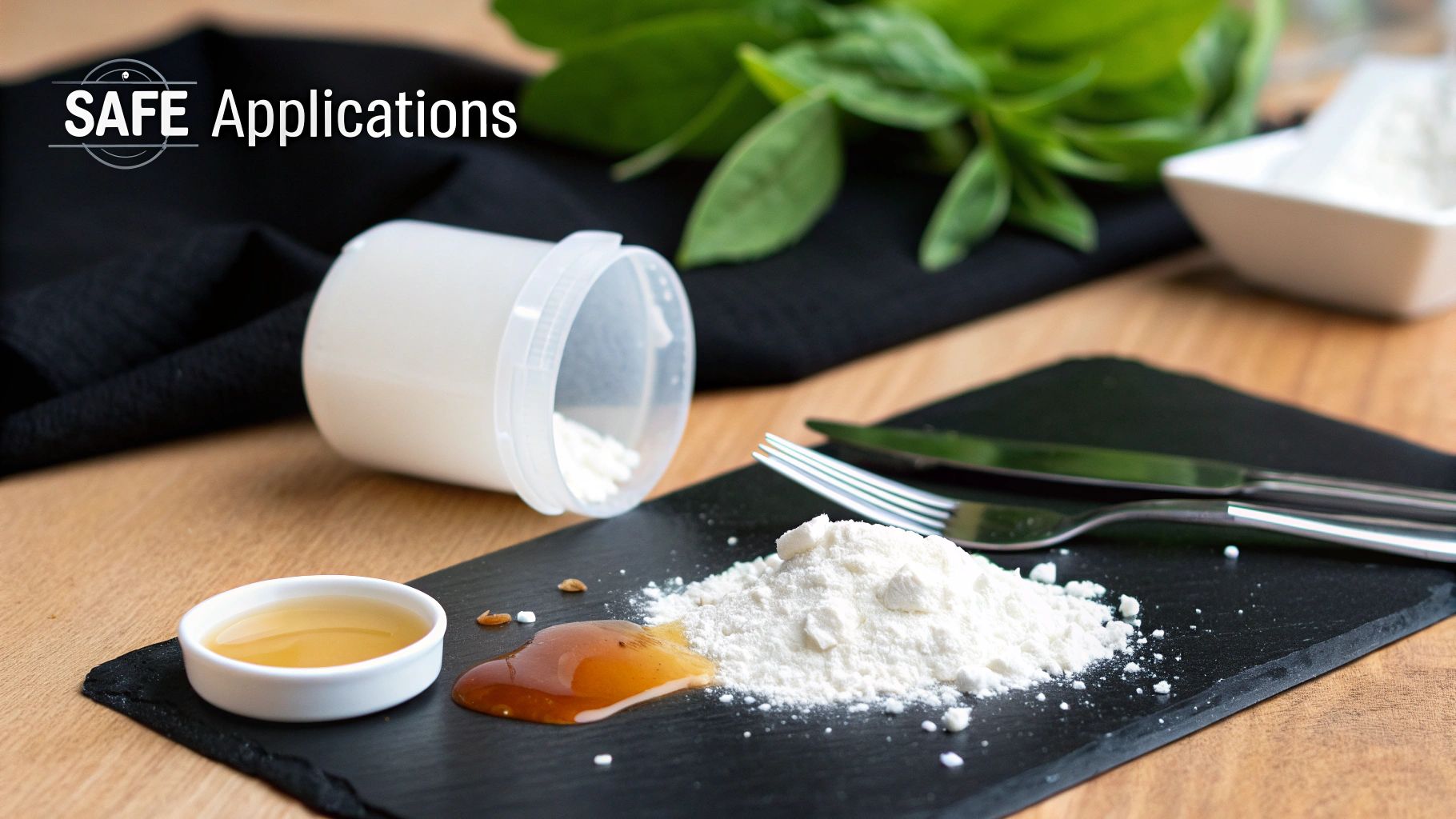
From eliminating pests to cleaning spills, its effectiveness comes from its physical structure, not a chemical reaction. This makes it an ideal tool wherever food safety is a priority.
A Non-Toxic Pest Control Solution
Food-grade DE is a popular choice for managing crawling insects like ants, cockroaches, and silverfish without harsh chemicals. It works mechanically: its microscopic, sharp edges scratch the waxy outer layer of an insect's exoskeleton.
Once this protective layer is damaged, DE's absorbent properties draw out oils and moisture, causing the insect to dehydrate. Because this process is physical, pests cannot build up a resistance to it like they can with chemical pesticides.
For it to work, insects must come into direct contact with the dry powder. Here’s the right way to apply it:
- Identify Hotspots: Locate pest trails and entry points. Common areas include dark pantry corners, under sinks, behind refrigerators, and along baseboards.
- Apply a Light Dusting: Use a powder duster or a simple shaker to apply a very thin, even layer into cracks and crevices. A light dusting is more effective and less messy than a thick pile.
- Keep It Dry: DE is only effective when dry. If it gets wet, clean it up, let the area dry completely, and reapply.
By targeting areas where pests travel, you create a 24/7 barrier without introducing synthetic poisons into food prep spaces. This strategy is a key part of maintaining a clean kitchen and aligns with food safety restaurant guidelines.
A Powerful Absorbent for Spills
Kitchens are prone to spills, and grease or oil can create a major slip hazard. Food-grade DE is a fantastic absorbent that soaks up oil, grease, and other liquids quickly and safely.
Its porous structure absorbs many times its own weight, turning a slick mess into a solid pile that you can easily sweep up. This is a game-changer in busy commercial kitchens where spills must be handled fast.
Beyond spills and pests, DE is also a great natural deodorizer. For more general home freshness, check out these tips for eliminating house odors.
Applications in Food and Beverage Production
The uses for 100 food grade diatomaceous earth extend far beyond the kitchen counter. It’s a major component of the global food and beverage industry, which has a market valued at over $1,141 million.
It serves as a natural filter, used to remove tiny impurities in an estimated 70% of commercial beer production and 50% of wine clarification. It is also added to about 25% of powdered food mixes in the U.S. as an anti-caking agent to prevent clumping.
Understanding this broader context—from a small spill to large-scale industrial filtration—highlights the versatility of this natural material.
How to Choose and Buy High-Quality DE
When you're ready to buy 100 food grade diatomaceous earth, you'll find that not all products are created equal. Just because a bag is labeled "food grade" doesn't guarantee quality. Treat it like any other food-safe ingredient: a little knowledge goes a long way.
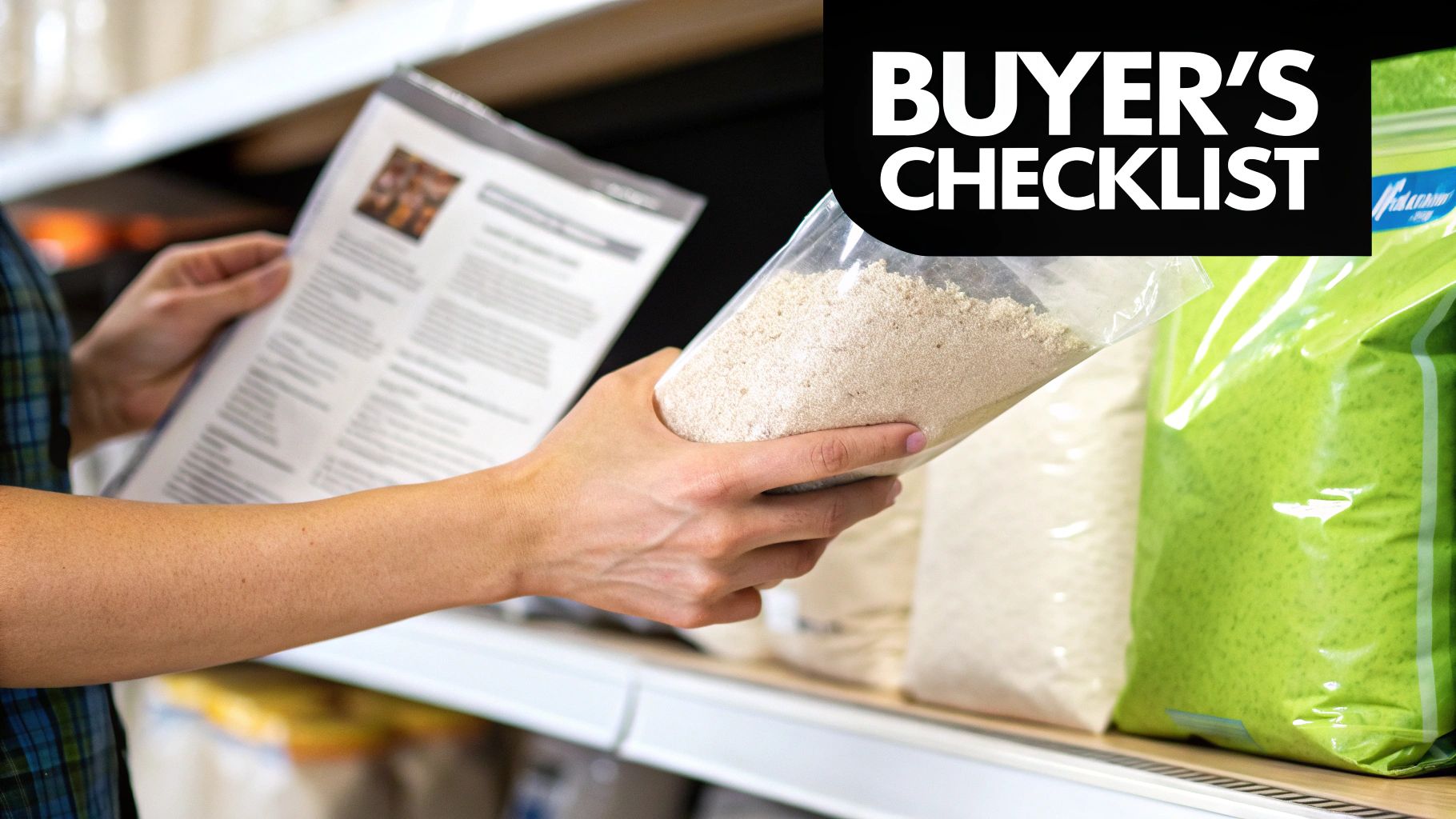
This simple buyer's guide will help you become an informed shopper, able to spot misleading marketing and focus on what matters for purity, safety, and effectiveness.
Look for Key Certifications
The easiest way to ensure quality is to look for third-party certifications. These logos are proof that the product has met strict, independent standards.
- OMRI Listed®: This is the gold standard. The Organic Materials Review Institute seal means the DE is approved for use in certified organic production, assuring it's free from synthetic additives.
- FDA Compliant: At a minimum, the label should state it meets FDA guidelines and is "Generally Recognized As Safe" (GRAS). This is non-negotiable for any DE used in a food environment.
These certifications provide a level of trust that a company's marketing claims cannot. Vetting ingredients this way is a core part of any robust food safety plan. To learn how these details fit into a larger framework, read about what is involved in a HACCP food safety system.
Read the Label and Check the Source
Beyond certifications, the product label itself provides critical clues. A reputable brand will be transparent about its DE's origin and composition.
The single most important factor is the source. High-quality 100 food grade diatomaceous earth should always come from freshwater deposits. Freshwater diatoms have a more consistent shape and are naturally lower in sediment and other unwanted minerals compared to saltwater varieties.
Finally, check the packaging. Good DE comes in a sturdy, resealable, and moisture-proof container. Because diatomaceous earth is a desiccant, it will clump and become useless if it gets damp. Proper packaging protects your investment and ensures the product remains effective.
What to Do When DE Isn't Working
If you've started using 100 food grade diatomaceous earth without seeing the desired results, don't get discouraged. Often, a simple adjustment is all that's needed.
The most common issue is moisture. Diatomaceous earth works by drying out an insect's exoskeleton, but it can only do so when the powder itself is completely dry.
If your DE has been exposed to rain, mopping, or high humidity, it loses its effectiveness. The fix is simple: let the area dry out completely and reapply a fresh, light dusting.
Common Problems and Quick Fixes
Sometimes the issue isn't moisture but application technique. Laying down a thick line of powder is less effective, as pests will often just walk around it.
Here are a few common issues and how to fix them:
- The Issue: Pests are avoiding the DE.
- The Fix: You’re likely using too much. The goal is a super-thin, almost invisible film of dust. Use a powder duster to lightly apply it into cracks, along baseboards, and in areas with pest activity. Less is more.
- The Issue: The powder blows away.
- The Fix: Apply it in calm, draft-free spots. For outdoor use, apply it early in the morning when there's a light dew. The moisture will help the dust stick to surfaces as it dries.
- The Issue: It’s not working on a specific pest.
- The Fix: DE is a specialist. It’s highly effective against crawling insects with exoskeletons (like roaches, ants, and bed bugs) but won't do much against flying insects like moths or fungus gnats.
Remember that diatomaceous earth works physically, not chemically. It needs time. It can take 24-72 hours after an insect makes contact with the dust for it to work. Patience is key.
When to Use Something Else
While versatile, DE isn't a silver bullet for every problem. Knowing its limits is crucial. For instance, in a perpetually damp corner of a basement, DE will struggle to stay dry and effective.
In situations where your main goal is absorbing moisture or odors in a very wet environment, a different natural product like bentonite clay might be a better choice. Using the right tool for the job always yields the best results.
Frequently Asked Questions
Using a natural product like diatomaceous earth can bring up a few questions. Here are answers to some of the most common ones.
Can I use 100% food grade diatomaceous earth in my garden?
Yes. It's an excellent tool for managing soft-bodied pests like slugs, snails, and aphids. Apply a light dusting on the soil around the base of your plants and on their leaves.
Keep in mind that DE works physically and cannot distinguish between pests and beneficial insects like bees. To protect pollinators, apply it late in the evening or early in the morning when they are not active. Avoid dusting open flowers where bees might forage.
Is it safe to use around children and pets?
When used as directed, 100% food grade DE is a safe, chemical-free option for homes with families and pets. The primary precaution is to avoid inhaling the fine dust during application.
Apply it in a well-ventilated area and allow the dust to settle before letting children or pets back in. Once settled on a surface, it is perfectly safe to the touch.
How long does it take to work on pests?
DE is not an instant-kill product. It works by dehydrating insects, which takes time. Expect it to take 24 to 72 hours after an insect makes direct contact with the powder.
The exact timing can vary based on:
- The type of pest and its exoskeleton.
- The humidity in the air, as higher humidity can slow dehydration.
- The application and how much contact the pest makes with the powder.
Of course, when used to absorb a liquid spill, the effect is immediate.
Ready to create a safer, cleaner environment without harsh chemicals? MODERN LYFE offers innovative, stylish solutions for keeping your spaces pest-free. Explore our products today at https://modernlyfe.com and discover a better way to protect your home and business.