You've set the patio, polished the glassware, and sent the first plates outside. Then one determined housefly starts orbiting the caprese. Someone swats at it with a menu, another guest waves a napkin, and a server reaches for citronella. None of those reactions changes the condition that matters: flies struggle when sustained airflow reaches them at food and table height.
That's why the best fan to keep flies away isn't necessarily the largest, fastest-looking, or most attractive model. It's the unit that creates a continuous air barrier across the point where flies approach food. This guide focuses on air velocity, placement, noise, power, mounting, and footprint, because those factors decide whether a fan protects service or merely stirs the room.
Why Flies Win Most Outdoor Service Setups
A busy Saturday patio exposes weak fly-control planning within minutes. Plates leave the pass, guests settle in, and uncovered food becomes an easy target. Staff swat, wave menus, light citronella, or set a trap near the perimeter. Those actions look responsive, but they leave the flight path between the insect and the plate open.
Operators often choose scent-based deterrents and visual barriers while ignoring the one variable that controls access to food: sustained airflow at table-edge height. Candles cannot form a dependable boundary across a buffet. Decorative screens may block people while leaving gaps underneath. A fan across the patio can run continuously while air around the plate stays nearly still.
That placement mistake explains why fan comparisons focused on blade size, RPM, or appearance miss the operational question. The useful unit is the one that maintains moving air where flies approach food, not the one that looks powerful from across the room. Measure the protected food zone first, then choose a fan that can cover it without disrupting guests or service.
The contamination concern is real. Houseflies can carry more than 200 pathogens, including bacteria associated with cholera, typhoid fever, diphtheria, dysentery, E. coli, and Salmonella, as discussed in this food-service fly-control review. Independent laboratory research also supports preventing physical fly contact with food, even when contact is brief, as described in this quantitative study of fly and food contact.
The operational cost is larger than the insect
A single fly can interrupt service, trigger guest complaints, force staff away from assigned tasks, and lead managers to replace dishes. Inspectors may also identify avoidable pest-control weaknesses. Diners who expect trouble outdoors can choose indoor tables instead, reducing patio value.
The fix is a deliberate airflow plan that protects the food zone, runs continuously, and fits the service layout. For broader outdoor hospitality or travel preparation, affordable camping patient items can support equipment planning. Fly control still depends on where the air moves and whether it reaches the table edge.
Operational rule: Protect the plate, not the room. If airflow does not reach the table edge, the fan is not doing the job.
The Airflow Science Behind House-Fly Repulsion
At an outdoor service line, a fan succeeds only if its airflow reaches the table edge and blocks the fly's approach. Blade diameter and RPM matter less than sustained air velocity at that height.
Houseflies struggle in steady wind because they depend on controlled lift and precise body positioning to approach, hover, and land. Research on freely flying houseflies found that they generally did not initiate flight when average ambient air speed exceeded about 0.63 m/s under the study's specified turbulence conditions, as reported in this housefly flight dynamics research.
Commercial exclusion requires a stronger airflow benchmark. A 2021 review reported 80% exclusion when moving air reached 8 to 9.1 m/s, measured 91 cm above the ground. It also found that vertical air curtains on both sides of a 91-cm-wide doorway prevented 98% to 100% of houseflies from entering at mean air velocities as low as 4 m/s, according to this review of alternative house-fly controls.

Velocity beats fan size
A large fan can move substantial air volume while producing weak airflow where food sits. A smaller unit placed close to the table may create the better barrier because the outlet has less distance to cover.
Use this field test:
- Measure at fly height. Check airflow beside the plate and at the table edge, not only at the grille.
- Build a cross-current. Aim across the approach path, forcing flies through the moving air.
- Keep it continuous. Intermittent gusts leave openings insects can exploit.
- Set the angle. Direct the stream laterally or downward. Air sent toward the ceiling protects nothing.
A fan that merely circulates room air may unsettle flies without keeping them away. This guide to whether fly fans work explains the difference. Choose by air speed at the protected height, then confirm placement, coverage, and service-line practicality. Decorative housing and an impressive RPM claim come later.
Comparing Fan Types for Fly Control
The right category depends on whether you're protecting a patio, a service window, a buffet, or one small table. No single design wins every layout. A pedestal fan can create a strong broad current, while a tabletop or clip-on unit may place air more precisely with less disruption to guests.
| Fan Type | Airflow at Fly Height | Noise Level | Power Source | Mounting | Footprint |
|---|---|---|---|---|---|
| Pedestal fan | Strong across a broad zone when positioned close | Moderate to high, depending on setting | Usually mains power | Freestanding, height-adjustable | Large base |
| Tabletop fan | Precise over a small dining area | Low to moderate | Mains, USB, or battery depending on model | Sits on table or service surface | Small |
| Overhead air curtain | Strongest continuous barrier for openings and food lines | Moderate, installation-dependent | Hardwired or mains power | Fixed above doorway or pass-through | Minimal floor space |
| Clip-on fan | Focused airflow for a plate, bar edge, or dish | Low to moderate | Mains, USB, or battery depending on model | Clips to an edge or frame | Very small |
Pedestal fans
Pedestal models are the practical choice for broad patios and open dining zones. Their height adjustment helps operators place the outlet near the approach path, and their larger airflow envelope can cover more than one table. The trade-off is physical intrusion. A wide base can block a pathway, while motor noise can interfere with conversation.
Tabletop fans
Tabletop units suit intimate dining, bars, and small service points. They're easy to aim and usually less visually intrusive, but they often lack the reach to protect a long buffet or an entire patio by themselves. Use them where precision matters more than coverage.
Overhead air curtains
Air curtains are engineered barriers, not ordinary circulation fans. They're designed to mount horizontally above doorways or service openings and push air continuously across the opening. That makes them the strongest option for pass-through windows, food-service entrances, and fixed buffet lines, but installation and electrical planning are unavoidable.
Clip-on fans
Clip-on models solve awkward placement problems. Attach one to a bar edge, table frame, or chafing-dish support to direct air exactly where a fly would approach. Their radius is limited, so treat them as point protection, not a substitute for a zone-level fan.
Five Buying Criteria That Matter More Than Brand
Brand familiarity doesn't tell you whether a fan will protect the food. Use these five criteria during a site walk, and reject any model that can't answer the practical question at the end of each test.
Airflow velocity
Ask whether the unit can sustain a meaningful air speed at table-edge height, not whether the box lists a high CFM figure. The published exclusion research measured airflow at fly-relevant height, which is why the outlet's performance several feet away matters more than the number printed on the motor housing.
Diagnostic question: Can I verify strong, continuous airflow at the edge of the plate?
Noise output
Noise is a hospitality constraint. A louder pedestal may disappear into a busy patio but dominate a quiet tasting room, private dining area, or small hotel event. Don't evaluate sound in an empty showroom. Stand where guests sit and listen at the setting you'll use.
Restaurant red flag: The fan forces guests to repeat orders or raises the room's conversational volume.
Diagnostic question: Can guests speak naturally while the fan runs at its protective setting?
Power source
Outlet access determines more than convenience. Check cable-run length, weather exposure, available circuits, and whether staff can route cords without crossing guest paths. Battery and USB models offer flexibility for temporary events and table-level protection, while mains-powered units suit fixed service zones.
Diagnostic question: Can the fan run for the entire service without an unsafe cable route or a power interruption?
Mounting style
Mounting should follow the service design. Pedestals work around buffet centers and open patios. Clip-ons fit chafing-dish edges, bar counters, and narrow tables. Overhead units belong above fixed openings where a permanent air barrier justifies installation.
Diagnostic question: Where can this fan sit so its airflow reaches food without occupying a guest or staff pathway?
Footprint
Floor space is operational space. A tripod base may look stable, yet it can narrow a patio aisle, interfere with bussing, or become a trip hazard during a crowded reception. Small fans preserve access but may require multiple units to build a reliable protected zone.
| Criterion | Key Question to Ask | Restaurant Red Flag | Home Patio Sweet Spot |
|---|---|---|---|
| Airflow velocity | Does air reach the plate edge continuously? | Strong airflow only at the grille | Focused cross-breeze over the dining area |
| Noise output | Can guests converse normally? | Staff and guests talk over the motor | Quiet setting that doesn't dominate the gathering |
| Power source | Is service duration covered safely? | Cords cross walkways or wet areas | Battery or nearby outlet with protected cable routing |
| Mounting style | Does the mount match the layout? | Fan blocks food handling or bussing | Tabletop or clip-on placement near seating |
| Footprint | Will it reduce usable access? | Base creates a pathway hazard | Compact unit positioned outside chair movement |
Placement and Setup by Environment
The same fan can work well or fail completely depending on its position. Airflow must cross the route flies use to reach food, and the operator must confirm that the stream exists at plate height rather than assuming the fan's angle is correct.

Restaurant patios
Place the fan close to the dining zone and angle it 30 degrees downward across the table edge. That creates a moving barrier over the approach path instead of blasting horizontally into guests' faces. Position the unit upwind when possible, so the current pushes insects away from the seating area rather than across it.
Don't hide the fan behind planters or furniture. Obstructions create dead zones exactly where guests place plates and glasses. Test the setup with a ribbon or narrow napkin strip, and watch whether it moves consistently at the plate edge.
Buffet lines
A buffet needs a longer, more deliberate barrier. Stagger units along the service side so their airflow overlaps across the food line, rather than placing one fan at the end and hoping it reaches every dish. Keep the fan out of the direct food-preparation path, and don't position it where crumbs, grease, or moisture can collect inside the grille.
Public-health guidance supports using screens and air curtains as part of food-business pest control, while also stressing that fly devices must remain away from food-preparation areas. The same guidance warns against using fly sprays near food or work surfaces, as outlined in this public-health pest-control factsheet.
Catered events
Walk the venue before guests arrive. Identify outlets, cable hazards, weather exposure, table orientation, and the direction of the prevailing breeze. A fan that works during setup can fail once guests, umbrellas, buffet risers, and serving staff change the airflow pattern.
For additional outdoor placement ideas, use this guide to outdoor fans for keeping bugs away, then verify the actual airflow with a ribbon or napkin strip before food leaves the kitchen.
Home patios
Home use is the simplest arrangement. Place one focused unit per dining zone, preferably upwind, and aim it across the seating area rather than directly at diners. Keep the base outside the chair path and protect cords from moisture and foot traffic.
Fly Control as a Food-Safety System
A fan belongs inside a food-safety plan, not in place of one. Preventing flies from landing on exposed food is a sensible control, but it works only when sanitation and airflow operate together. Cover food whenever practical, clear scraps quickly, manage drains and waste, and remove odors that draw insects toward the service area.
Keep the unit away from trash stations. Positioning it beside a bin can push odors and insects toward guests or the serving line. Aim airflow across the table edge or food-station edge, where it can maintain a practical barrier without disrupting handling.

Four controls belong together
- Fan selection: Choose a unit that delivers sustained airflow at serving height, then test the protected zone while staff work and guests move nearby.
- Placement: Create a continuous air curtain across the approach path to food, while keeping the device outside direct food handling.
- Maintenance: Clean grilles and blades on a regular schedule. Dust and grease reduce airflow and create a hygiene problem.
- Attractant control: Control bins, drains, scraps, standing water, and dirty serviceware before they turn the dining perimeter into a fly source.
Screens provide another layer at openings. Food-processing guidance distinguishes a 16-mesh screen for most flies from a finer 20-mesh screen for fungus gnats and Drosophila fruit flies, as explained in this screening guidance for food-processing facilities. Use that distinction when specifying screens for doors, windows, or service openings.
A fan protects the serving zone. Screens, closed doors, sanitation, and waste control address entry and breeding conditions, so the operating plan must use all of them together.
For food-service applications, treat the fan as a visible perimeter-control tool rather than a decorative gadget. This food-service applications guide provides further context for integrating table-level airflow into service environments.
Recommended Configurations by Use Case
Buy for the layout you need to protect, not for a generic room size. A single fan rarely covers a full patio or long buffet because insects can approach through the unprotected sides. Layered placement at the table edge and food-station edge creates a more dependable velocity field.
| Use Case | Fan Type | Quantity | Placement | Airflow Setting | Noise Limit |
|---|---|---|---|---|---|
| Full-service restaurant patio | Pedestal units for broad zones, with tabletop or clip-on support at exposed tables | Multiple units based on dining layout | Close to the outer table edge, aimed across seating and away from guests | Strongest setting that maintains a comfortable guest experience | Conversation-friendly at the table |
| Catered buffet line | Overhead air curtain for fixed openings, with clip-on or tabletop units at exposed dishes | Layered across the food line | Above pass-throughs or along the service edge, never obstructing food handling | Continuous barrier across the approach path | Low enough for announcements and guest conversation |
| Residential outdoor dining | Tabletop, clip-on, or compact pedestal fan | One per dining zone | Upwind of seating, aimed across plates and serving surfaces | Moderate to strong, adjusted after ribbon testing | Quiet enough for relaxed conversation |
Restaurant patio
Use pedestal units when tables are spread across a broad outdoor area. Add compact table-edge protection where guests sit close to food, especially around shared plates and exposed appetizers. Keep every base outside the main walking lane, and confirm airflow at the edge of the nearest plate.
Catered buffet
A fixed air curtain is the cleanest solution for a permanent pass-through or service opening. For temporary events, combine compact units with careful placement along the serving edge. The objective isn't to blow directly onto food. It's to stop flies before they cross into the food zone.
Residential dining
Homeowners usually need precision rather than industrial coverage. A quiet tabletop or clip-on fan can protect a small table without turning the gathering into a mechanical installation. For larger patios, use a compact pedestal outside the chair path and aim the airflow across the dining zone.
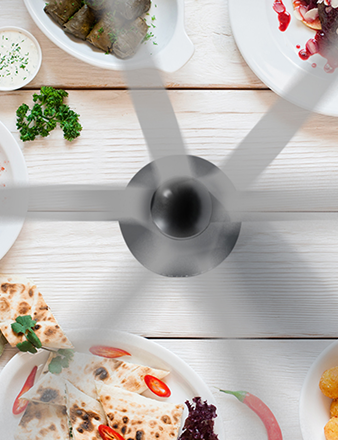
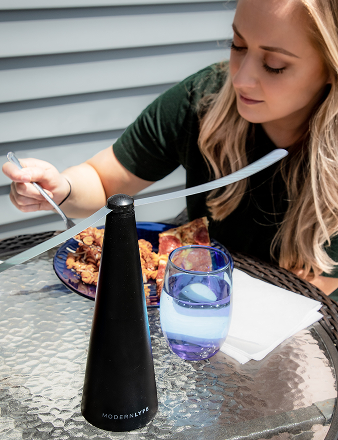
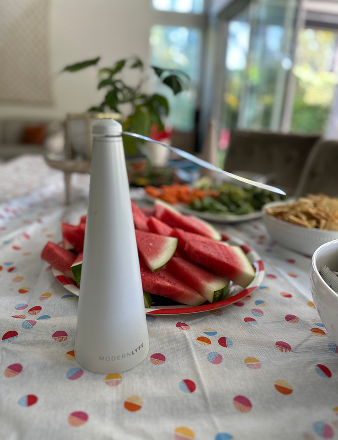
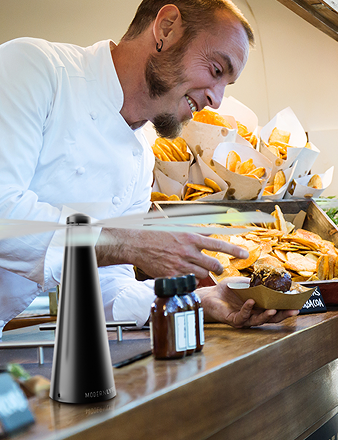
MODERN LYFE offers table-oriented fly fans, including the Black Fly Fan, designed to use spinning blades and airflow to help keep flies from landing on food. Its battery-operated, quiet format can suit restaurants, hotels, caterers, food trucks, and home gatherings where flexible table placement matters.
Visit MODERN LYFE to review table-level fly-fan options built for restaurants, events, outdoor receptions, and home dining. Choose the configuration that matches your service layout, then test airflow at plate height before the next meal leaves the kitchen.