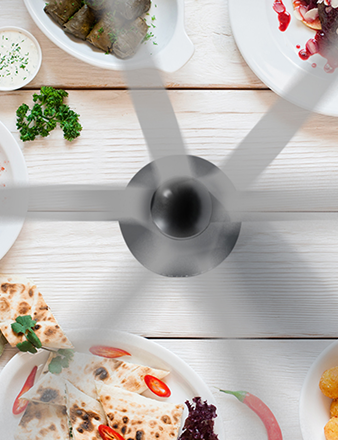
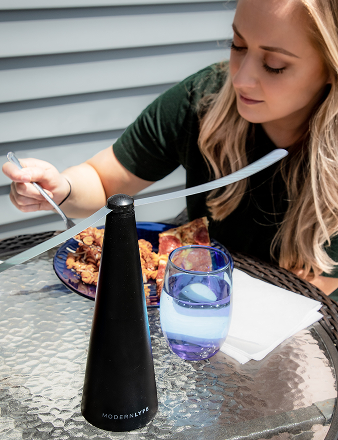
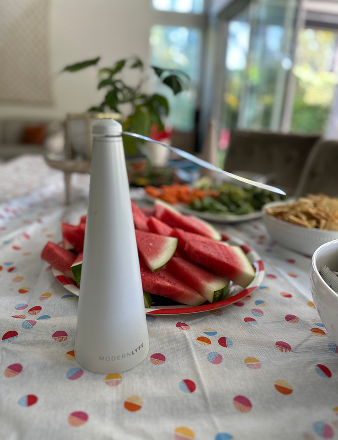
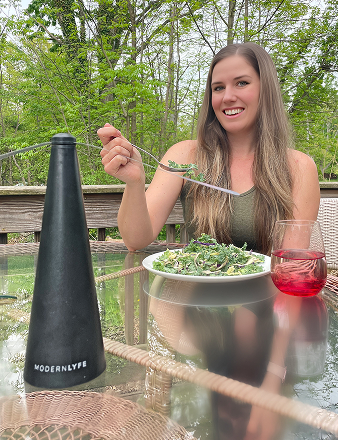
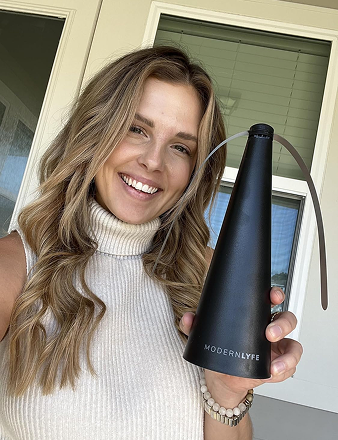
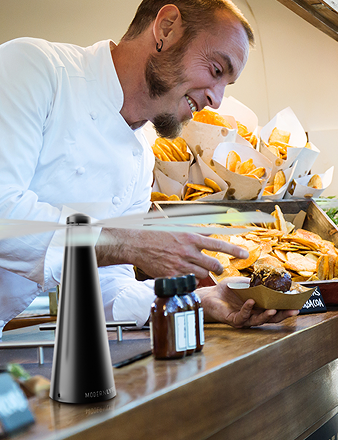
The best fly and mosquito repellent isn't a single product—it's a smart strategy. It’s about layering defenses to create a pest-free zone, especially around food. For dining tables, nothing beats a chemical-free fly fan. For an entire backyard, you'll need a bigger game plan.
Choosing Your Defense Against Pests
Flies and mosquitoes are more than just annoying. They're a threat to hygiene and comfort, capable of ruining any dining experience. Whether you run a restaurant patio or just host backyard barbecues, keeping them away is essential. The challenge isn't a lack of options; it's finding what actually works for your space.
This guide cuts through the noise. We're moving beyond a one-size-fits-all approach to match the right repellent strategy to the right environment. Instead of a simple product list, we'll compare the main defense categories:
- Chemical Repellents: Potent sprays and vaporizers that deliver a powerful punch.
- Natural Alternatives: Essential oil-based solutions for an eco-conscious approach.
- Physical Traps & Barriers: Devices like fly fans and sticky traps that physically stop pests.
- Spatial Devices: Repellents designed to protect larger areas, like a full patio.
Key Repellent Categories at a Glance
Understanding the basic differences is the first step. Each type has its own strengths and is designed for specific jobs, from protecting an indoor buffet to securing an outdoor wedding reception.
| Repellent Type | How It Works | Best For | Food Safety Concern |
|---|---|---|---|
| Fly Fans | Air Current & Light Reflection | Tables, buffets, food stations | Excellent (Chemical-free) |
| Chemical Sprays | Neurological Disruption | Open outdoor areas, perimeters | High (Avoid near food) |
| Natural Sprays | Scent Deterrence | Patios, personal use | Moderate (Avoid direct contact) |
| Traps (UV/Sticky) | Lure & Capture | Kitchens, away from guests | Low (If placed correctly) |
Think in layers. A fly fan on a table is your last line of defense. Other methods work in the background to lower the total pest population.
The demand for effective solutions is massive. The global insect repellent market is valued at around USD 6.02 billion in 2024, highlighting how seriously people take pest control. This growth is driven by a focus on health, hygiene, and guest comfort. You can find more market details at fortunebusinessinsights.com.
Ultimately, choosing the best fly and mosquito repellent means being smart about your needs. Get an overview of different strategies in our comprehensive guide on fly and mosquito control.
A Head-To-Head Repellent Comparison
Picking the best fly and mosquito repellent is a balancing act. You're constantly weighing four key factors: raw effectiveness, food safety, guest comfort, and ease of use.
This breakdown compares five common solutions: chemical sprays like DEET and Picaridin, natural essential oils, fly fans, spatial vaporizers, and classic UV or sticky traps.
The goal isn't just to find what kills the most bugs. It’s about finding the right tool for the job.
A quiet, bladeless fly fan is the perfect chemical-free guardian for a buffet line, while a spatial vaporizer is ideal for setting up a defensive perimeter around a patio. Your choice comes down to matching the solution to your environment and what your guests will find acceptable.
Comparison Criteria and Scenarios
To make sense of it all, we're judging each repellent on four practical criteria that will guide your decision.
In a high-end banquet hall, food safety is everything. But on your own backyard patio, you're probably more concerned with wide-area coverage.
- Effectiveness: How well does it deter pests indoors and outdoors?
- Food Safety: Is it safe to use around open food and dining tables?
- Guest Impact: Does it create unpleasant noise, a strong odor, or is it an eyesore?
- Operational Simplicity: How much work is involved in setup, maintenance, and cost?
Repellent Method Comparison Matrix
This comparison matrix cuts through the marketing fluff and shows you how each method stacks up based on what really matters.
| Repellent Method | Best Use Case | Effectiveness Score (1-5) | Food Safety | Guest Impact |
|---|---|---|---|---|
| DEET Spray | Outdoor perimeters | 5 | Low | Neutral (strong scent) |
| Picaridin Spray | Mixed indoor/outdoor | 4 | Moderate | Slight scent |
| Essential Oils | Patio seating | 3 | Moderate | Pleasant aroma |
| Fly Fan Device | Buffet lines | 4 | Excellent | Silent and sleek |
| Spatial Vaporizer | Large patios | 3.5 | Moderate | Mild diffuser sound |
| UV/Sticky Traps | Back-of-house kitchens | 2 | Low | Visible device silhouette |
The table makes it clear: while DEET is a powerhouse for sheer effectiveness, it’s a non-starter near food. On the other hand, fly fans offer an unbeatable mix of safety and close-range deterrence, making them perfect for service areas.
The decision tree below helps visualize your selection process, clarifying how your approach should differ for indoor versus outdoor spaces.
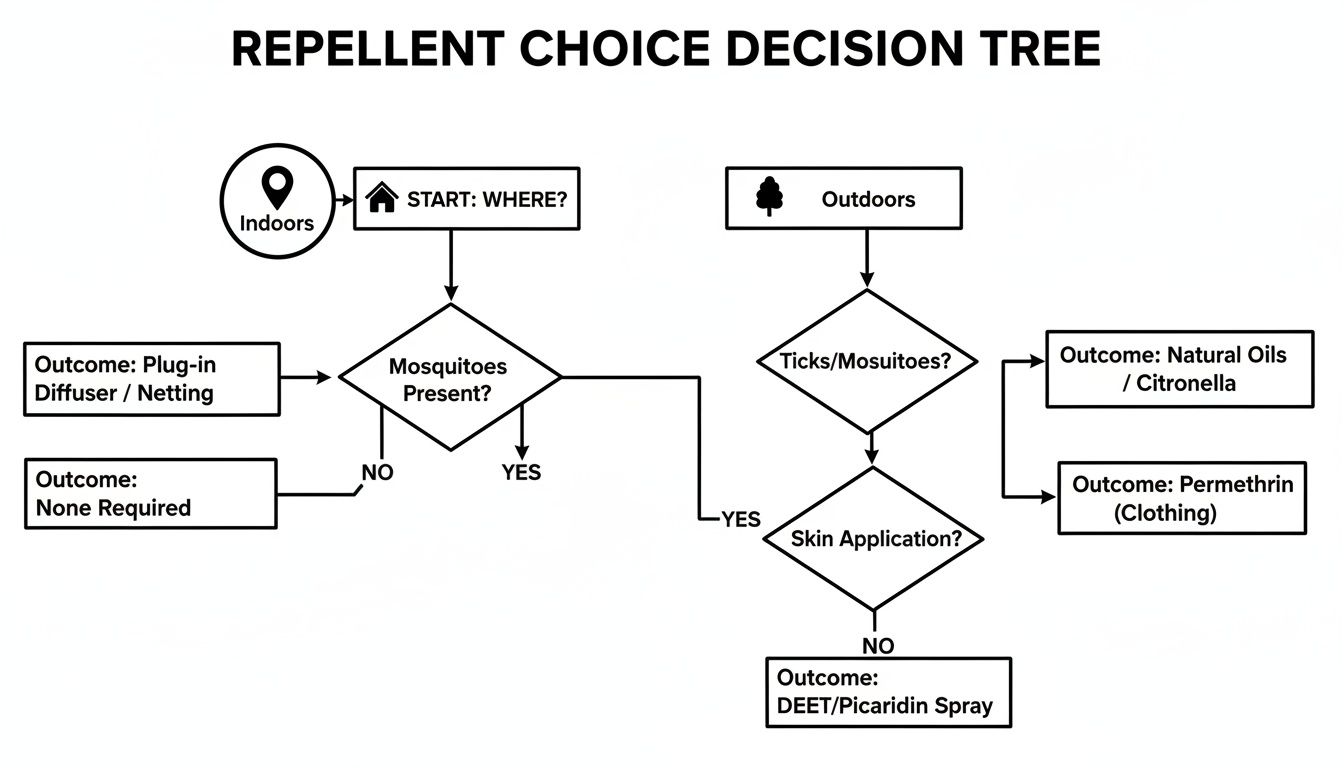
As you can see, the moment you move indoors, physical barriers like fly fans become the star players. Outdoors requires a blended strategy of perimeter sprays and spatial devices.
While conventional repellents hold a massive 82.73% of the market, natural alternatives are catching up fast, growing at an 8.47% CAGR through 2030.
What does this mean for you? Your guests are increasingly aware of—and asking for—greener, less intrusive pest control. You can dig into more trends over at Mordor Intelligence.
Real World Use Cases
Let’s get practical. In a hotel banquet hall, placing fly fans on each food table creates a chemical-free bubble right where it's needed, without any distracting noise. You could then add spatial vaporizers around the room's perimeter to keep mosquitoes from entering the main area.
Planning an outdoor wedding? Use handheld sprays to create an initial barrier at key entrance points. But for the food stations, fly fans provide crucial, layered protection without adding chemical odors that interfere with the meal. This is the exact one-two punch professional caterers use.
Operational Simplicity and Maintenance
Each method has its own upkeep needs. Chemical sprays require careful storage and restocking, plus staff training to ensure safe use.
Natural oil diffusers are simpler, but you're still managing cartridge swaps or refilling oils—another item on a busy inventory list.
Fly fans are remarkably low-maintenance. Most run on batteries and just need a quick blade wipe and a recharge. This simplicity is a huge win for busy kitchens and event teams.
UV traps and spatial devices fall in the middle, needing bi-weekly or monthly attention to stay effective.
-
Fly Fan Device Maintenance
- Wipe down blades once per week.
- Recharge batteries every 30 days.
-
Spatial Vaporizer Care
- Replace diffusing mats monthly.
- Check indicator lights weekly.
-
Trap Routine
- Clean collection trays biweekly.
- Swap adhesive sheets as needed.
Choosing the Right Tool for Your Space
So, how do you pull this all together? If food safety is your top priority, lean heavily on fly fans and natural diffusers placed well away from open dishes. This keeps the integrity of your food's aroma and flavor intact.
For a large patio, a layered strategy works best. Place vaporizers at entry points to create a "no-fly zone," then line the tables with individual fly fans. This combination of perimeter defense and point-of-use protection stops insects before they can bother your guests.
Ultimately, there's no single "best" repellent. The most effective approach is a mosaic, blending different methods to create comprehensive coverage. Chemical sprays own the open field, but fly fans are the champions at the table.
A Closer Look at Chemical-Free Fly Fan Technology
While sprays and traps have their place, many people are seeking solutions that are safe around food and won't disturb guests. This shift has pushed chemical-free technology to the forefront, with the modern fly fan as the star. It's a surprisingly effective device that relies on clever design, not chemicals.
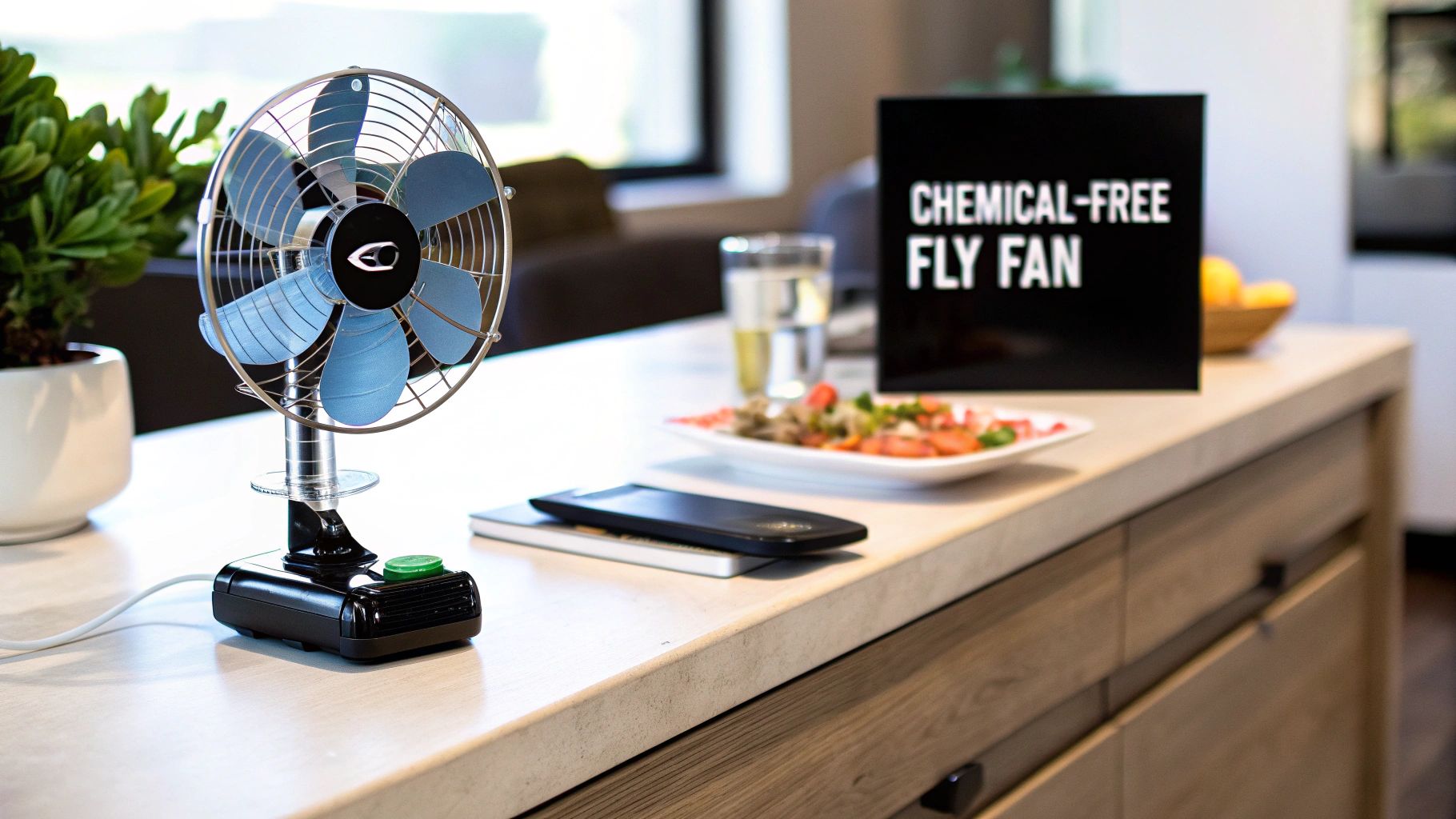
Instead of poisons or baits, these fans use an insect's own biology against it. The concept is built on two simple principles, creating a powerful but localized defense that's completely safe around food, children, and pets.
The Science Behind the Spin: Disruption and Deterrence
What's the secret? It's all in the fan's soft, reflective blades. Flies have compound eyes composed of thousands of tiny lenses, making them incredibly sensitive to light and movement. The holographic patterns on the blades constantly refract light as they spin, creating a confusing visual field that flies instinctively avoid.
From a fly's perspective, the shifting light patterns look like a complex, unpredictable threat. This visual chaos keeps them from getting close enough to land.
At the same time, the blades create a gentle, consistent air current. While barely noticeable to humans, it’s like a turbulent windstorm for a small insect. Flies and mosquitoes aren't strong fliers, so this disturbed air physically prevents them from landing nearby.
Key Features for Hospitality and Home Use
Not all fly fans are created equal. A few key features make them a perfect fit for both professional settings and your backyard patio, elevating them from a simple gadget to an essential tool.
- Whisper-Quiet Operation: Noise ruins ambiance. The best fans use virtually silent motors, so they work without interrupting dinner or conversation.
- Battery-Powered Portability: No cords, no problem. Being battery-powered means you can place them anywhere—the middle of a buffet, a patio table, or a catering station—without worrying about outlets or trip hazards.
- Sleek, Modern Aesthetics: Looks matter. A repellent shouldn't be an eyesore. Modern fly fans have clean, minimalist designs that blend seamlessly into any decor.
These elements make the fly fan one of the best fly and mosquito repellent choices for targeted protection, especially when safety and guest experience are top priorities.
Putting It to Work: Real-World Scenarios
The true test of any product is its real-world performance, and this is where fly fans shine. Their versatility makes them perfect for situations where chemical sprays are a definite no-go.
Imagine an elegant outdoor wedding buffet. A few fly fans along the table create an invisible shield, protecting the food without any chemical smells to ruin the meal's aroma and taste.
Or picture a hotel's poolside bar. Guests want to relax with drinks, not swat pests. A fan on the bar and a few on nearby tables keep the area clear, improving comfort and showing attention to detail. For homeowners, it’s as simple as putting one on the picnic table to keep a summer barbecue focused on family, not flies.
This technology makes the fly fan more than just a repellent; it's a sophisticated, practical tool. You can see how these devices work in our article on the Modern Lyfe fly fan. It’s proof that effective pest control doesn't require harsh chemicals or loud zappers.
How to Get the Most Out of Your Repellents
Choosing the right repellent is only half the battle. To truly win, you have to use it smartly. Even the best product will fail if it’s in the wrong place. It all comes down to strategic placement and layering your defenses.
Think of it as creating overlapping zones of protection. A fly fan is brilliant for keeping pests off food, but its reach is small. A spatial repellent can clear a whole patio but doesn't belong next to a dinner plate. The secret is using these tools together to cover all your bases without compromising your guests' experience.
Mastering Placement for Fly Fans
Fly fans are the precision tools in your arsenal. They create a specific barrier of moving air and distracting light right where you need it most.
Here’s how to place them for maximum effect:
- Dining Tables: For a standard 4-6 person table, one fan in the center is usually enough. For a long rectangular table, use two fans spaced out to ensure full coverage.
- Buffet Stations: This is where you can't compromise. Place fans every three to four feet along the entire buffet line. This creates an invisible, overlapping air shield that makes it impossible for flies to land on the food.
- Entryways and Pass-Throughs: A fan near a busy kitchen door or patio entrance acts like an air curtain, disrupting a fly's path just enough to keep it from following people inside.
Proper placement is a game of geometry. You're creating overlapping cones of protection where pests simply can't stabilize themselves to land.
Creating a Defensive Perimeter With Sprays and Spatial Devices
While fly fans guard the immediate dining area, other repellents are best used to establish a broader defensive perimeter. This tactic reduces the total number of pests in the area, taking pressure off your close-range defenses.
When using sprays, foggers, or spatial devices like citronella torches, always work from the outside in. Apply them around the outer edge of your patio or event space. Focus on areas with dense plants or standing water, where mosquitoes breed. This builds a "no-fly zone" that pests must cross to reach your guests.
A crucial tip: always ensure good ventilation when using any chemical or strong-smelling product. You want the repellent to deter bugs, not overwhelm your guests.
Integrating Methods for a Comprehensive Strategy
The strongest defense is a layered one. By combining different methods, you create a cohesive strategy that addresses multiple weak points at once for near-complete protection.
Scenario A: The Restaurant Patio
- Perimeter: Place citronella torches or spatial diffusers around the patio railing.
- Point-of-Use: Put a sleek, quiet fly fan on each dining table.
- Result: The perimeter defense keeps the overall pest count low, while the fans provide a final, chemical-free barrier that directly protects diners and their food.
Scenario B: The Outdoor Wedding Buffet
- Wide Area: Have a professional service lightly fog surrounding bushes an hour before guests arrive.
- Food Zone: Line the entire length of the buffet and dessert tables with multiple fly fans. This creates an impenetrable shield over the food.
- Result: This approach makes the whole venue more comfortable while focusing the most intense, food-safe protection exactly where it's needed most.
Custom Repellent Strategies For Professional Venues
For a professional venue, guest experience is everything. Standard bug sprays won't cut it. A single fly can ruin a five-star meal. You need a real strategy tailored to your space, one that blends powerful effectiveness with the aesthetics and food safety your guests demand.
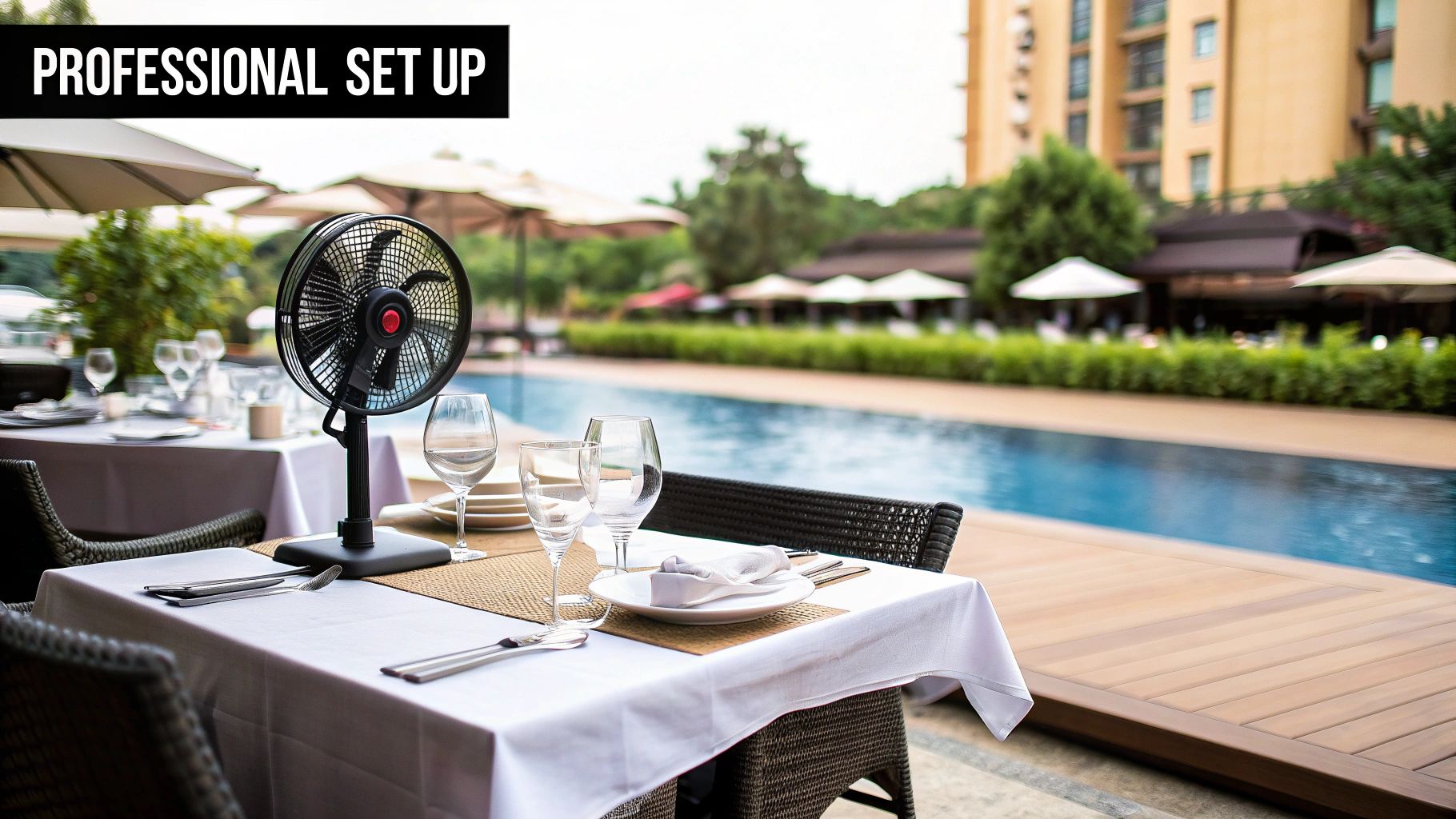
It’s not about finding one magic bullet. It's about layering different defenses to create overlapping zones of protection that make your space an impenetrable fortress, ensuring guests feel comfortable from the moment they arrive.
For Upscale Restaurants with Outdoor Seating
In an upscale dining setting, ambiance is non-negotiable. Any pest solution must be discreet, silent, and odorless. Nothing should detract from the food and conversation.
- Primary Defense: Place one sleek, battery-operated fly fan in the center of each table. This creates an immediate, chemical-free bubble of protection around your guests and their meals without any noise or scent.
- Secondary Defense: Set up an aromatic perimeter. Position a few elegant diffusers with subtle, natural oils like lemongrass or citronella at key entry points, tucked near planters to blend in.
This two-layer system ensures tables are actively protected by the best fly and mosquito repellent for dining, while a broader, softer defense works in the background.
The key is subtlety. Your pest control should be felt by the absence of pests, but never seen or smelled.
For Large-Scale Catered Events and Weddings
Outdoor catered events are a huge challenge. Wide-open spaces and large food service areas are magnets for pests. Your strategy must be robust and scalable.
First, identify high-risk zones: the buffet lines, drink stations, and the cake table.
- Food Zone Fortress: Deploy a line of fly fans every three to four feet along the entire length of your buffet and food service tables. This creates a powerful air curtain that physically blocks flies.
- Perimeter Control: Before guests arrive, knock down the local pest population. An hour before the event, use spatial repellents like Thermacell devices or misters around the event's outer boundary.
- Guest Comfort Stations: Place additional fly fans near seating areas and cocktail lounges to give guests localized protection away from the main food zones.
This multi-pronged approach covers the entire venue, from broad perimeter control to a targeted, food-safe defense where it matters most. For more on using these tools in a business setting, check out our guide on commercial fly fans.
For Hotel Resorts and Poolside Bars
At a resort, the goal is maintaining a pristine, relaxing vibe. The challenge is providing continuous protection in high-traffic areas where food and drinks are constantly served.
- Bar Top Defense: Place fly fans directly on the bar counter, spaced between service wells and garnish stations. This keeps pests out of cocktails and away from patrons.
- Lounge Area Coverage: Set up fans on cocktail tables and inside private cabanas to give guests a personal pest-free zone.
- Strategic Natural Repellents: As the sun sets, use large, decorative citronella candles or tiki torches around the pool deck's perimeter to handle the evening mosquito shift.
This plan ensures every guest touchpoint is covered. The demand for such effective, non-intrusive solutions is booming. The Asia-Pacific market is expanding rapidly, with India's market alone projected to hit USD 610.7 million by 2030, driven by the high standards of the hospitality industry.
Your Top Pest Repellent Questions Answered
Even with a solid plan, you'll have questions when picking the right repellent. Here are straight, clear answers to the most common ones, designed to help you finalize your strategy.
These are practical, real-world answers to help you get the best results, whether you're setting up for a small family dinner or a huge catered event.
Are Fly Fans Effective Against Mosquitoes Too?
Yes, absolutely. While the holographic blades disrupt a fly's vision, the real weapon against mosquitoes is the air movement.
Mosquitoes are weak fliers and can't handle a breeze. A good fly fan creates a pocket of air currents that makes it nearly impossible for them to land on your food or your guests. You get a two-for-one, chemical-free shield against summer's biggest pests.
What Is The Safest Insect Repellent To Use Around Food?
When food is involved, safety comes first. The safest options are always non-chemical, physical barriers. Fly fans are the ideal choice, hands down. They use only air and light, so there are zero chemicals, fumes, or odors to worry about.
This is why you see them on buffet lines and dining tables. It's a level of safety you just can't get from anything else. Never use chemical sprays or fogs anywhere near where food is being served.
How Do I Combine Repellents For A Large Outdoor Event?
For a big outdoor event, one solution is never enough. You need to think in layers.
- Set Your Perimeter: Create a defensive line around the outer edge of your event space using spatial repellents like citronella torches or Thermacell devices. This is your first line of defense.
- Protect the Hotspots: Focus on where people and food are concentrated. Place fly fans directly on dining tables, bars, and buffet stations for targeted, food-safe protection.
- Offer Personal Options: As a thoughtful touch, have skin-safe personal repellents available in a common area or restrooms for guests mingling away from the protected zones.
This layered approach is key. Start broad with perimeter control, then get specific where food is present, and finally, add a layer of personal comfort for your guests.
What Maintenance Do Different Repellent Devices Require?
Upkeep varies a lot and affects both your budget and your time.
- Chemical Devices: Vaporizers and diffusers constantly need refills—cartridges, liquids, or mats—which adds up.
- Traps: UV and sticky traps need regular cleaning. You have to empty collection trays or replace bug-covered adhesive sheets, which is often an unpleasant job.
- Fly Fans: A quality battery-powered fly fan is about as low-maintenance as it gets. A quick wipe of the blades and changing or recharging the batteries is usually all it takes.
This is why fly fans are a great fit for busy venues—staff can focus on guests, not on fussing with pest control devices. To keep up with the latest expert advice, be sure to check out the latest pest control insights.
Ready to create a comfortable, pest-free dining experience without chemicals or hassle? The Modern Lyfe fly fan is the elegant, effective, and food-safe solution trusted by top restaurants, caterers, and homeowners. Its silent operation and sleek design protect your food and guests without disrupting the ambiance.