A fly bait trap is a simple, effective tool for pest control. It uses a potent attractant to lure flies into a container they can't escape. Think of it as a one-way ticket for flies, designed to knock down dense populations, especially in busy commercial areas.
What Is a Fly Bait Trap?
If you run an outdoor café, event space, or restaurant patio, you know flies are more than an annoyance—they're a threat to your reputation and hygiene. A single fly can ruin a customer's experience. This is where a fly bait trap becomes an essential tool.
It acts like a powerful magnet for flies. Instead of broad-spectrum sprays that can harm beneficial insects or leave chemicals in the air, a bait trap uses a simple principle: attract and capture. It emits a scent flies find irresistible, pulling them away from your customers and into a trap.
Once inside, the trap's design makes escape impossible. This targeted approach helps you manage fly populations at the source, catching them before they bother your guests.
The Core Components
A fly bait trap is a straightforward device with a few key parts working in sync. Understanding how they work together makes it clear why this solution is so effective for managing pests in demanding environments like a busy restaurant patio. For more hands-on advice, check out this detailed guide on using a fly trap with bait.
Demand for these traps is surging. The global fly trap market, valued at USD 1.2 billion in 2024, is projected to hit USD 2.5 billion by 2033. This growth is driven by the need for effective pest control in markets like North America, where hospitality managers constantly battle flies in outdoor spaces. You can find more details on this booming fly trap market.
So, what makes a fly bait trap work? Let's break it down.
Fly Bait Trap Components at a Glance
This table provides a quick overview of the essential parts of a typical fly bait trap and their functions.
| Component | Function and Purpose | Common Examples |
|---|---|---|
| The Container | The main body of the trap, designed to hold the bait and captured flies securely. Its shape is key to preventing escape. | Reusable jugs, disposable bags, or durable plastic containers. |
| The Attractant | The powerful lure, usually a liquid or solid, that emits a scent flies find irresistible. This is the "bait" that does the work. | Food-based scents, water-soluble powders, pheromones. |
| The Entry Point | A one-way entrance, like a funnel or cone-shaped opening, that lets flies in easily but makes exiting nearly impossible. | Conical lids, small apertures, inverted funnels. |
The design is brilliantly simple. Each component has a specific job, and together, they create a highly efficient, self-operating fly-catching machine.
How It Works: The Science of Attraction
Fly bait traps don't chase flies; they convince them to enter. The process exploits a fly’s most powerful tool—its sense of smell.
It starts with an attractant, a carefully formulated lure designed to broadcast a scent flies can't resist. Flies have incredibly sensitive antennae that detect faint smells from a distance. A good trap uses this to its advantage, turning a simple scent into a powerful crowd-control tool.
This straightforward, three-step journey from lure to capture is what makes every fly bait trap effective. Here’s how it works:
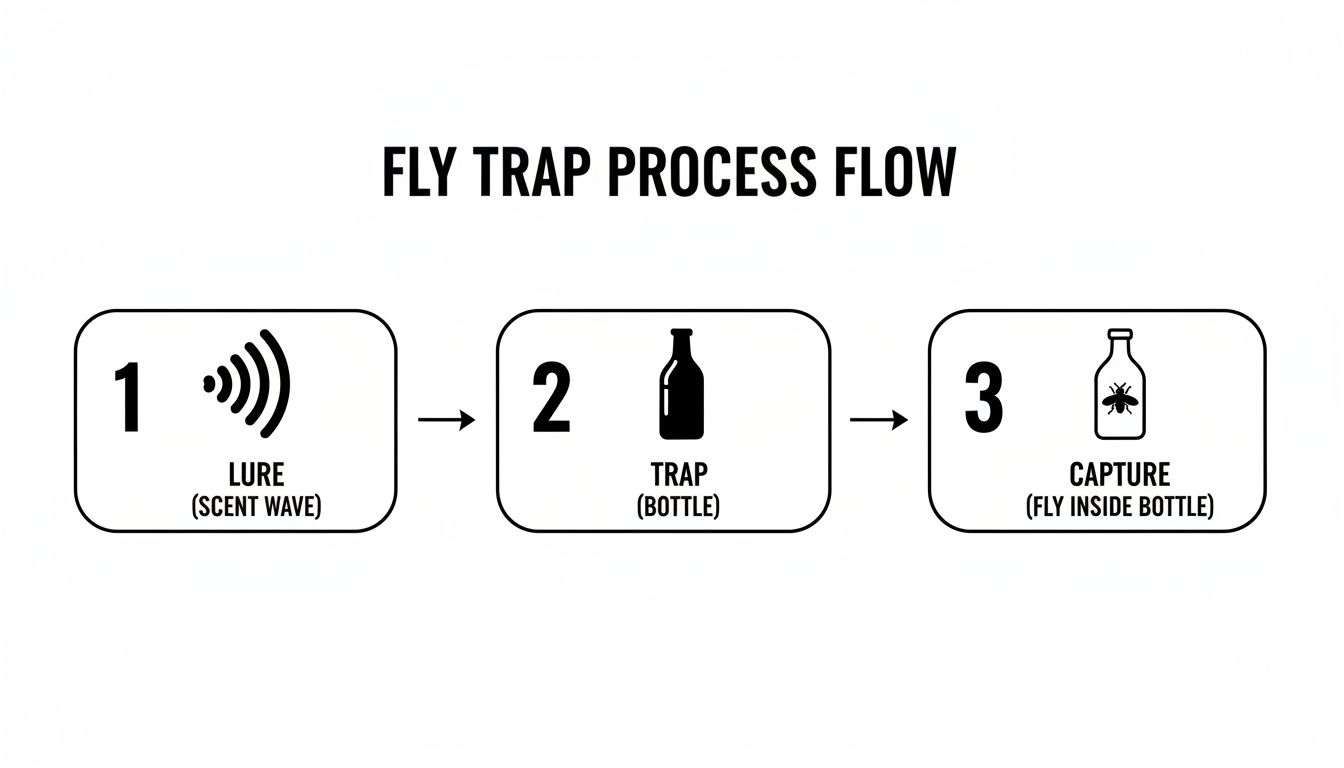
First, the trap emits a scent to draw flies in. Next, it funnels them into the container. Finally, it ensures they can't get out. It's a one-way trip designed for maximum impact.
Decoding the Irresistible Lures
Not all fly bait is created equal. The specific lure in a trap is often engineered to target the most common nuisance flies. The goal is to mimic the smells flies naturally seek for food or egg-laying.
There are two main types of attractants:
- Food-Based Attractants: The most common type. They often smell like decaying organic matter, such as rotting fruit or meat. While unpleasant to us, it’s a five-star signal to a fly for a meal or a breeding spot.
- Pheromonal Attractants: Some baits include synthetic versions of fly pheromones—chemical signals flies use to communicate. A key ingredient is muscalure, a sex attractant for houseflies that tricks them into the trap by hijacking their mating instinct.
Choosing the right bait is critical. A high-quality attractant actively pulls flies away from your guests and dining areas to a designated capture zone.
The Point of No Return
Once a fly detects the attractant's scent, it follows the trail to the source. This is where the trap’s physical design takes over.
A fly bait trap's effectiveness hinges on a simple promise: an easy entrance and an impossible exit. The engineering behind the one-way entry system is what converts attraction into capture.
The entrance is typically a funnel or cone-shaped opening. Flies easily crawl or fly through the wide outer part and into the trap. Once inside, their instincts betray them. When trying to escape, they naturally fly upwards and outwards, repeatedly hitting the inner walls and missing the small opening they entered.
It’s a simple but brilliant design that guarantees a high capture rate. The fly is drawn in by instinct and trapped by its own navigational flaws.
Capture and Elimination
Once a fly is trapped, the final mechanism takes over. Most traps rely on one of two methods for elimination.
Drowning Mechanism Many popular traps, especially reusable jugs or disposable bags, use a bait that dissolves in water. Adding water activates the attractant, creating a scented liquid at the bottom. When flies enter and fall into the liquid, they drown. This is a common and highly effective method for handling large numbers of flies.
Adhesive Surfaces Other traps, known as sticky traps, use a non-toxic glue. Lures are sometimes paired with bright colors to attract flies visually. Once they land on the adhesive, they're stuck for good. These are often placed in higher areas where flies tend to rest.
Weighing the Pros and Cons
Is a fly bait trap right for your business? For restaurants, cafes, and hotels—where the guest experience is paramount—this is a critical business decision.
The right tool can be a silent guardian of your reputation. The wrong one can create new problems.
These traps are powerful. They are designed for one job: to reduce heavy fly populations with minimal effort. This makes them a potent ally in keeping your establishment clean and sanitary.
The Clear Advantages
When used correctly, fly bait traps offer significant benefits. They provide a "set it and forget it" approach that works 24/7 to lure and eliminate flies, freeing up your staff to focus on customers.
The numbers confirm their popularity. The market for baited insect traps is projected to grow from USD 512.34 million in 2021 to USD 734.04 million by 2027. This reflects a growing demand for reliable pest control solutions in the hospitality industry. You can dig deeper into the booming baited insect trap market to see why.
Here's what makes them so attractive:
- High-Volume Reduction: These traps are workhorses, capable of capturing thousands of flies and making a visible dent in the local population.
- Targeted Action: The bait is designed for nuisance flies, meaning beneficial insects like bees and butterflies are generally left alone.
- Low Maintenance: Once set up, a fly bait trap runs itself. Just check it periodically to empty or replace it.
The Potential Downsides
Here's the catch: the very thing that makes these traps effective also creates their biggest drawbacks. The powerful attractants often rely on the smell of decay, which means the traps themselves can produce a strong, unpleasant odor.
That's a non-starter for any area where people are eating, drinking, or relaxing.
Beyond the smell, a trap full of dead flies is unsightly and can ruin the ambiance you've worked hard to create. For any food service business, effective fly control is a crucial part of your restaurant health inspection checklist.
The challenge for any hospitality business is balancing a fly bait trap's power with the need for a pleasant guest environment. Its effectiveness is unmatched for population control, but its aesthetics demand it be kept far from public view.
These limitations are serious. Placing a trap too close to a patio, entrance, or open window will do more harm than good by drawing flies toward your guests.
Benefit vs. Risk for Hospitality
To make the right choice, you need to see the full picture. This table compares the pros and cons of using a fly bait trap in a commercial setting.
| The Upside (Pros) | The Downside (Cons) | Best Hospitality Application |
|---|---|---|
| Exceptional Effectiveness: Drastically reduces dense fly populations by attracting and eliminating thousands of pests. | Unpleasant Odors: The powerful attractant can emit a strong, foul smell that is off-putting to guests and staff. | Perimeter Defense: Ideal for placement near dumpsters, loading docks, and property lines to intercept flies before they reach guest areas. |
| Low Labor Investment: Requires minimal effort to set up and maintain, working continuously without daily intervention. | Aesthetic Issues: A trap filled with dead flies is visually unappealing and can detract from a carefully curated ambiance. | Back-of-House Control: Perfect for managing fly populations near kitchen backdoors, garbage collection zones, or other operational areas. |
| Targeted Pest Control: Specifically lures nuisance flies while largely sparing beneficial insects like pollinators. | Strategic Placement is Non-Negotiable: Must be placed far away from customers to avoid attracting pests directly to them. | Seasonal Infestation Management: A powerful tool for knocking down fly populations during peak season when infestations are at their worst. |
Ultimately, a fly bait trap is a specialized tool. It's incredibly effective for back-of-house or perimeter defense but requires a different approach for front-of-house guest areas.
Strategic Placement for Maximum Impact
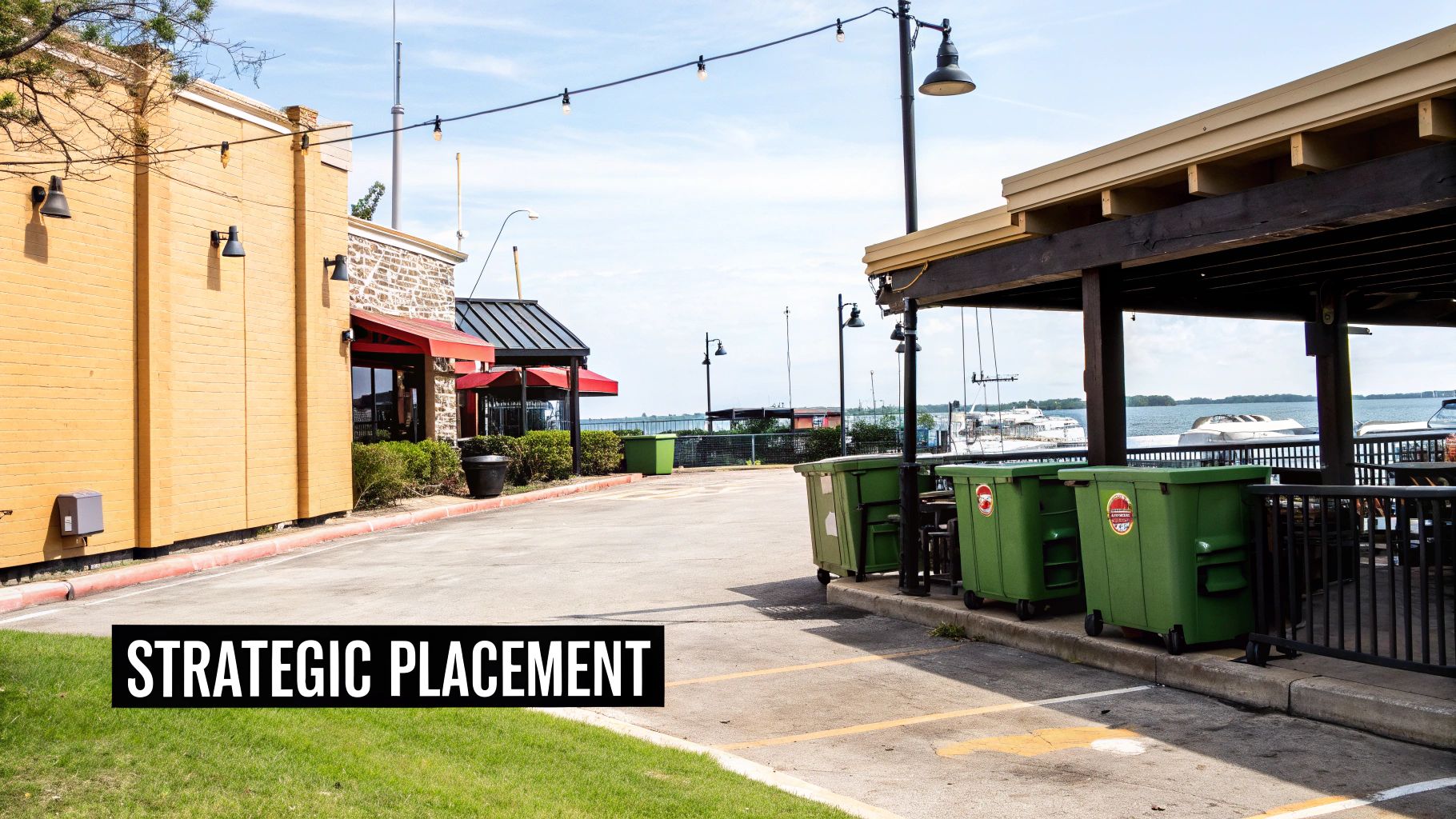
Using a fly bait trap is only half the battle; where you place it determines its success. The wrong placement can draw pests toward your guests, making the problem worse. The goal is to intercept flies long before they reach sensitive areas.
This means placing traps along your property's perimeter, creating a defensive line to protect your core business. You want to catch flies at the border, far from dining patios, entrances, and outdoor seating.
This strategic thinking is driving their popularity. The global fly trap market, valued at USD 294.1 million in 2025, is projected to hit USD 517 million by 2035. This growth signals a shift toward smarter, more sustainable pest control where placement is key. You can read more about these fly trap market trends to learn more.
Placement Do's and Don'ts
To get the results you need, you need a game plan. A misplaced trap is worse than ineffective—it's counterproductive. Here’s a simple checklist to guide your deployment.
The Golden Rules of Placement (DOs):
- DO place traps near fly hotspots like dumpsters, compost piles, and loading docks.
- DO position traps at least 30 feet away from guest areas to create a crucial buffer zone.
- DO consider wind direction. Place traps downwind from your patio so the scent blows away from guests.
- DO hang traps at the right height. Most nuisance flies are active between 4 to 6 feet off the ground.
Common Mistakes to Avoid (DON'Ts):
- DON'T hang a trap next to an entryway or open window. This is an open invitation for flies.
- DON'T place traps in dining areas or on patios. The smell and sight will ruin the customer experience.
- DON'T position traps in direct, intense sunlight, as the liquid bait can evaporate too quickly.
- DON'T place traps in high-traffic areas where they can be disturbed.
Maintenance and Disposal Schedule
A fly bait trap is low-maintenance, not no-maintenance. A consistent schedule for checking, refreshing, and disposing of traps is essential for peak performance.
Long-term success with a fly bait trap depends on proper maintenance. Consistent care ensures the trap remains a potent solution, not part of the problem.
Follow this straightforward schedule to maximize your investment.
Step 1: Weekly Checks Once a week, visually inspect all traps. Check how full they are and monitor the bait level. In hot, dry weather, the liquid can evaporate quickly, rendering the trap useless.
Step 2: Refreshing the Bait The attractant doesn't last forever. Most manufacturers recommend replacing the bait every 2 to 4 weeks. If a trap fills up with flies sooner, service it immediately. Set a calendar reminder to stay on track.
Step 3: Sanitary Disposal When a trap is full, dispose of it properly. For disposable bags, seal the bag and toss it in an outdoor trash can with a tight lid. For reusable jugs, empty the contents into a sealed bag, rinse the jug, and add fresh bait. Always wear gloves during this process.
Chemical-Free Alternatives: When to Use Fly Fans
Fly bait traps are workhorses for reducing dense fly populations, but they aren't right for every situation. In hospitality, where aesthetics and guest comfort are non-negotiable, their unpleasant odor and unsightly appearance make them a non-starter for front-of-house use.
This is where modern, chemical-free alternatives fill a critical gap.
These solutions protect the immediate guest experience by keeping flies at bay without the downsides of traditional baits. Instead of luring and killing flies across the property, they create a protective bubble right where you need it—on the dining table or buffet line. It’s a shift from long-term population control to immediate, localized deterrence.

A Closer Look at the Modern Fly Fan
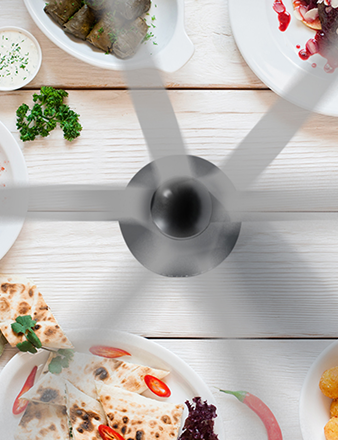
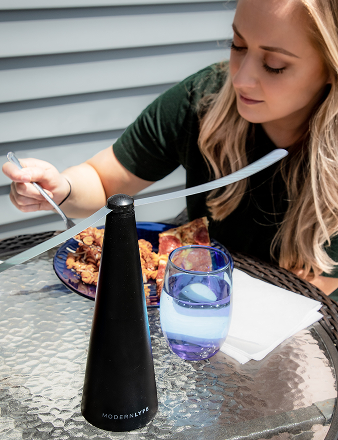
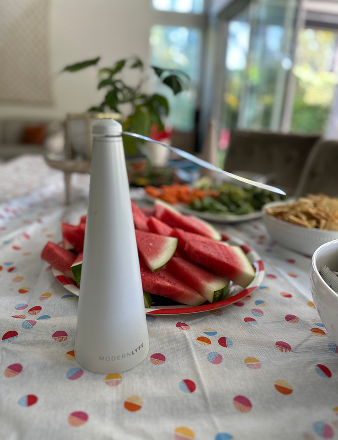
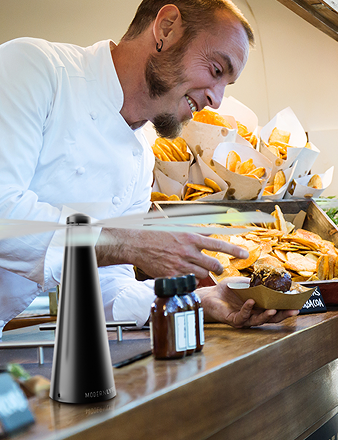
One of the most effective non-chemical solutions is the fly fan. Think of it not as a trap, but as a silent bodyguard for your food. These devices sit on a table, using soft, flexible blades to create a gentle air current that disrupts the air in a way flies find confusing and difficult to navigate.
Why does it work? Flies have compound eyes that are highly sensitive to motion. The fan's constantly spinning blades create a visual disturbance they are hardwired to avoid. The gentle breeze also makes it physically difficult for them to land, creating an invisible, fly-proof shield around your dishes.
The genius of the fly fan is its simplicity. It uses a fly's own biology against it to create a protective zone that's both effective and unnoticeable to your guests.
This approach offers a clean, elegant, and immediate solution. There’s no waiting for a trap to work, no foul smells, and no gross cleanup. It simply prevents flies from becoming a problem in the first place. To learn more, find out how effective fly fans really are.
Layered Defense: Traps and Fans Together
The smartest fly control strategy isn't about choosing one tool over another; it's about using the right tool for the right job. A fly bait trap and a fly fan aren't competitors—they're teammates. One plays offense on the perimeter while the other plays defense at the table.
Imagine you’re hosting an outdoor wedding. Here’s how a layered defense would work:
- Perimeter Defense (Fly Bait Trap): Weeks before the event, you place several fly bait traps around the property's edge—near dumpsters and service entrances. These traps work quietly in the background, capturing thousands of flies and dramatically reducing the overall pest pressure.
- Tabletop Protection (Fly Fans): On the wedding day, sleek, quiet fly fans are placed on every dining table and buffet line. They create an immediate, chemical-free barrier that stops any stray flies from landing on the food or bothering guests.
This integrated system tackles the problem from both ends. The bait trap handles the heavy lifting of population control, while fly fans provide the final, elegant layer of protection that enhances the guest experience. It’s how you create a comprehensive, fly-free environment. It's helpful to understand the full range of non-toxic pest control options.
Choosing the Right Tool for the Job
Deciding between a fly bait trap and a chemical-free alternative comes down to your goal and location. This table breaks down the ideal use cases for each.
| Scenario | Best Solution | Why It Works |
|---|---|---|
| Heavy infestation near a back dock or dumpster | Fly Bait Trap | Its high-capacity design and powerful attractant are perfect for cutting down large fly populations at their source, far from guest view. |
| Protecting an outdoor dining patio during service | Fly Fans | Provides immediate, silent, and odor-free protection right on the tables, ensuring a pleasant guest experience without chemicals. |
| Managing flies in an open-air bar area | Fly Fans | Creates a comfortable, fly-free zone where patrons are eating and drinking, preserving the venue's ambiance. |
| Seasonal fly reduction for a large property | Fly Bait Trap | Ideal for long-term, low-maintenance population control on the perimeter of a venue, hotel, or resort. |
Building Your Integrated Fly Control Strategy
The best way to handle flies isn't with a single magic bullet. It's by building a smart, layered defense where different tools work together. This is the core idea behind Integrated Pest Management (IPM), an approach that provides a comprehensive solution.
Think of your property as a fortress. The goal is to stop flies before they get near your guests and their food. Fly bait traps are your powerful perimeter guards, while modern fly fans provide elegant, close-range protection.
By combining these tools, you create a system that’s both effective and suited to the demands of a hospitality business. You get function without sacrificing aesthetics. You can learn more about the principles of what Integrated Pest Management is and how to apply them.
Matching the Tool to the Task
How do you choose the right tool? Ask yourself: what is my immediate goal in this specific spot? The answer will point you to the right solution.
Here are a couple of real-world scenarios:
-
Scenario 1: The Back Door Problem The area around your kitchen’s back door and dumpster is always buzzing with flies.
- Solution: A fly bait trap is the workhorse you need. Placing it 30-40 feet away lures flies away from the building, tackling the problem at the source.
-
Scenario 2: The Five-Star Patio Experience Guests on your outdoor patio are being bothered by a few stray flies.
- Solution: Modern Lyfe fly fans are your frontline defense. Placed on tables, they create an immediate, silent, and odor-free barrier, protecting the guest experience.
The ultimate strategy is a dual approach. Use powerful fly bait traps to manage the pest population behind the scenes, and deploy stylish fly fans to guarantee comfort where it matters most—right in front of your guests.
When you assign each tool to its ideal role, you create a seamless system that keeps your establishment clean, comfortable, and fly-free.
Common Questions About Fly Bait Traps
Running a hospitality business is demanding enough without becoming a pest control expert. Here are straightforward answers to the most common questions about fly bait traps.
Are Fly Bait Traps Safe Around Food Service Areas?
Yes, but only with strategic placement. A fly bait trap’s job is to pull flies away from your guests and kitchen.
Place traps on the outer edges of your property—near dumpsters or loading docks—at least 30 feet from any dining or food prep areas. For the tables themselves, a non-chemical option like a fly fan is the only truly safe choice.
How Often Should I Change the Bait?
Consistency is key. As a general rule, change most liquid baits every 2-4 weeks.
Keep an eye on them, though. Hot weather can cause the liquid to evaporate faster, and a trap can fill up quickly during peak fly season. A quick weekly check ensures your traps are always working.
Fresh bait is the engine of your fly trap. Regular maintenance ensures it continues to pull pests away from sensitive areas, maintaining a strong defensive perimeter.
Will a Fly Bait Trap Attract More Flies to My Property?
It can. These traps work because their attractant is incredibly powerful, drawing in flies from the surrounding area.
This is why proper placement is non-negotiable. When positioned on the outer perimeter of your property, they create a barrier that intercepts flies before they find your patio. If you put a bait trap near an entrance or on a table, you're inviting trouble.
What's the Difference Between a Fly Bait Trap and a Fly Fan?
The core difference is simple: one is for killing, the other is for protecting.
- A fly bait trap is a population control tool. It lures, traps, and kills flies to reduce their numbers over the long term.
- A fly fan is a deterrent. It uses a gentle breeze to create an invisible shield, physically stopping flies from landing on a specific area, like a plate of food.
Think of it this way: traps are your long-range defense, while fans provide close-up, elegant protection for the immediate guest experience.
Ready to protect your guest experience without compromise? Discover how Modern Lyfe fly fans provide a silent, chemical-free solution to keep your dining areas pristine. Explore our collection of innovative fly fans today.