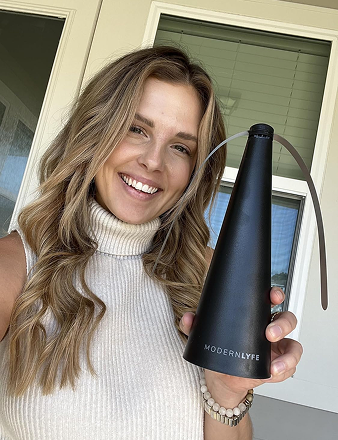
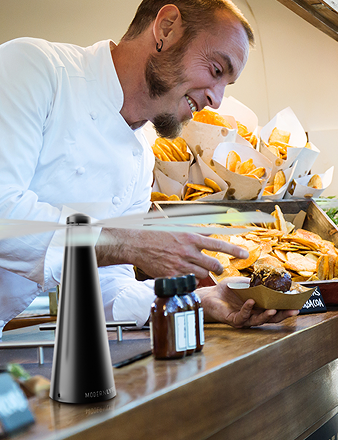
That fruit fly buzzing over a guest's table isn't just a nuisance. It's a direct threat to your brand, your reputation, and your bottom line. A plug in fruit fly trap is a simple electronic device that uses light to attract pests and a sticky surface to trap them, offering a silent, 24/7 defense for your business.
The Unseen Cost of Fruit Flies in Hospitality
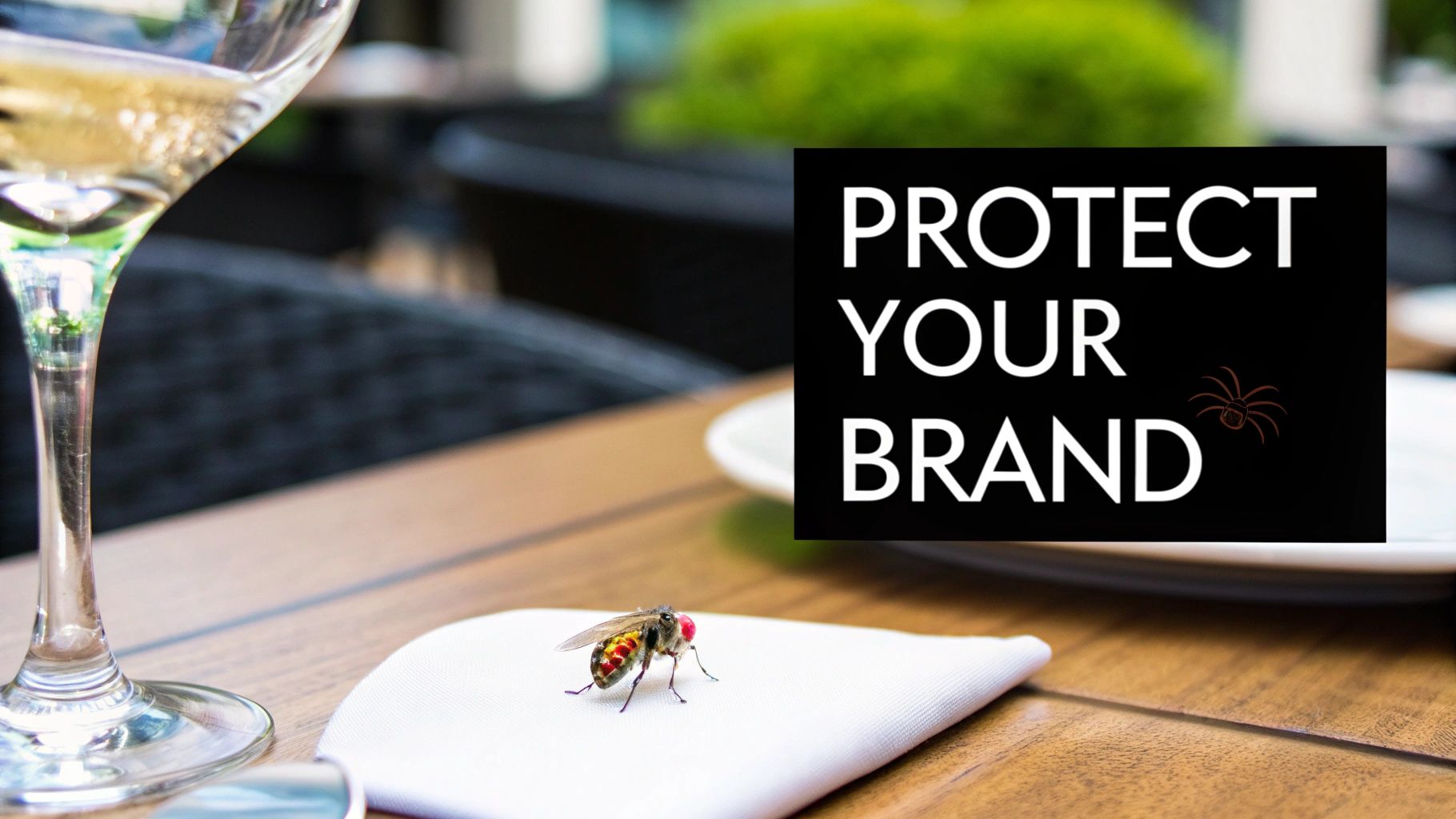
In hospitality, perception is everything. A single fruit fly can shatter the clean, inviting atmosphere you’ve worked hard to create, turning a perfect dining experience into a negative memory. To a guest, that tiny pest screams "unclean," no matter how spotless your kitchen is.
This small problem can create big headaches. A customer bothered by a fly is less likely to return and more likely to post a negative online review that steers other customers away. In the age of Yelp and Google Reviews, your reputation is fragile, and a gnat can do real damage.
Beyond Bad Reviews
The fallout doesn’t stop with customers. Health inspectors see fly activity as a major red flag for sanitation gaps, potentially leading to citations, a lower health grade, or even a failed inspection. This elevates fly control from good service to a core business requirement.
Smart fly management is also a cornerstone of any serious food safety plan. Flies carry and spread bacteria, creating a real risk of contamination. Integrating pest control into a broader safety strategy is non-negotiable. Dive deeper into this topic in our guide on what is HACCP food safety.
A Growing Industry Concern
The struggle with fruit flies is so universal that it has sparked a major industry response. The global demand for fruit fly traps shows just how seriously restaurant and hotel managers are taking this issue.
The global fruit fly trap market, valued at USD 540 million, is expected to nearly double to USD 1.12 billion. This surge proves that industry professionals are proactively seeking solutions, not just reacting to pests.
This market growth sends a clear signal: business owners need reliable tools. A plug in fruit fly trap is often the first line of defense due to its discreet design and ease of use. The need for a solid strategy is undeniable—protecting your brand starts by sweating the small stuff.
How a Plug-In Fruit Fly Trap Really Works
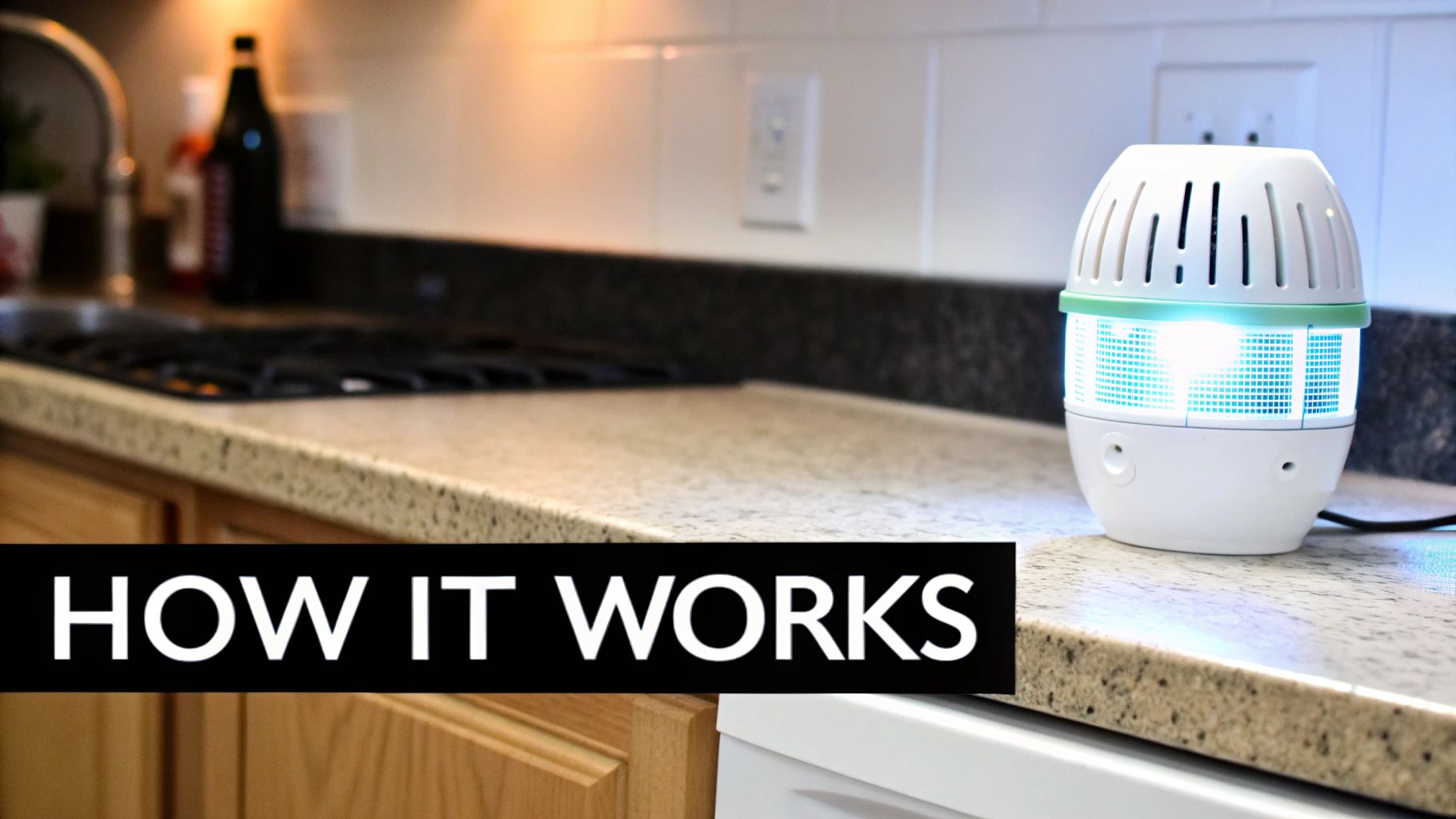
Think of a plug-in fruit fly trap as a silent, automated guard for your business. It doesn’t hunt flies; it lures them in and makes sure they never leave. The process is simple but effective, relying on two key components: the lure and the capture.
Instead of messy chemical sprays, this technology taps into basic insect instinct. It’s a clean, straightforward approach that works continuously in the background, needing only a standard wall outlet to do its job.
The Lure: A Beacon in the Dark
The heart of any plug-in fruit fly trap is its light source. These devices emit a specific spectrum of blue and ultraviolet (UV) light designed to attract common pests. This isn't a random choice—it’s based on a biological principle called phototaxis.
Put simply, phototaxis is the instinct causing certain organisms to move toward light. For pests like fruit flies and gnats, UV light acts like a powerful magnet. They are biologically programmed to navigate using natural light, and the trap’s glow cleverly hijacks this instinct, pulling them away from your food, drinks, and customers.
A single pair of fruit flies can lay up to 500 eggs in their short lifespan, maturing in as little as a week. This is why a continuous, 24/7 trapping solution is so crucial—it breaks the rapid reproductive cycle before an infestation takes hold.
The light works silently and without odors, creating a focused "attraction zone" that pulls pests out of the air around the clock.
The Capture: A Clean and Silent Finish
Once the UV light lures a fly toward the device, the capture mechanism takes over. Tucked discreetly behind the light is a disposable, non-toxic glue board. This sticky surface is the final destination for any insect that investigates the light.
The design is deliberate. The glue board is almost always hidden from view, so customers never see trapped insects. As a fly nears the light, it touches the adhesive and is instantly stuck. This method offers major advantages for a professional setting:
- No Zapping: Unlike loud, startling bug zappers, glue boards are completely silent.
- No Chemicals: The trap works physically, not chemically. No need to worry about sprays or poisons near food service areas.
- Contained and Hygienic: Trapped pests are held securely, so there's no risk of them falling onto counters, floors, or food.
This two-step system provides an elegant and effective solution. You can dive deeper into different trapping methods in our complete guide on the best fly trap for fruit flies. By understanding how the lure and capture work together, you can see how these devices help maintain a cleaner, more professional environment.
Evaluating the Pros and Cons for Your Business
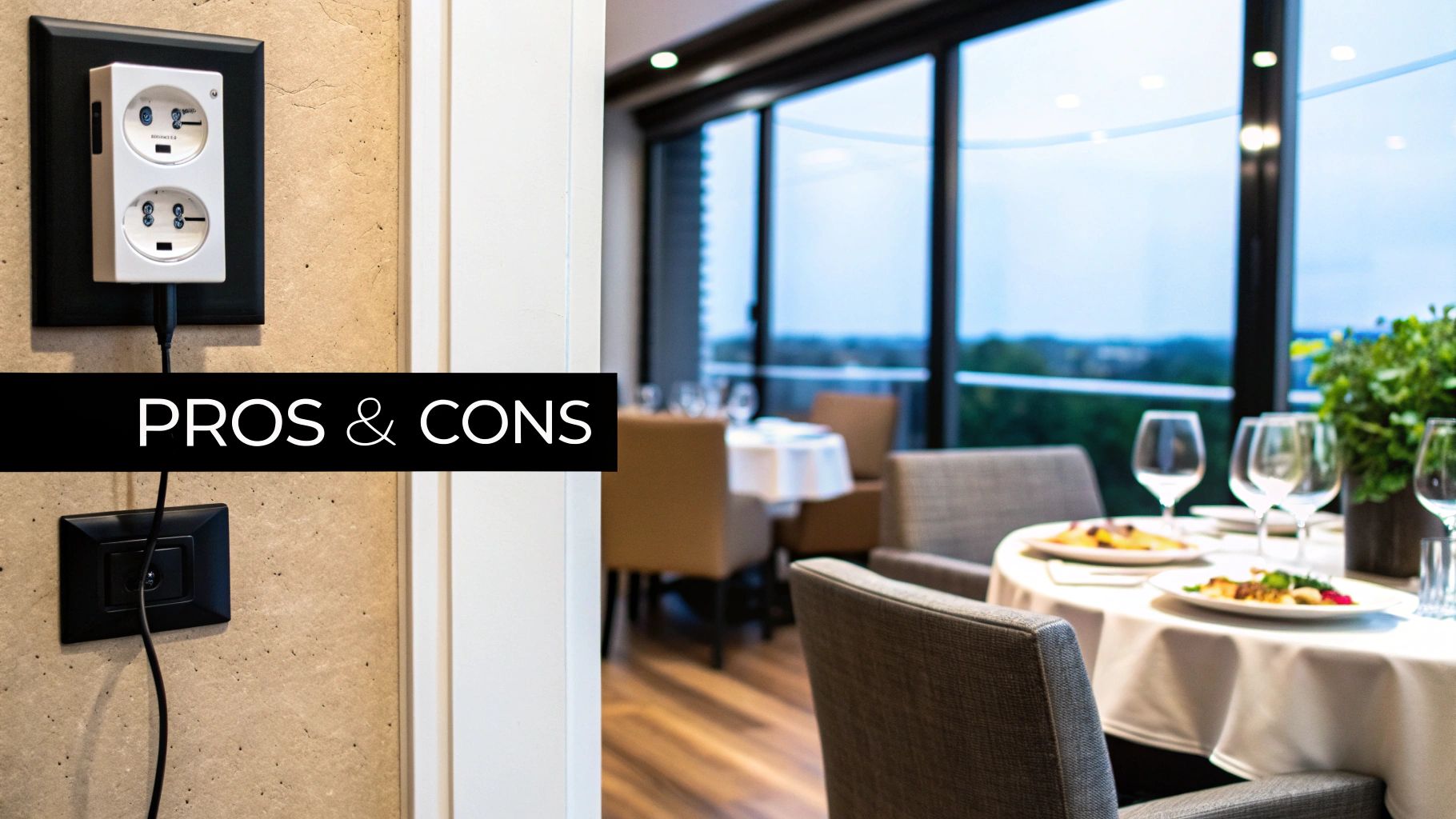
Before adding any new equipment—even a simple pest trap—you need to know how it will perform in your space. A plug in fruit fly trap can be a great tool, but it’s not a magic bullet for every situation, especially in the high-stakes world of hospitality.
To know if this is the right move for your brand, you need the full story: the good, the bad, and the practical.
The biggest draw is quiet, hands-off operation. You plug it in, and it works without noise or chemical smells, which is perfect for guest-facing areas. But that simplicity comes with limitations that can create headaches for managers trying to maintain a flawless environment.
Let's break down the gains and the risks.
The Clear Advantages of Plug In Traps
One of the best things about a plug in fruit fly trap is its silent and continuous operation. It works 24/7 to attract and catch pests without disturbing the atmosphere in your dining room, bar, or lounge.
Another major benefit is that they are completely chemical-free. This is a huge win for any food service business. You avoid airborne pesticides near food, drinks, or prep surfaces, giving your team and your health-conscious customers total peace of mind.
The core value of a plug-in trap is its 'set-it-and-forget-it' nature. It offers a consistent, low-maintenance defense that helps break the pest breeding cycle before a minor issue becomes an infestation.
Finally, these devices are incredibly easy to use. Insert a glue board, plug it into the wall, and you're done. No complicated setup or training is required, making it a practical choice for busy staff who need a solution that just works.
The Significant Disadvantages in Hospitality Settings
For all their benefits, plug-in traps have real downsides, especially front-of-house. The biggest is their limited effective range. A single trap only covers a small area, usually just a few feet around the outlet. Protecting a whole dining room would require several units, which isn't always practical or visually appealing.
But the deal-breaker for many hospitality brands is the unsightly visual of a full glue board. Even if the trap has a cover, it doesn't completely hide the sticky card. A guest sitting at the right angle could easily spot a board covered in dead insects, instantly shattering the clean, upscale image you’ve built.
This creates a dilemma. To be effective, the trap must be near the problem—often a bar, server station, or dining area. But placing it there puts it in your guests' line of sight. You have to choose between hiding it (making it less effective) or placing it optimally (risking your aesthetic). It's a classic case of function clashing with form.
Plug In Fruit Fly Trap Pros and Cons in Hospitality
To make the right call, it helps to see the trade-offs side-by-side. Here’s a quick rundown of what plug-in traps bring to the table in a hospitality environment.
| Feature | Advantage (Pro) | Disadvantage (Con) |
|---|---|---|
| Operation | Runs 24/7 silently without disrupting the guest experience. | The visual of a full glue board can be unappealing to guests. |
| Safety | Chemical-free and safe for use around food and drink areas. | Must be placed in an outlet, which can limit optimal positioning. |
| Range | Targets specific, known problem spots like drains or counters. | Very limited effective range, requiring multiple units for larger spaces. |
| Maintenance | Simple to set up; just plug in and occasionally replace the glue board. | Requires regular checks to replace full boards and maintain a clean look. |
| Cost | Generally low upfront cost for a single unit. | Costs can add up when purchasing multiple units and ongoing glue board refills. |
Ultimately, while plug-in traps offer a discreet and safe way to handle minor fruit fly issues, their visual drawbacks and limited range mean they may not be the best primary solution for maintaining a pristine front-of-house appearance.
The push for effective, non-chemical pest solutions isn't just local; it's a global trend. The Asia-Pacific region is now the fastest-growing market for fly traps, with a projected 10.8% compound annual growth rate, driven largely by strict regulations for pesticide-free produce. You can explore the full industry report on fly trap solutions to learn more about these global market shifts.
Strategic Placement for Maximum Effectiveness
You can have the best plug-in fruit fly trap on the market, but if it's in the wrong spot, it’s just a glorified nightlight. Placement is the single most important factor for success. Think of it like a security camera—you wouldn't point it at a blank wall. You have to put it where the action is.
The trick is balancing maximum fly-catching power with discretion. You want it to be a secret weapon, not a glaring announcement of a pest problem. A little strategy goes a long way in protecting both your space and your brand.
Finding the Sweet Spots for Your Trap
Fruit flies hang out where they find food and moisture. Your goal is to intercept them in these high-traffic areas. The best approach is to place your traps near these hotspots, but not directly on top of them.
Here are common magnets for fruit flies in any hospitality setting:
- Near Entry and Exit Points: Back doors, service entrances, and open windows are key. A trap here acts as a first line of defense, catching flies as they sneak in.
- Behind Service Counters: Areas around espresso machines, soda fountains, and bars are prime real estate for pests. A trap plugged in low and out of sight behind a counter can work wonders.
- In Back-of-House Areas: Food prep zones, dish pits, and dry storage rooms are ground zero. Placing traps here controls the population at its source before it migrates to guest-facing areas.
Crucial Tip: Never place a plug-in trap directly over food prep surfaces or open food displays. Most health codes strictly prohibit any insect-trapping device where there's a risk of contamination.
Common Reasons Your Trap Isn't Working
If your trap isn't catching anything, don't assume it's broken. Nine times out of ten, the problem is placement. A few simple tweaks can make all the difference.
1. Competing Light Sources
The trap’s UV light needs to be the main attraction. It can’t compete with the sun or a bright overhead light. If you place it next to a sunny window or under a spotlight, flies won't even notice it.
- The Fix: Move the trap to a darker corner or an area with ambient lighting. Its glow should be the most attractive light source in the immediate area.
2. Incorrect Height
Fruit flies tend to hover a few feet off the ground. A standard wall outlet is usually at the perfect height to intercept their flight path.
- The Fix: Avoid outlets high up on a wall or near the ceiling. The trap will be too far above where pests are actually flying.
3. Poor Airflow
Placing a trap in the direct path of a strong fan or an AC vent creates air currents that push flies away. They simply can't reach it.
- The Fix: Find a spot with relatively still air. This allows the trap’s UV light to create a clear "attraction zone" that flies can easily enter.
A Simple Maintenance Checklist
A trap is only as good as its last cleaning. A glue board caked in dust or already full of flies is useless. To keep your trap at 100% effectiveness, you need a consistent maintenance schedule. For a deeper dive, check our complete guide on creating a successful fruit fly trap for restaurants.
Here’s a quick checklist to stay on track:
- Weekly Board Inspection: Check the glue board once a week. If it's more than 50% covered, it's time for a new one.
- Monthly Replacement: At a minimum, swap the glue board every 30 days, even if it doesn't look full. The adhesive loses its stickiness over time.
- Routine Cleaning: Wipe the outside of the trap with a dry cloth each week. Dust and grime can block the UV light, making it less effective.
Proactive vs Reactive Fly Control Solutions
So far, we’ve discussed how a plug in fruit fly trap eliminates pests after they’re already inside. This is a reactive approach. Think of it like a mop and bucket—great for cleanup, but it doesn't stop the spill from happening in the first place.
In a high-stakes setting like a restaurant or hotel, winning the war against pests isn't about cleanup. It's about ensuring the problem never reaches your guests. This means shifting your mindset from reactive to proactive. A proactive strategy stops flies before they become a nuisance, protecting your atmosphere, your food, and your reputation.
This shift toward prevention is a major trend. The global market for all pest control traps is on track to hit USD 1,500 million, growing at a steady 8.5%. This demand signals a clear move toward smarter, integrated strategies in hospitality.
The Limits of a Reactive Strategy
A plug in fruit fly trap is a useful tool, but if it's your only defense, you have a blind spot. Traps work by luring pests that are already buzzing around your dining room. While they thin the herd, they can't erase the moment a guest first spots a fly.
And that's the real issue. The mere presence of a fly, even for a second, is what you want to avoid. That single interaction is enough to plant a seed of doubt in a customer’s mind. This is the core weakness of any reactive device: it solves the problem after your brand has already taken a hit.
A Modern Proactive Alternative: Fly Fans
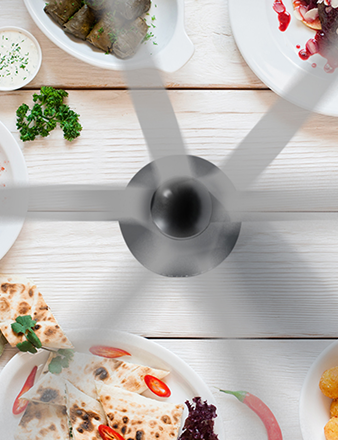
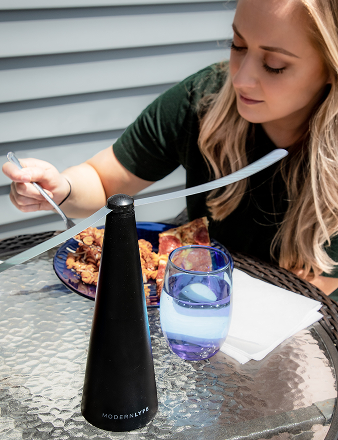
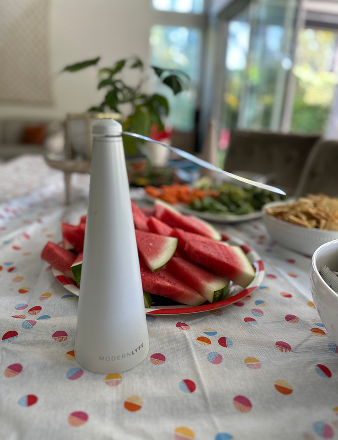
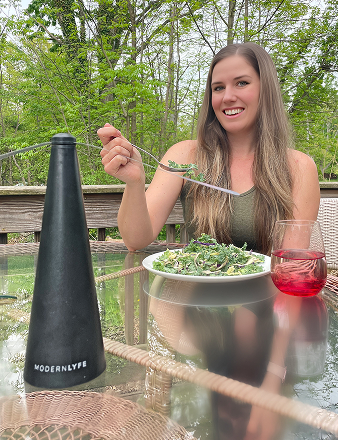
This is where proactive solutions like modern fly fans change the game. Instead of trapping flies, these devices create an invisible barrier that pests can’t penetrate. A fly fan uses soft blades to generate a quiet, consistent air current that disrupts a fly's fragile flight pattern.
To a tiny insect, that gentle breeze feels like a gale-force wind. They can't navigate it, so they give up and go elsewhere. By placing a fly fan on a dining table, buffet line, or service counter, you create a protected, fly-free zone.
The difference in philosophy is fundamental:
- Reactive Traps: Catch flies that are already inside, cleaning up the mess.
- Proactive Fans: Stop flies from ever landing on food or bothering guests in the first place.
This approach reframes pest control from a cleaning task to an essential part of the guest experience, just like mood lighting and background music.
Visualizing Your Placement Strategy
Whether you choose a reactive trap, a proactive fan, or both, placement is everything. The decision tree below breaks down the key questions to ask when positioning any pest control device so it stays effective without being an eyesore.
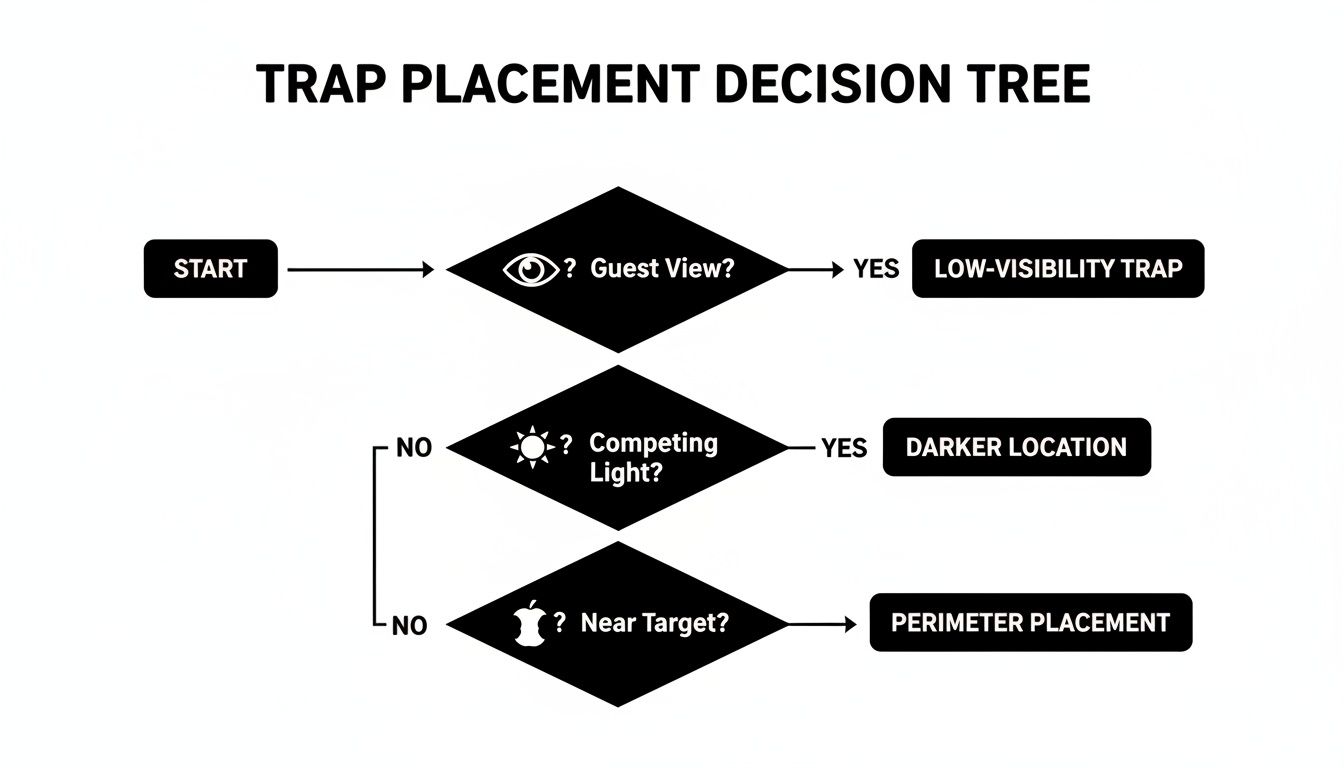
As the chart shows, the sweet spot is always out of your guests' line of sight, away from competing light sources (for UV traps), and near potential pest hotspots like bussing stations or bar drains. Getting this balance right is crucial for top performance.
Building a Comprehensive Defense
The best pest management plan isn't about choosing one tool over another. It's about layering proactive and reactive methods on top of a rock-solid foundation of hygiene. Flies are drawn to moisture and organic matter, which means impeccable cleanliness is your most powerful line of defense.
A truly effective strategy doesn't rely on a single gadget. It integrates proactive repellents, reactive traps for stragglers, and uncompromising sanitation protocols to create an environment where pests simply can't thrive.
Beyond hardware, your fly management plan must include strict cleaning routines. For instance, knowing how to prevent cross-contamination in your kitchen is non-negotiable. When you eliminate their food sources and breeding grounds, you make your establishment a much less attractive destination from the start. This layered approach covers all your bases, protecting your brand and ensuring every guest has a flawless experience.
Choosing a Solution That Protects Your Brand
The pest control tools you use speak volumes about your brand. Every guest notices the details, and a buzzing fly can instantly sour the atmosphere you’ve worked so hard to create. It’s more than an annoyance; it’s a crack in their experience.
The real question isn't just about getting rid of flies. It's about deciding whether you want to react to a problem or proactively protect your reputation. That’s what separates an okay solution from a great one.
Aligning Your Choice with Brand Standards
In any hospitality business, guest comfort, hygiene, and a polished look are non-negotiable. A standard plug in fruit fly trap is a decent reactive tool—it catches pests that have already gotten inside, silently and without chemicals.
The biggest issue, though, is that it looks like a trap. A device covered in dead insects is the last thing a guest wants to see while enjoying a meal. To be effective, you often have to place it right where everyone can see it, pitting its function directly against your brand's aesthetic.
The real win isn’t just a fly-free dining room. It’s creating an environment where the idea of a pest never even occurs to your guests. Proactive solutions make this happen by stopping the problem before it starts.
Proactive Solutions for a Polished Image
This is where proactive technologies like modern fly fans shine. Instead of trapping flies after the fact, they create a gentle, invisible barrier of air that keeps them from ever landing on food or bothering customers in the first place. This approach turns pest control from a cleanup chore into a seamless part of your service.
Consider the guest's perception:
- A Visible Trap: A customer sees the trap and thinks, "They must have a fly problem." It plants a negative seed.
- A Stylish Fan: A guest sees an elegant, modern fan on the table and sees it as a premium touch—part of a well-designed experience.
For unique setups like food trucks, every piece of equipment matters. Having a complete list of essential equipment for food truck kitchens is crucial, as space is tight and hygiene is everything.
The right solution doesn't just eliminate pests; it elevates the guest experience. A proactive approach sends a clear message that you are obsessed with excellence in every detail. You're not just putting out fires—you're preventing them, ensuring every guest enjoys the flawless environment your brand stands for.
A Few Common Questions, Answered
When you're running a restaurant or hotel, every decision impacts your guests. Pest control is no different. Let's tackle some of the most common questions about using a plug in fruit fly trap and other solutions in a hospitality business.
Are These Traps Safe to Use Around Food Prep Areas?
Absolutely. One of the main benefits of a plug-in trap is that it’s completely chemical-free and non-toxic. It uses UV light to attract flies and a sticky board to catch them, so there are no airborne pesticides.
However, you still need to be smart about placement. Health codes are clear: any device that traps insects must be kept away from open food to prevent contamination. This is a key difference from repellents like fly fans, which don't trap anything and can be placed closer to the action without the same risk.
How Often Do I Really Need to Change the Glue Board?
In a busy hospitality setting, checking the board once a week is a solid habit. Plan to replace it at least every 30 days, but if you're dealing with a surge, you'll need to swap it out as soon as it's full.
A glue board covered in dead flies is not just unsightly, it’s also useless for catching new ones. This ongoing maintenance—and the cost of replacement boards—is a factor to weigh against a one-time investment like a fly fan, which has no refills.
Can a Plug-In Trap Actually Get Rid of a Big Fly Problem?
Let's be clear: a plug-in trap is not a silver bullet for a major infestation. It’s a maintenance tool, perfect for catching stray flies and keeping a low-level issue from escalating. It's not designed for crisis control.
If you're facing a full-blown fly invasion, a plug-in trap can be part of the solution, but it can't be the only solution. An Integrated Pest Management (IPM) plan is essential. That means deep cleaning, sealing entry points, and likely calling a professional to tackle the root cause of the problem.
Ready to stop trapping pests and start proactively protecting your space? The MODERN LYFE fly fan offers a more elegant solution, creating a fly-free zone that actually adds to your ambiance. See how you can defend your dining experience at https://modernlyfe.com.