A fly can undo a lot of good work.
The table is set. Drinks are down. Food lands hot. Guests are relaxed. Then one fly starts orbiting the bread basket, lands near a plate, and turns a polished service moment into a small but memorable irritation. In hospitality, that's the problem. It's rarely just the insect. It's what the insect says about cleanliness, control, and attention to detail.
Most owners respond the same way. They hang a blue light zapper and hope the problem disappears. That reaction makes sense. It feels direct, visible, and decisive. But “does it kill flies?” isn't the only question that matters in a dining room, on a patio, or at a buffet.
The better question is sharper. Are flies attracted to UV light? Yes. But that doesn't automatically make UV the right front-of-house solution.
The Unwanted Guest at Every Table
A restaurant patio can look flawless and still lose the battle to a single fly. Guests don't care that your staff polished the glassware, reset the umbrellas, and timed the fire features perfectly if a fly keeps circling the appetizer. They notice the nuisance fast. They remember it longer than managers want to believe.

The common fix is familiar. Someone installs a glowing blue unit near the service station, the host stand, or a back corner of the patio. It signals action. Staff feel like something is being done. Guests, unfortunately, often get a different message. They see industrial pest control equipment in the middle of a space that's supposed to feel relaxed and well-managed.
Why the usual answer feels right but lands wrong
A zapper appeals to owners for practical reasons:
- It's obvious: You can see it working.
- It's simple: Plug it in and leave it alone.
- It feels aggressive: People assume a harsher tool must be more effective.
That logic breaks down in hospitality settings. Guest-facing pest control has to solve two problems at once. It has to reduce fly pressure, and it has to do it without creating a second problem such as noise, visual clutter, or hygiene concerns near food.
Practical rule: In a dining environment, the right pest solution should disappear into service. If guests notice the tool more than the problem, the tool is part of the problem.
There's also a deeper issue. Many fly-control devices are built around one idea: attract the insect first. That can work in the right place. It can also be exactly the wrong strategy when the area you're trying to protect contains people, plates, and open food.
For back-of-house use, that trade-off may be acceptable. For front-of-house, it often isn't. Elegant fly control usually starts with a different mindset. Instead of pulling flies toward the space, block them from settling there in the first place.
Why Flies See the World in Ultraviolet
Flies don't react to UV light because it looks interesting. They react because their visual system is tuned for it.

A fly's compound eyes process the world differently than ours do. What looks like an ordinary fixture to a human can function like a strong visual beacon to a fly. In practical terms, UV light can act like a bright signal that says “come investigate.”
A foundational finding behind modern insect light traps is that flies show strong positive phototaxis toward ultraviolet light in the 310 to 370 nm range, according to a 1973 Journal of Economic Entomology finding summarized here. That's the core science behind modern UV-based fly control.
What positive phototaxis means in plain English
Positive phototaxis means movement toward light. For flies, certain UV wavelengths are especially effective at triggering that response.
Think of it as a visual shortcut. Flies don't reason through the decision the way people do. Their sensory system detects cues tied to navigation and food-seeking behavior, then pushes them toward the source. In the right wavelength range, UV becomes less like a lamp and more like a neon sign.
That matters because it explains why so many devices rely on UV. They aren't randomly glowing blue. They're exploiting a predictable instinct.
Here's a helpful visual explainer:
Why this matters to an operator
If you run a restaurant, bar, hotel patio, or catered event, the science answers a narrow question very clearly. Yes, flies are attracted to UV light. That part isn't controversial.
What needs more careful thinking is application. A fly trap can be scientifically sound and still be poorly suited to a guest-facing space. Owners often stop at the attraction mechanism and never examine the operating reality: where the light competes with daylight, where guests can see the unit, and where “drawing flies in” may conflict with the experience they're trying to create.
UV attraction is real. Good fly control still depends on where you use that fact, and where you shouldn't.
Deconstructing the Blue Light Bug Zapper
Most blue light units fall into two camps. One uses an electric grid. The other uses a glue board. Both depend on the same basic mechanism: UV light attracts the insect, then the device either kills it on contact or captures it on an adhesive surface.
That sounds straightforward until you look at how sensitive performance is to the environment around the trap.

Two devices, two trade-offs
| Trap type | How it works | Main operational issue |
|---|---|---|
| Electrocution zapper | Uses UV to lure insects to a charged grid | Noise, insect fragmentation, poor fit near guests |
| Glue board trap | Uses UV to lure insects onto adhesive boards | More discreet, but still depends heavily on placement and light contrast |
Glue board units are generally the more sensible version indoors when a trap is necessary. They avoid the popping sound and the mess associated with grid systems. But they still share the central limitation of UV trapping: they work by attraction, and attraction is highly affected by surrounding light.
Why trap performance isn't as simple as switching it on
A 2019 Journal of Medical Entomology study found that hourly on and off cycling was far more effective than constant single-trap use, and catches dropped significantly when ambient light exceeded 27 to 51 lumens/m². That's a practical detail owners miss all the time.
If a trap depends on standing out visually, then bright surroundings weaken the effect. Sunlit patios, bright entry vestibules, windows, and strong interior lighting all reduce contrast. In those areas, the trap is fighting the room.
For operators comparing options, this breakdown of a UV light trap for flies is useful because it shows how much real-world success comes down to placement and context, not just the device itself.
A UV trap doesn't perform in isolation. It performs against daylight, pendant lights, window glare, and every other light source in the space.
Where UV traps tend to work, and where they don't
- More workable locations: Back prep areas, enclosed utility rooms, dimmer service corridors, and non-public spots where food isn't exposed.
- Weaker locations: Patios, bright dining rooms, window lines, open entrances, and buffet areas with heavy guest traffic.
- Frequent mistake: Mounting a trap where flies are visible to guests instead of where the trap can outcompete surrounding light.
That's why many owners overestimate what a zapper can do. They buy the idea of UV attraction, then install the unit in the exact environment that undercuts it.
Why UV Zappers Can Hurt Your Business
The question in hospitality isn't whether a device can kill insects. It's whether it helps or harms the room.
A blue light zapper often harms the room.
The sound problem is real
Dining spaces run on atmosphere. Music level, glassware noise, kitchen bleed, and table spacing all shape how guests feel. Add a sharp electrical pop in the middle of that environment and the room changes. It doesn't matter that the sound is brief. Guests notice it because it cuts through everything else.
That interruption is especially damaging in outdoor dining, cocktail service, weddings, and hotel events where operators work hard to make the setup feel effortless.
The hygiene optics are worse than most owners admit
An electrocution unit creates a visible kill. Some managers like that because it proves activity. The downside is obvious to any guest who thinks about it for half a second. If a trap kills insects by impact on a charged grid, people naturally wonder where the remains go.
You don't want customers thinking about insect debris while they're eating. Even when no one says it out loud, the unit can plant the exact mental image you don't want associated with your food program.
The placement paradox makes them awkward
The places where owners most want protection are also the places where UV often struggles. Host stands. Window tables. patios. Open-air bars. Buffet lines. Those are bright, active, guest-facing zones. As noted earlier, competing light can sharply reduce trap effectiveness.
So the operator gets boxed in. Put the device where it works better, and it may be far from the experience you're trying to protect. Put it near the guests, and it may work worse while looking worse.
A more detailed explanation of these trade-offs appears in this overview of ultraviolet light traps, especially for spaces where appearance and comfort matter as much as capture.
They look industrial in spaces built to feel polished
This is the point many teams overlook because they've become blind to their own equipment. Guests haven't. A blue light trap near a carefully designed bar or dining area looks like a maintenance compromise. It signals that the room has a pest issue, even if the issue is minor.
That visual cost is often avoidable.
If a control method protects food but damages the guest experience, it's not a complete solution for hospitality.
For warehouses, service alleys, and some back-of-house areas, UV traps still have a place. In front-of-house, they're often the wrong tool for the brand standard operators are trying to maintain.
Modern Fly Control for Elegant Spaces
The cleaner strategy is to stop treating fly control like a lure-and-kill problem in guest areas. In elegant spaces, it works better as an exclusion and disruption problem.
Flies are persistent, but they aren't strong fliers in turbulent micro-airflow near a table. That's why controlled air movement works so well around food service. Instead of inviting the insect toward the protected zone, airflow makes the landing area unstable and annoying enough that flies move on.

Airflow is the front-line defense
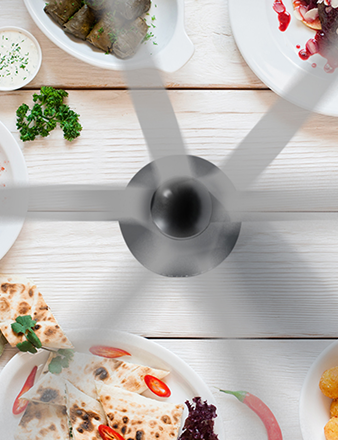
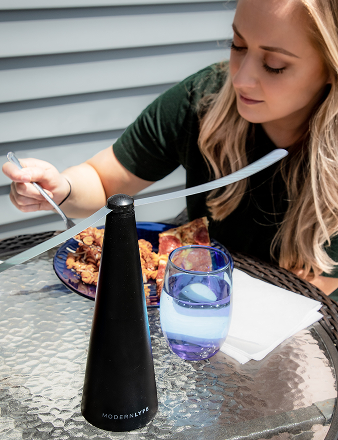
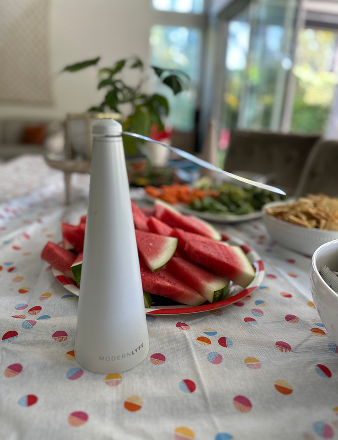
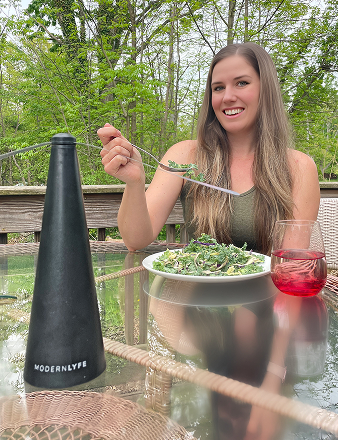
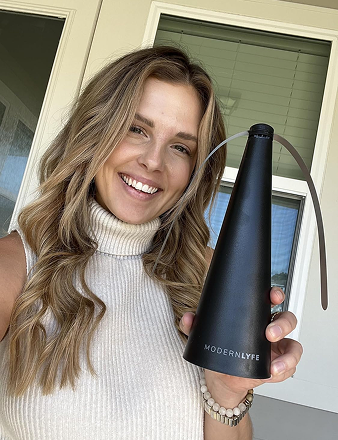
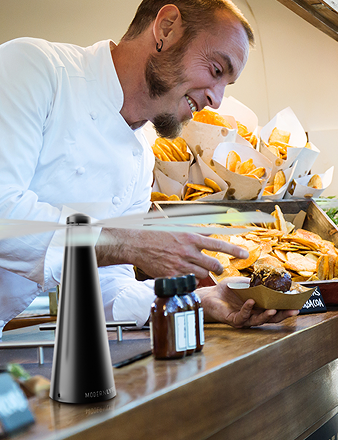
A quiet table fan designed for fly control creates an invisible barrier over plates, platters, and prep presentation areas. That's a different philosophy from UV. It doesn't advertise to insects. It denies them a comfortable approach path.
This matters on:
- Restaurant patios where daylight weakens light-based traps
- Buffet lines where exposed food needs protection without visual clutter
- Outdoor weddings and catering where aesthetics are essential
- Bars and tasting rooms where guests sit close to garnishes and small plates
One option in that category is the Modern Lyfe fly fan, a battery-operated table fan used to create a low-profile airflow barrier over dining and service areas.
Build a layered system around the room
Airflow works best when the rest of the operation isn't feeding the problem. Smart fly control is layered.
Sanitation has to remove the reward
Flies stay where the room offers moisture, sugar, residue, and easy landing points. That means managers need to look beyond obvious spills.
- Check drain areas: Soda stations, floor sinks, and mop sinks support fly activity.
- Tighten trash timing: Don't let full liners sit through service transitions.
- Reset condiment zones: Syrup rims, garnish trays, and sticky menus create repeated attraction points.
Entry control matters more than gadgets
A dining room can be spotless and still have fly pressure if doors stay open, screens gap, or receiving doors are left unattended during deliveries.
Use practical barriers:
- Door discipline during peak service
- Tight seals on rear entries
- Screen maintenance where applicable
- Fast removal of bus tubs and waste from transitional spaces
Operator note: The best guest-area fly control usually starts outside the guest area.
Lighting choices can reduce general insect pressure
For exterior-facing spaces, lighting still matters. Warm-toned exterior bulbs are generally less attractive to flying insects than harsh, cool-toned lighting. That doesn't replace sanitation or airflow, but it can reduce the amount of insect activity gathering near doors, patios, and outdoor bars.
The key is restraint. Don't turn the protected space into a beacon. Light the area for people first, and avoid creating unnecessary insect draw near entrances.
What works best in polished environments
If the room is guest-facing, the strongest setup is usually:
- Keep attraction sources low through sanitation.
- Reduce entry opportunities.
- Protect food and table zones with gentle airflow.
- Use UV trapping, if needed, away from guest view and away from exposed food.
That approach respects both pest pressure and presentation. It's more operationally mature than hanging a blue light and hoping nobody notices.
Your Practical Checklist for a Fly-Free Environment
A workable fly plan doesn't need to be complicated. It needs to be consistent.
Start with a walk-through during service, not before opening. You're looking for where flies show up when drinks, food, trash, and traffic are all in motion. That usually reveals more than a morning inspection.
Use this checklist in order
- Map the pressure points: Note where flies appear first. Patio railings, bar garnishes, bussing stations, trash routes, and service doors are common triggers.
- Fix what feeds them: Clean syrup, fruit residue, drains, and waste-handling areas with discipline. If the room keeps rewarding flies, no device will solve the issue cleanly.
- Protect guest zones with airflow: Use low-profile air movement at tables, buffets, and service displays where you need protection without noise or visual disruption.
- Audit your lighting: Reduce insect draw near entrances with warmer exterior lighting and avoid over-lighting patio edges when possible.
- Keep UV tools in their lane: If you use UV traps at all, reserve them for non-guest-facing areas where placement is practical and exposed food isn't part of the equation.
For operators refining the whole guest setup, it also helps to review adjacent service details. Guides like Afida's professional pub essentials are useful because fly prevention is rarely a standalone issue. It connects to bar organization, waste flow, tabletop management, and how service equipment supports cleanliness under pressure.
The simplest standard is the right one. If a method protects food while keeping the room calm, clean-looking, and comfortable, keep it. If it solves one problem by creating a guest-facing distraction, replace it.
If you want a cleaner way to protect dining spaces without the usual blue-light trade-offs, MODERN LYFE offers fly-control tools built for tables, events, and other guest-facing setups where appearance and comfort matter.