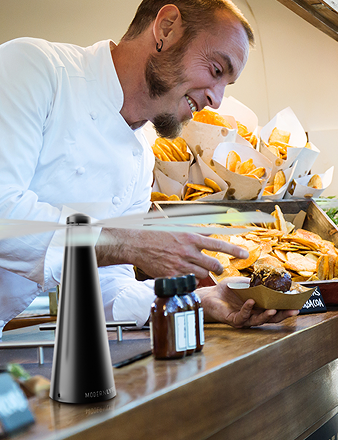
You're halfway through a Saturday reception when the dessert table becomes the busiest part of the venue, and not because guests want seconds. Fruit flies have found the exposed pastries. There's no outlet near the table, the generator is already carrying the kitchen load, and an extension cord across the guest path would create a bigger safety problem than the insects.
A battery operated shop fan gives you a practical way to manage that moment. Positioned correctly, it creates a steady air curtain that disrupts fly movement without turning the service area into a noisy worksite. For hospitality teams, that makes cordless airflow a guest-facing fly-control tool, not merely a portable cooling accessory.
When a Battery Operated Shop Fan Saves the Service
At a rooftop wedding reception, the pastry team can't relocate the cake table after guests arrive. The plated desserts are staged, the lighting is set, and the terrace layout has already been approved. A quiet cordless fan placed behind the table can push air downward across the exposed food zone, interrupting the flight path flies use to land, while keeping cords out of walkways.
That distinction matters. A plug-in fan may deliver stronger continuous airflow, but one loose cable beside a chair leg or service station can create a trip hazard. A battery unit lets the banquet lead move the protection with the food station instead of redesigning the room around an outlet.
Practical rule: If a fan needs a cable running through guest traffic, it isn't a clean service solution.
The same logic applies to an outdoor wine bar where power is limited, a poolside brunch buffet where wet ground makes cable management harder, and a food truck lineup where each vendor needs localized airflow under an awning. Hotel porte cochère arrivals create another useful scenario. A compact fan near a welcome drink station can discourage flies without making the entrance feel industrial.
Battery operation also helps when venue managers prohibit temporary cords across public areas. The fan can sit on a weighted base, move between stations during the event, and operate independently of the building's electrical infrastructure. That flexibility is especially valuable for caterers working in unfamiliar venues, where outlet locations, breaker capacity, and weather exposure are uncertain.
The category has a long history. Fan-history sources note that electric fans were marketed in the late nineteenth century, with a battery-operated ceiling fan appearing in 1884. Historical and sourcing guidance on rechargeable fans places battery operation among the earliest alternative power modes, not a recent novelty.
What a Battery Operated Shop Fan Actually Is
A battery operated shop fan is a portable electric fan designed to deliver directional airflow without a permanent power connection. It shouldn't be treated as a household tower fan with a battery attached. A proper unit combines a motor, impeller, guard, control system, battery, and charging equipment into an appliance intended for repeated movement and variable operating conditions.
The safety framework is broader than many buyers realize. IEC 60335-2-80, updated in 2024, covers electric fans for household and similar purposes, including direct-current supplied and battery-operated models. It applies to rated voltage up to 250 V for single-phase appliances and 480 V for other appliances, as described by the IEC fan safety standard information. In the United States, UL 507 is the principal fan safety standard, and current testing guidance includes portable lithium battery fans, neck fans, and USB fans.
That doesn't mean every portable fan is automatically suitable for food service. It means battery-operated models sit within a formal appliance category with defined electrical safety pathways. The same U.S. guidance references enhanced 2024 requirements for lithium-battery charging circuits and battery standards including UL 2054, UL 62133-2, and UL 1642.
Separate the fan types before you buy
A household tower fan prioritizes quiet indoor circulation and a slim footprint. A misting fan adds water handling and humidity, which can be the wrong choice around plated food, electronics, and polished tables. A contractor-grade jobsite fan emphasizes durability, directional throw, and compatibility with tool batteries.
The right shop fan for hospitality should offer controlled airflow, a stable base, a guard that can be cleaned easily, and charging components designed for the battery system. If it will sit directly beside exposed food, ask for sanitation information rather than assuming a general electrical listing covers food-contact or food-zone suitability.
Pay attention to the impeller and grille. Reinforced polymer can reduce weight, while metal construction may tolerate harder use but can add cleaning and corrosion concerns. Brushless DC motors are attractive for portable service because they can regulate speed efficiently and avoid brush wear, but the specification that matters most is still the airflow and noise delivered at the speed you'll run.
Battery Power Versus AC and Solar Shop Fans
Power selection should follow the service environment, not the fan aisle. AC, battery, and solar models each solve a different operational problem.
| Power Source | Portability | Typical Runtime | Noise Level | Weather Tolerance | 5-Year Cost Range |
|---|---|---|---|---|---|
| AC plug-in | Limited by outlet and cord length | Continuous while powered | Varies by motor and speed | Requires protected electrical supply | Equipment plus electrical and cord-management costs |
| Battery operated | High, with no service cord | Depends on pack and speed | Often quiet at lower settings, but varies widely | Good when the unit has suitable weather protection | Fan, batteries, chargers, and eventual pack replacement |
| Solar | High in suitable daylight locations | Depends on sunlight and storage | Usually low to moderate | Sensitive to cloud, shade, and wet conditions | Fan, solar hardware, storage, and replacement components |
AC wins when a protected outlet is close to the work area and the fan must run continuously. It usually provides strong airflow for the purchase price, but cords create trip points and limit placement around patios, food trucks, remote tents, and pool decks. A GFCI-protected circuit and careful cable routing are essential in hospitality environments.
Solar works for venues with a strong sustainability focus and reliable direct sunlight. It's less dependable under awnings, beside tall buildings, or during changing weather. A solar fan may keep a welcome area comfortable, but it shouldn't be your only fly-control plan for a long banquet service unless it includes dependable stored power.
Battery fans offer the cleanest deployment. They start where the manager places them, hold consistent output independent of sunlight, and move between stations without electrical planning. Their weakness is finite energy, especially at high speed. Battery technology continues to shape portable equipment, and this overview of battery technology advances is useful background when comparing replaceable packs with sealed systems.
Don't accept an advertised runtime without asking for the test condition. Verified testing has shown a 20V model running about 6 hours on low and 2 hours on high with a 2.0Ah pack, while another jobsite test recorded 14 hours on low and 2 hours on high with a similar pack. Independent cordless fan runtime testing demonstrates why service planning must use the speed setting that produces meaningful airflow.
Technical Features That Actually Matter
The first specification to check is CFM at the operating speed you'll use, not the largest number printed in the headline. For table-side fly control, I prefer a controlled, directional fan in the 250 to 450 CFM range, provided the airflow can be aimed downward instead of blasted across guests.
Testing shows why platform and motor design matter. One cordless fan reached 500 CFM on high with a 2.0Ah pack, while another platform delivered 200 CFM at the same setting. A separate test found runtime extending from roughly 7.5 hours at 3.0Ah to 16 hours at 6.0Ah on another model. Cordless fan airflow and battery testing supports a simple buying rule: compare watt-hours and measured output, not amp-hours alone.
Read the noise rating under load
A fan that sounds acceptable in a warehouse can be disruptive beside a table. Some battery fan specifications list noise around 76.8 dB at 3m, which is loud for guest-facing use. Published battery fan product specifications are a reminder to ask where and how the manufacturer measured noise.
For indoor dining, target under 55 dB at the speed you'll actually run. Quiet portable models can fall around 23 dB to 45 dB, and some are rated below 30 dB on low speed, according to this portable battery fan noise guide. Low speed may be too weak for a large buffet, so test the fan in a room with conversation before buying multiple units.
Use watt-hours to plan the shift
Battery capacity determines how long the motor can sustain usable airflow. Consumer rechargeable fans commonly use 2,000 mAh to 10,000 mAh batteries, with typical runtimes of roughly 2 to 20 hours, depending on speed and motor efficiency. The rechargeable portable fan buying guide notes that larger desk-style fans generally last longer at low settings than handheld units.
A technical guide gives a useful reference point: a 10W fan on a 5,000 mAh, 3.7V battery provides about 1.85 hours at maximum speed, extending to 4 to 6 hours with speed adjustment. Portable fan power-output guidance makes the practical point clear. A larger watt-hour pack matters more than a bigger amp-hour number attached to a different voltage system.
| Specification | Minimum | Preferred | Why It Matters |
|---|---|---|---|
| Usable airflow | 250 CFM | 250 to 450 CFM | Creates a controllable air barrier |
| Noise at service speed | Below 65 dB | Below 55 dB | Protects conversation and guest comfort |
| Battery system | Rechargeable lithium | Swappable, serviceable pack | Supports repeated event deployment |
| Weather protection | Patio-suitable enclosure | IPX4 or higher | Reduces risk during outdoor service |
| Weight | Manageable for staff | Below 8 lb | Makes repositioning practical |
| Controls | Multiple speeds | Fine variable-speed control | Lets staff balance airflow and noise |
For a deeper explanation of how to compare performance data, use this guide to technical specifications. Treat battery chemistry, charging design, and replacement access as part of the fan, not as afterthoughts.
Placement Tips for Fly Control at Buffets and Tables
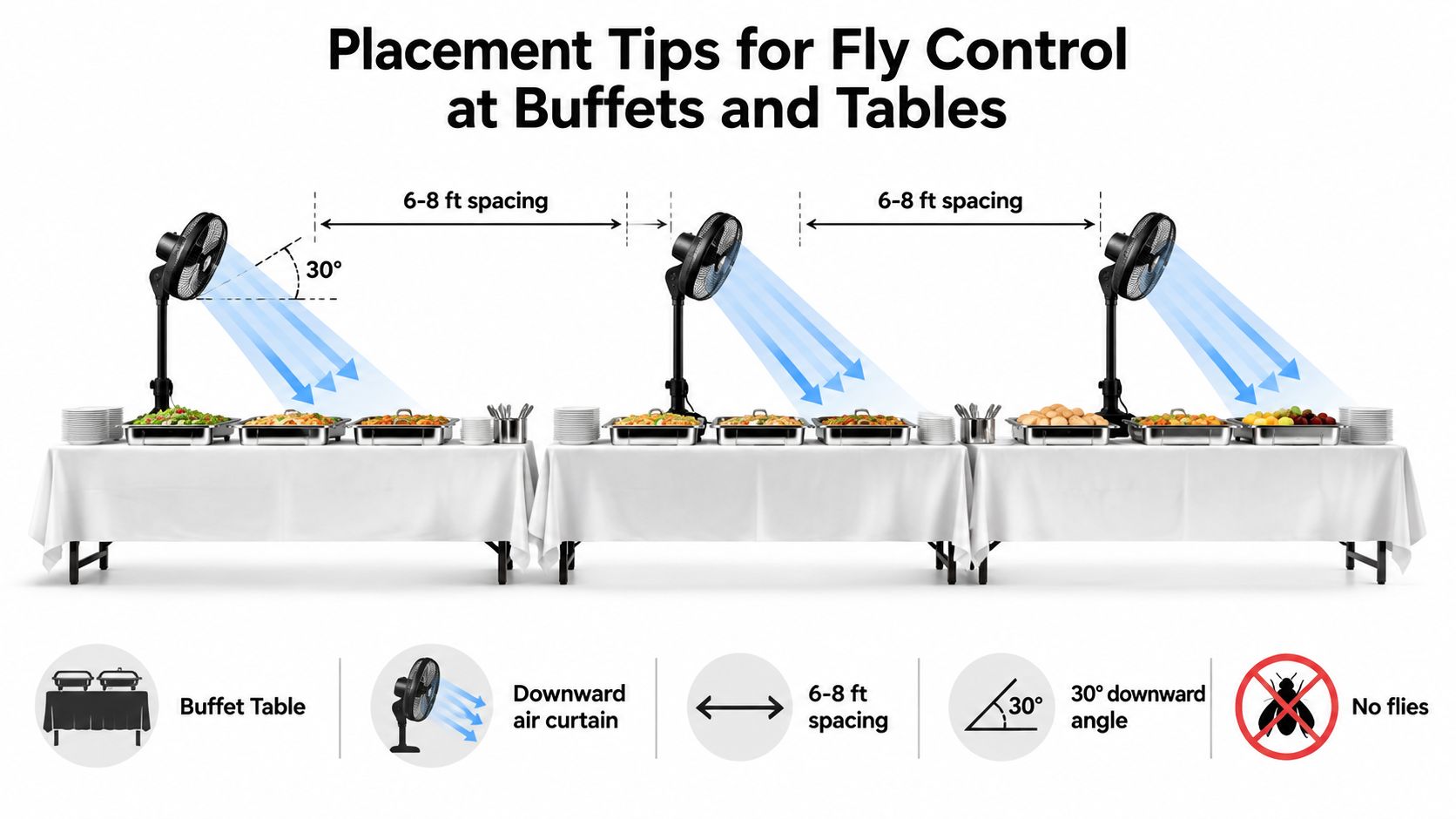
Airflow works best when it creates a downward air curtain, not when it blows directly across food or into guests' faces. Your objective is to disturb the insect approach path while keeping napkins, candles, garnishes, and plated food stable.
At a buffet, place fans at table-edge height and angle them approximately 30 degrees downward toward the food surface. A practical layout uses one unit every 6 to 8 feet, with each fan overlapping the next airflow zone. That spacing creates a more continuous barrier than placing one powerful fan at the end of the line.
Match placement to the service format
For individual table service, position a compact fan 18 to 24 inches from the table edge, slightly behind and above the plate zone. The fan should protect the surface without directing a sharp stream at diners. Test it with napkins and glassware in place. If anything moves, reduce speed or change the angle.
Cocktail receptions require a different layout. Place fans around the perimeter of the food station and point them inward, so insects meet moving air before they reach the guests. Avoid mounting a fan directly above hot food. Rising heat can carry odors into the airflow and make the station less pleasant.
- Buffet lines: Use overlapping downward airflow along the exposed food zone.
- Bar backs: Aim across the service perimeter, not toward seated guests.
- Outdoor receptions: Use weighted bases or non-slip pads on uneven surfaces.
- Food truck awnings: Keep the fan clear of exhaust and grease-heavy airflow.
- Poolside setups: Protect the battery and charging gear from splash exposure.
A soft opening is the right time to test placement. Lighting, landscaping, wind direction, and nearby waste areas can change fly pressure from one venue to the next. If the venue also needs a broader cleanliness plan around storefront glass and entrance zones, a grocery store window washing service can help maintain the surrounding customer-facing environment.
Maintenance, Charging, and Troubleshooting
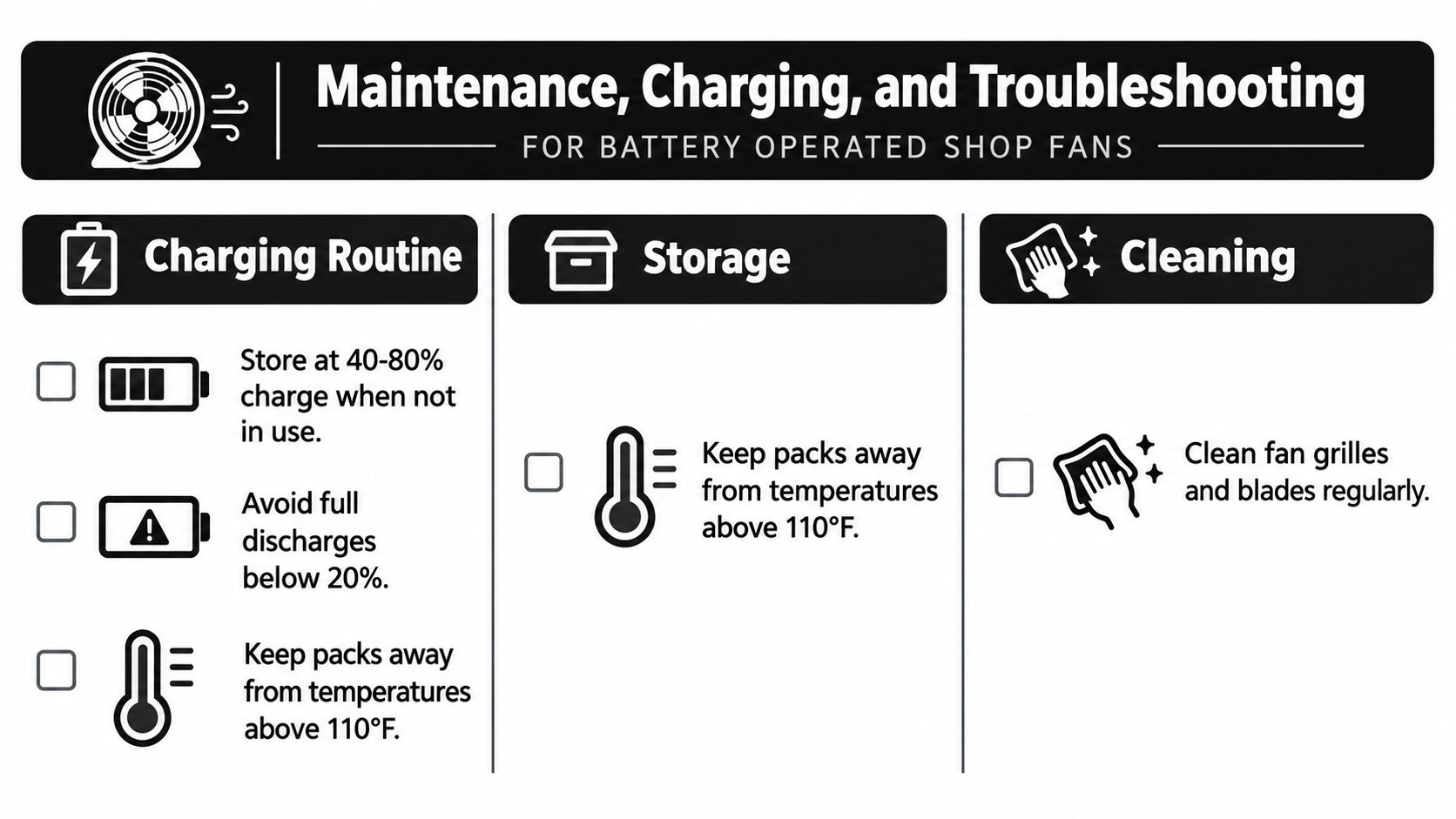
A cordless fan earns its place in a service kit only if staff can maintain it between events. Start with a simple charging routine. Store the battery at 40% to 80% charge when it won't be used for a while, avoid full discharges below 20%, and keep packs away from temperatures above 110°F.
Clean the grille and blades weekly with a dry brush. Wet wipes can release moisture into the motor housing, especially when staff clean the fan while it's still assembled. Inspect charging contacts monthly for corrosion if the unit operates outdoors or travels between humid venues.
Follow a clear fault path
If runtime drops by more than 30%, fully charge the battery and then fully discharge it once to recalibrate the system. If performance doesn't recover, the cells are likely aging. Don't keep sending the same weak pack into service and hope staff won't notice.
A fan that stops during an event may have reached its thermal cutoff. Check the reset procedure before declaring the battery dead. A sudden increase in noise usually points to debris entering the housing, a loose guard, or an obstruction near the impeller.
Electrical symptoms deserve disciplined handling. If a charger, outlet, or charging base behaves unpredictably, consult a qualified professional and use this resource on electrical troubleshooting for context. Don't improvise repairs around lithium packs.
Battery risks are physical damage, puncture, heat, fire exposure, and poor-quality charging equipment. A damaged pack should be isolated in a suitable metal container and routed through certified e-waste disposal. Modern battery-management systems control charging, so the claim that every overnight charge automatically destroys a battery is too simplistic. The safer rule is to use the manufacturer's charger, keep the pack on a hard surface with ventilation, and never charge a visibly damaged battery.
For replacement planning, review this battery replacement guide before choosing a sealed or proprietary system.
Warranty, Service, and the Business Case
A cheap jobsite fan can look economical until the battery fails, the housing rattles, or the manufacturer stops supporting the pack. Hospitality operators should buy for service continuity, not just the initial invoice.
A strong purpose-built unit should offer at least two-year fan motor coverage, plus a separate one- to two-year lithium battery warranty with clear capacity-retention language. Replacement batteries matter more than polished packaging. If the pack can't be purchased separately, the business may have to discard an otherwise usable fan when the battery reaches the end of its service life.
UL or ETL listing signals tested electrical safety for the applicable equipment. For food-service placement, ask whether the finishes and construction carry NSF or equivalent sanitation certification. These are separate questions, and a general electrical listing doesn't automatically establish food-zone suitability.
| Factor | Hospitality-Built Fan | Jobsite Fan |
|---|---|---|
| Service appearance | Designed to blend into guest areas | Built for work zones |
| Noise objective | Tuned for conversation and dining | Often prioritizes power |
| Battery support | Replacement packs should be available | May depend on a tool platform |
| Cleaning access | Smooth, accessible surfaces preferred | Guards may collect dust and debris |
| Warranty focus | Motor, battery, and service support | Often centered on the tool body |
| Deployment | Tables, buffets, receptions | Workshops, garages, construction areas |
Guest perception is part of the return. A quiet, finished fan signals that the operator has planned for comfort and food protection. A rattling contractor fan beside a plated dessert can undermine the presentation, even if it moves plenty of air.
Don't invent a precise ownership saving from a replacement cycle the vendor hasn't documented. Instead, compare the actual 12-month cost before purchase: fan price, battery and charger, replacement-pack availability, warranty exclusions, cleaning time, and the cost of replacing a complete unit if the pack is sealed. That calculation exposes the difference between a service appliance and a disposable accessory.
Choosing the Right Fan for Your Setup
Choose by service zone first, then by fan size. An 8-inch tabletop fan fits a two-top or compact counter. A 12-inch model suits a four-top or small buffet table. An 18-inch or larger unit makes more sense for a buffet line, bar back, or open outdoor station where the airflow must cover a wider area.
Use three essentials for the first filter:
- Real runtime: Require at least four hours at full speed if the fan must cover a complete service window.
- Conversation-friendly noise: Keep indoor dining models below 55 dB at the setting you'll use.
- Outdoor protection: Choose IPX4 or higher for uncovered patio deployment.
Then score the remaining candidates. Give airflow and real runtime the highest weight, followed by noise, warranty, and price. A fan that costs less but cannot complete service at usable speed isn't cheaper. It's an interruption waiting to happen.
Before ordering, confirm the following:
- Battery access: Verify that replacement packs are available and separately sold.
- Charging logistics: Check whether your team needs a removable pack, a charging base, or USB charging.
- Placement stability: Confirm that the base works on tile, decking, grass, and uneven patio surfaces.
- Cleaning: Look for a grille and housing that staff can clean without exposing the motor.
- Service documentation: Read the warranty exclusions for batteries, outdoor use, and commercial operation.
- Noise evidence: Ask for measurements taken at the operating speed, not only the lowest setting.
- Airflow direction: Choose adjustable tilt and speed control for buffet and table layouts.
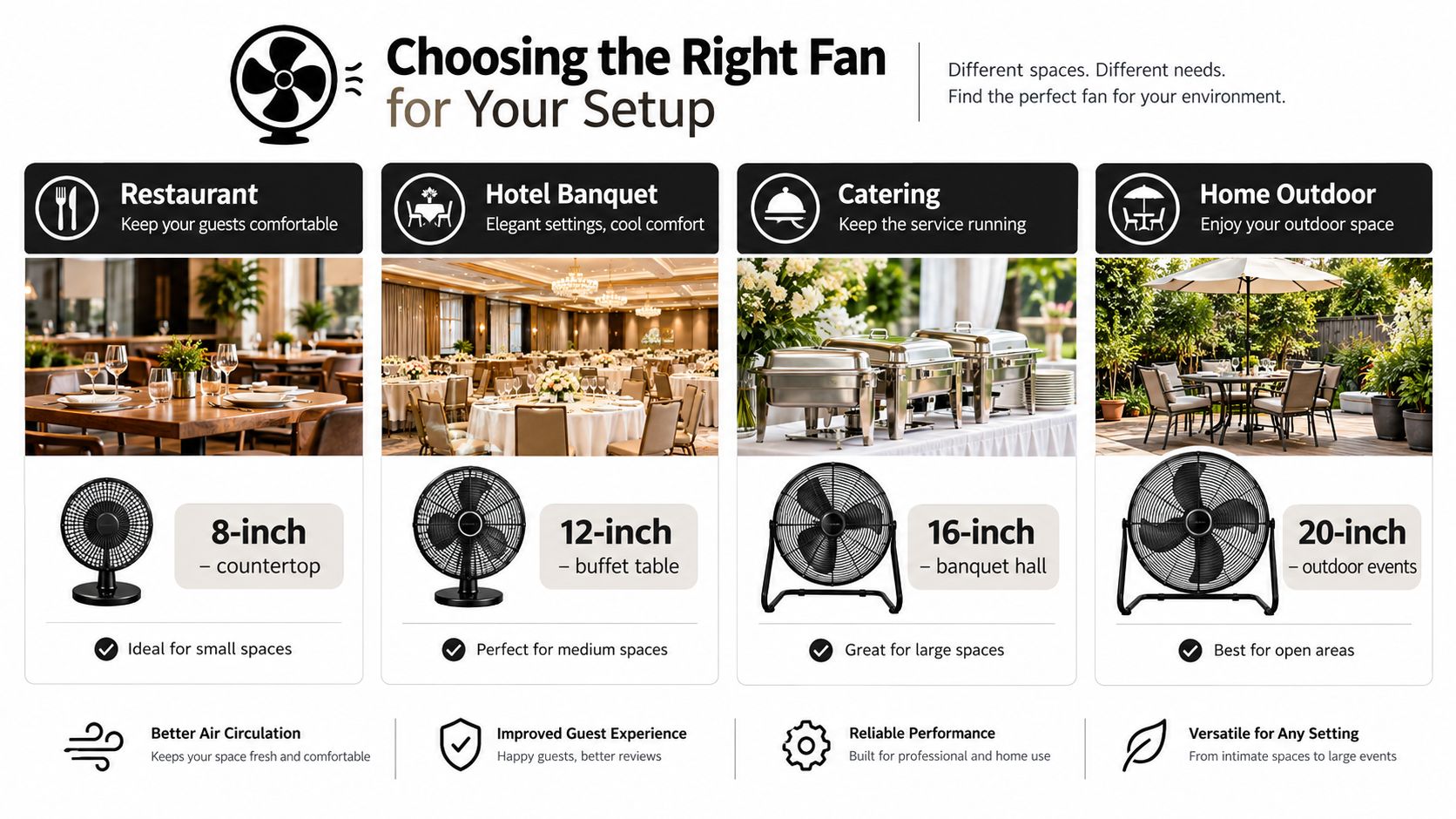
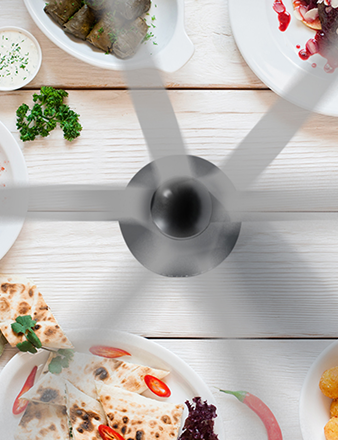
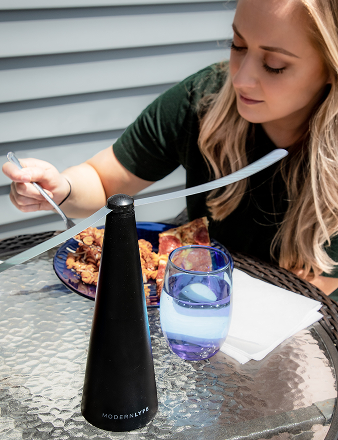
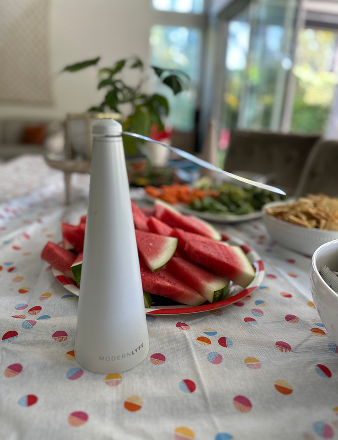
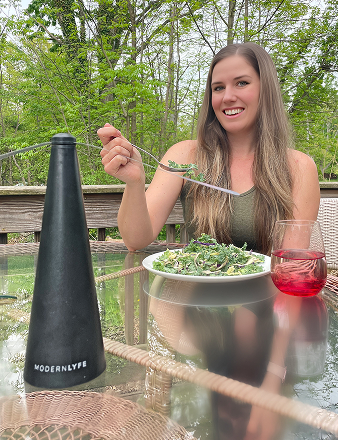
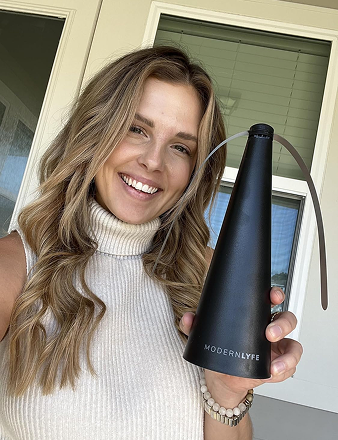
For operators who want a compact fly-control option rather than a large jobsite unit, MODERN LYFE offers a portable fan that operates on 2 AA batteries or a USB cable, with the company describing runtime of up to 12 hours on 2 AA batteries. Use that type of product for localized table and buffet protection, then reserve larger cordless shop fans for areas requiring stronger directional throw.
Buy the fan only after you've matched its tested runtime, noise, airflow, battery support, and placement stability to the actual service. Visit MODERN LYFE to review battery-operated fly-fan options for restaurant tables, hotel banquets, catering stations, and outdoor gatherings, then choose the model your team can deploy before the next service.