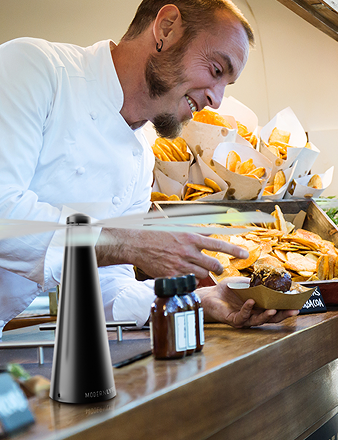
The evening reception is underway, the appetizers look ready, and a housefly lands beside the serving tongs. You wave it away, apologize to a guest, and realize your outdoor buffet needs something more dependable than someone standing guard. A bug repellent fan may help, but choosing one starts with understanding what it can do around food.
The Outdoor Buffet Problem and What a Bug Repellent Fan Is
Exposed food creates a practical challenge for anyone serving outdoors. A caterer needs guests to reach the platters easily, a restaurant manager needs staff to move freely, and a homeowner wants to enjoy dinner rather than repeatedly shoo insects away. The equipment has to fit the table without becoming another obstacle.
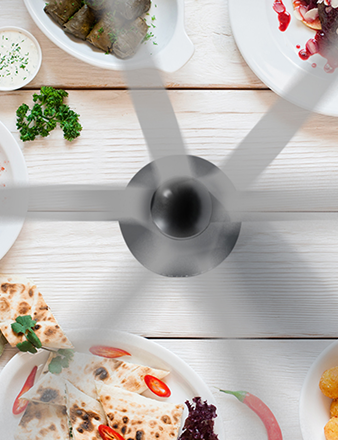
A bug repellent fan is a table-friendly device intended to discourage flying insects near a serving area. For an airflow-based design, the useful mechanism is moving air across an insect's approach path. It's a supplemental exclusion tool, not a device that sterilizes food or makes an exposed buffet safe by itself.

Know which device you're considering
The product category can be confusing because sellers use similar language for different mechanisms. A fan that moves air, a device with rotating deterrent blades, and a fan that disperses a repellent shouldn't automatically be treated as equivalent.
- Airflow fans aim to make the route toward food harder for insects to find.
- Misting or dispensing systems introduce a substance into the surrounding area. Their operating requirements differ from those of a plain fan.
- Bug zappers kill or stun insects rather than discouraging their approach.
For restaurants, hotels, caterers, and outdoor kitchens, the appeal is straightforward: a compact device can be placed close to the point where food is exposed. That's a useful operating concept, but the label alone doesn't establish effective coverage.
The defensible promise is narrow: help reduce insect access within a defined serving zone. Evaluate the mechanism, placement, cleaning requirements, and observed results rather than treating a spinning propeller as proof of protection.
How Airflow Becomes an Insect Barrier
Think of moving air like a stream flowing over a rock. The stream isn't a solid wall, but something trying to settle on the rock must contend with the current. A fly approaching a platter faces a similar control problem when directed airflow crosses its path.
Controlled housefly experiments found that flies typically didn't initiate takeoff when mean air velocity exceeded approximately 0.63 m/s under low-turbulence conditions; with turbulence, reported body-roll changes reached about 18.5 times baseline variation, according to the controlled housefly flight research. These findings concern specific experimental conditions, not a universal setting for every tabletop device.
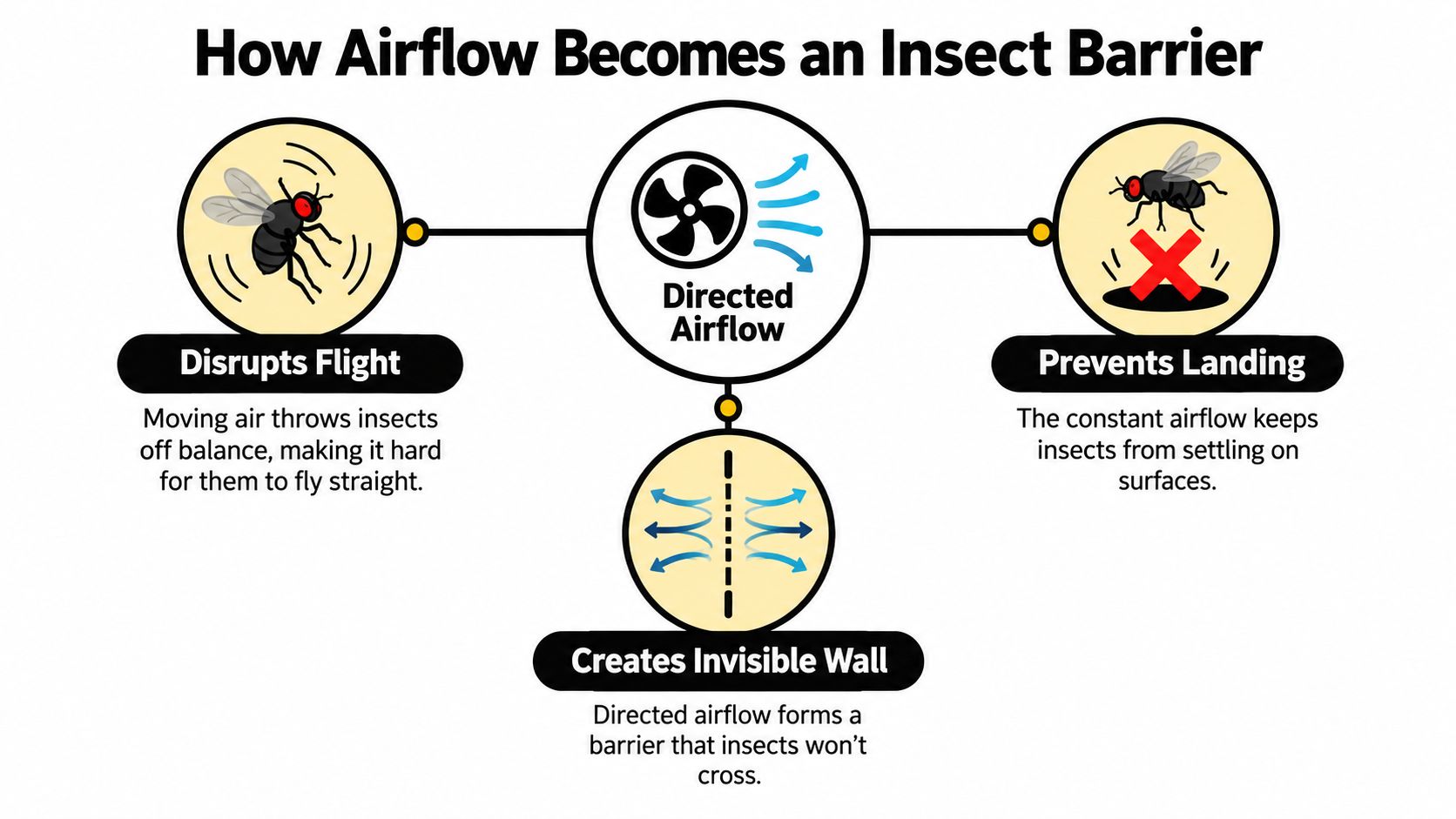
From flight disruption to practical exclusion
A larger-scale example shows what a deliberately engineered air barrier can accomplish. A 2005 USDA report described an aircraft-doorway experiment with vertically mounted fans on opposite sides; the arrangement excluded about 99% of flies and mosquitoes, and insects couldn't penetrate the barrier when moving air reached at least 1 m/s, as described in the USDA air-curtain experiment.
That result belongs to the tested doorway arrangement. It isn't a performance rating for a compact buffet fan, and it doesn't establish that a tabletop unit will keep out the same proportion of insects.
Engineering rule: Evaluate the air where insects approach the food, not just where it leaves the fan.
Three practical variables matter:
- Direction: The air needs to intersect the approach zone. A strong stream aimed above the platters may miss it.
- Velocity: Motor speed doesn't establish air velocity at the protected surface. Distance and geometry matter.
- Consistency: Gaps around serving dishes, corners, and display stands can leave routes outside the moving air.
Use an anemometer to assess local air velocity at platter height and along the serving perimeter. Don't assume that a larger motor, higher revolutions per minute, or visibly spinning blades establish the required conditions.
A compact fan is a cousin to an air curtain only when it creates useful directed airflow. If it barely moves air, the air-curtain research doesn't validate its performance.
Which Insects a Bug Repellent Fan Actually Deters
Start with houseflies, because the flight experiments directly address them. Blowflies and flesh flies are also relevant food-service pests, but the housefly findings don't establish identical responses for those insects. Avoid converting evidence about one species into a guarantee for an entire group.
Houseflies matter for more than guest comfort. The CDC's explanation of parasite transmission notes that houseflies may carry organisms externally on their bodies, including organisms that cause diarrhea in people.
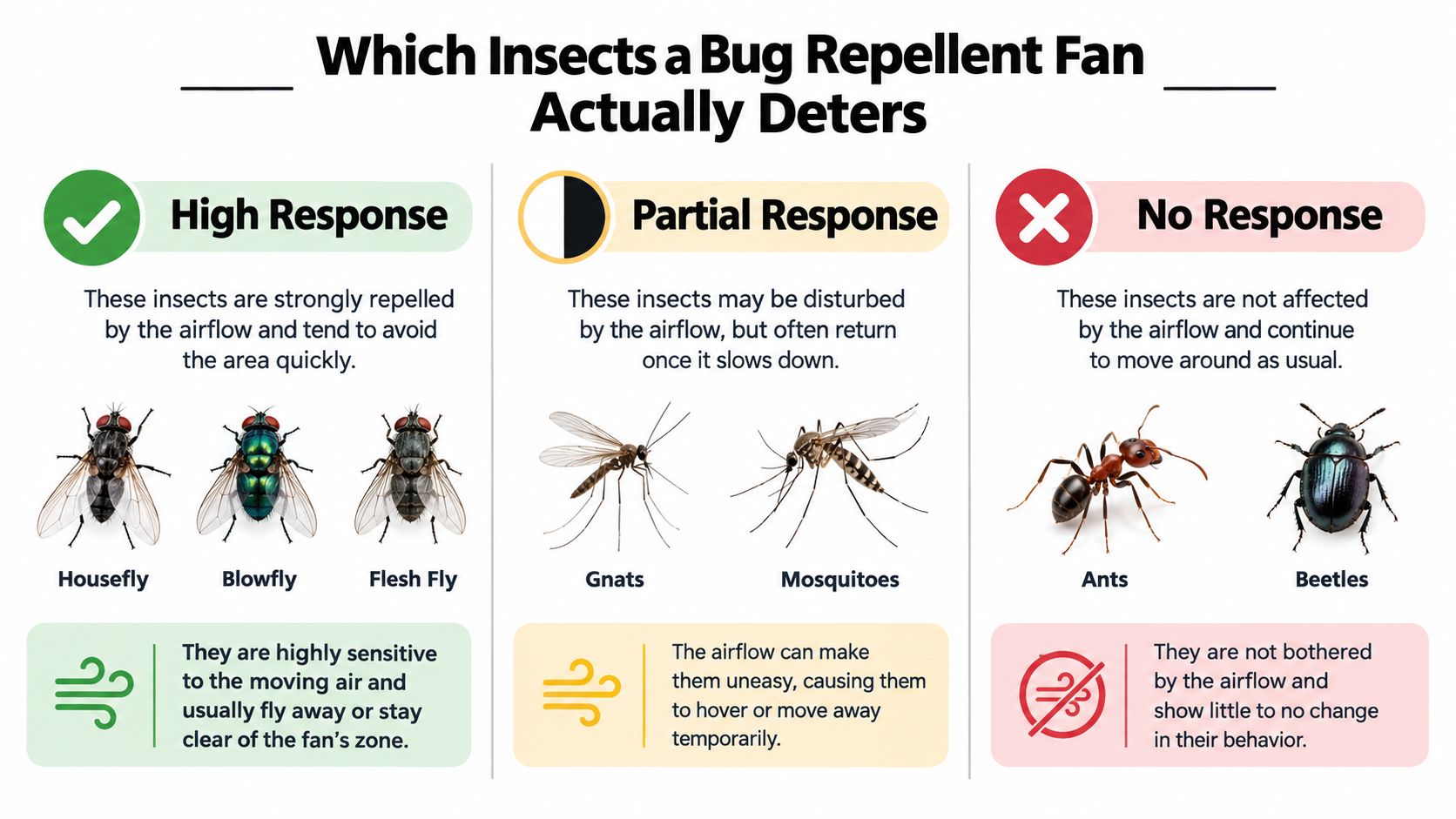
Treat insect categories as a starting point
The graphic is a simplified planning aid, not a tested effectiveness ranking for every species or fan. In particular, the available evidence doesn't justify assigning guaranteed high, partial, or zero response across these groups.
- Houseflies: The strongest direct flight evidence discussed here concerns this target. Observe whether your setup reduces approaches and landings.
- Mosquitoes: They were included in the doorway exclusion experiment, but protecting a platter isn't the same as protecting guests from bites.
- Blowflies and flesh flies: Include them in your monitoring rather than assuming housefly results transfer unchanged.
- Fruit flies, gnats, moths, and wasps: Don't promise control without device-specific evidence. Persistent activity calls for identifying the pest and adding an appropriate control layer.
- Ants and beetles: A barrier intended to interrupt flight doesn't address an insect walking onto the table through an unprotected route.
Why contact near serving time deserves attention
A CDC-published Campylobacter investigation describes infectious material carried on flies' feet, proboscis, legs, and body hairs, or transferred through regurgitation and defecation. It also identifies contamination close to consumption, including catering environments, as particularly relevant.
For an operator, the useful question isn't whether a fan repels every bug. It's whether the selected equipment helps limit the insects approaching ready-to-eat food in that setting.
How a Bug Repellent Fan Compares to Other Fly Controls
Choose fly controls by their role and their potential to create another hazard. Equipment that reduces insect activity can still be unsuitable above a dessert display if it deposits insects or debris onto the food.
The FDA Food Code provisions for insect-control devices require devices designed to electrocute or stun flying insects to retain the insects within the device. Placement must also prevent dead insects and insect fragments from falling onto food, clean equipment, utensils, or food-contact surfaces.
Comparing Common Fly-Control Methods
| Method | Target Insects | Food-Safety Concern | Best Use |
|---|---|---|---|
| Bug repellent fan | Flying insects entering its effective zone | Dirty equipment or poorly directed air | Supplemental serving-perimeter protection |
| Bug zapper | Flying insects attracted to the device | Insect retention and fragment placement | Suitable locations away from exposed food |
| Spray insecticide | Pests specified on the product label | Application around food and equipment | Approved, label-directed pest management |
| Citronella candle | Intended nuisance-insect deterrence | Flame placement near service materials | An amenity, not a dependable food-protection plan |
| Sticky trap | Insects contacting the trap | Captured insects near food or utensils | Suitable monitoring or capture locations |
| Screens | Flying insects approaching openings | Gaps and damaged screening | Building-entry exclusion |
| Food cover | Insects approaching the covered item | Cleanliness and correct handling | Direct protection while food isn't being served |
This isn't an effectiveness league table. Each method addresses a different part of the operation, and sprays or candles shouldn't be assumed suitable because they're sold for outdoor use.
For a buffet, a cover protects an item during pauses in service, while a fan can be evaluated for the periods when guests need access. The guide to choosing a fly cover for food is useful when matching that physical protection to your serving arrangement.
A serving-area device addresses the arrival point. Staff still need to address the sources that keep insects coming.
USDA research on filth-fly transmission describes houseflies, blowflies, and flesh flies developing in fecal material or decomposing matter and investigates their potential to transmit Salmonella and E. coli O157:H7 to leafy greens and other unprocessed foods. That's the reason to combine exclusion with waste management and source control rather than buying a single device and stopping there.
Placing and Running the Fan Around Food Service
Set up the serving zone before choosing the final fan position. Identify exposed items, the guest approach side, nearby waste containers, and any dusty surfaces. Then find a stable location that lets the device protect the approach zone without obstructing serving utensils or staff.
The FDA Food Code's airflow and pest-control provisions recognize properly designed and installed air curtains as a flying-insect control method, require premises to be maintained free of pests, and prohibit airflow systems from contaminating food, food-contact surfaces, equipment, or utensils. That recognition doesn't automatically make a consumer tabletop fan a compliant air curtain.
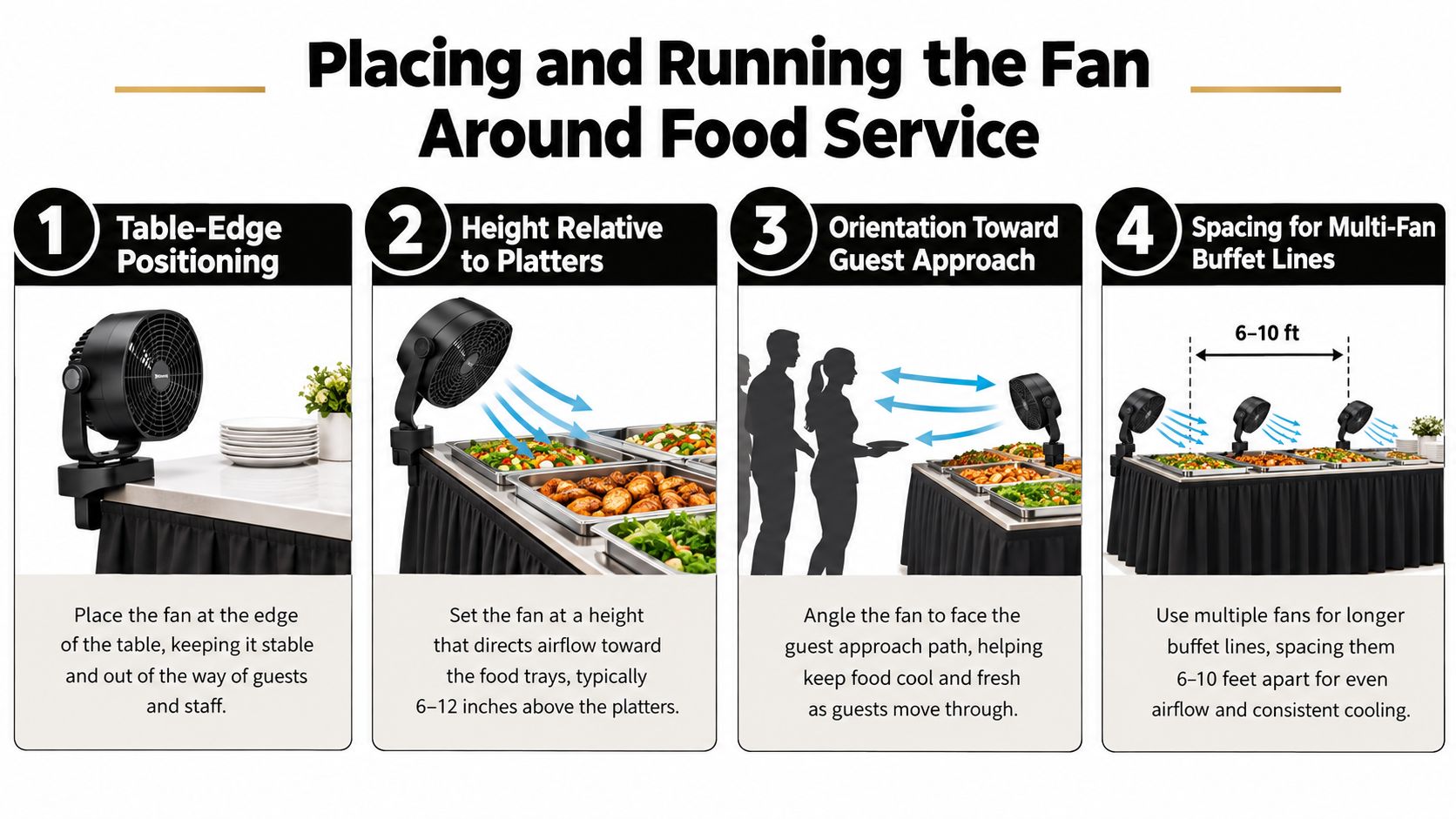
Establish coverage without creating contamination
- Start at the table edge: Keep the base secure and outside the guest's normal reach for plates and tongs.
- Match platter height: Aim for the food-facing approach zone, accounting for raised cake stands and deeper trays.
- Orient deliberately: Where practical, direct clean air outward toward the approach side. Follow the prevailing breeze only if it doesn't bring dust or other contaminants toward service.
- Check the gaps: For a buffet line, position additional fans according to observed coverage, not an assumed universal spacing.
Check direction with a clean tissue held securely at platter height, away from food and moving blades. Its movement can reveal weak spots, but a tissue test isn't an efficacy test and doesn't establish air velocity. Use the measurement method described earlier when you need a defensible airflow assessment.
Keep operation suitable for the venue
Disconnect power before cleaning, follow the equipment instructions, and remove accumulated soil from the grille and accessible surfaces. Don't redistribute cleaning debris over a prepared buffet.
Keep the device away from flames, candle heat, fryers, and hot surfaces. Confirm battery readiness before service, listen for noise at the guest position, and check that airflow doesn't disturb napkins or lightweight coverings. Reassess the arrangement whenever staff move a platter or change the display.
Choosing the Right Bug Repellent Fan for Your Setting
A quiet wine dinner, a mobile catering station, and a restaurant patio need different equipment priorities. The host may care most about conversation and table space. The caterer needs dependable power through setup and service, while the restaurant manager needs equipment staff can clean and maintain consistently.
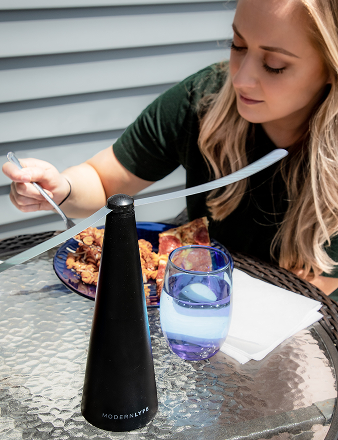
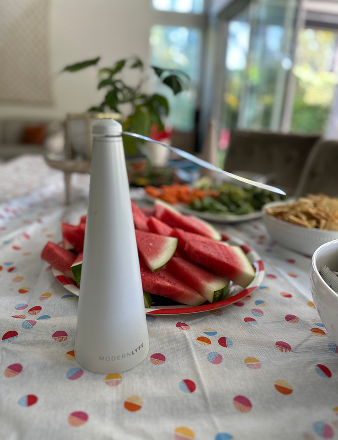
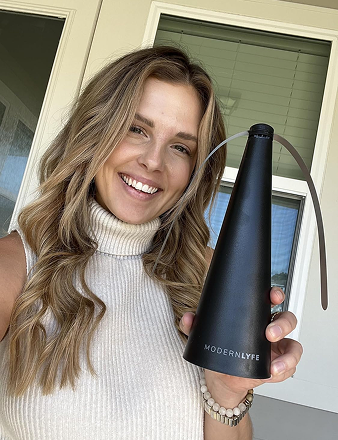
Modern Lyfe's battery-operated, quiet table fans are one option positioned for restaurants, hotels, catering, and home gatherings. Their sleek presentation illustrates a buying consideration, but appearance and brand positioning don't replace checking the selected model's mechanism, instructions, and operating performance.
Ask for specifications you can use
| Buying criterion | What to confirm | Why it matters |
|---|---|---|
| Power source | Rechargeable, replaceable-battery, or plug-in operation | Determines charging logistics and cable needs |
| Runtime | Duration at the intended operating setting | Must suit the complete service window |
| Noise | Decibel information and measurement conditions, if available | Helps assess suitability for conversation |
| Footprint | Base dimensions and required blade clearance | Prevents crowding around dishes |
| Cleanability | Accessible surfaces and approved cleaning method | Makes routine maintenance practical |
| Replacement parts | Propeller or blade availability | Supports repairs after damage |
| Warranty and support | Coverage terms and contact process | Clarifies what happens when equipment fails |
Don't accept a runtime claim without asking which setting and battery condition it assumes. For rechargeable equipment, ask about charging requirements and storage guidance; for replaceable batteries, confirm the specified type. Plug-in models require a suitable power arrangement that doesn't introduce a trip hazard.
Buy for the protected zone
Ask whether the device produces directed airflow or primarily uses rotating visual or physical deterrence. Those mechanisms shouldn't share an evidence claim unless the manufacturer has appropriate testing.
If a listing emphasizes air volume, the discussion of a 100 CFM blower offers related equipment context. Still, a volume specification alone doesn't tell you the local velocity at a platter or whether corners remain unprotected.
Buying test: Choose equipment you can position, verify, clean, and support in your actual service environment.
A useful purchasing decision connects every feature to a job. Small dimensions matter only if there's adequate coverage; quiet operation matters only if the fan still performs at the setting you'll use.
Why One Layer of Defense Is Not Enough
The mistake isn't using a fan. It's treating the purchase as permission to relax the rest of the food-protection program.
The World Health Organization's food-safety assessment reports that its 2015 estimates, using 2010 data, attributed approximately 600 million illnesses, 420,000 deaths, and 33 million healthy life-years lost annually to contaminated food; children under five accounted for about 125,000 deaths, roughly 30% of the total, and a World Bank translation estimated an annual productivity burden near US$95 billion. These figures cover contamination by bacteria, viruses, parasites, toxins, and chemicals, not illnesses attributed solely to flies.
Put the purchase in the right risk category
A fly near a wedding cake is immediately noticeable to guests. Across repeated service occasions, an operator also needs to consider food exposure, pest entry, equipment condition, and how staff respond when controls aren't working. You can't translate the global burden into illnesses prevented by buying a fan.
Instead, treat the fan as a control with a defined purpose and limits. The FDA requirements discussed earlier make the same operational point: the method must control insects without introducing contamination through airflow or insect debris.
- Assign ownership: Identify who prepares, checks, and removes the equipment.
- Define corrective action: Specify what staff should do if insects continue landing or power fails.
- Include verification: Record observations alongside existing service checks rather than relying on the device's presence.
The principles of integrated pest management provide a useful framework for coordinating prevention, monitoring, and corrective action.
A bug repellent fan can become part of a routine where its use is justified and verified. It shouldn't become an automatic standard everywhere because it's convenient. The stronger decision is to use it where it addresses a real exposure problem and retain the other controls the operation requires.
A Practical Setup Checklist for Any Event
Keep a setup card with the fan rather than relying on someone to remember the details during loading. Assign the checks to a named staff member, and make them part of preparing the serving station.
For mobile refreshment planning, resources such as The Matcha Bike's Miami matcha bike events can help organizers explore an event-service format. Whatever vendor or station you choose, discuss exposed ingredients, counter space, power, and responsibility for pest protection before the event.
Before guests arrive
- Prepare power: Fully charge rechargeable units or fit fresh specified batteries. Pack an appropriate backup.
- Inspect cleanliness: Check the grille, blades, base, and controls. Clean according to the manufacturer's directions.
- Secure the position: Place fans across the approach zone, not where they can draw air from dusty surfaces or obstruct guests.
- Protect the remaining routes: Prepare food covers, screened openings where available, waste control, and prompt spill cleanup.
- Separate from heat: Keep fans away from open flames, fryers, and candle heat.
- Verify the arrangement: Use a securely held tissue for direction checks at platter height, keeping it away from food. Remember the test's measurement limitations.
During service and pack-down
- Watch actual results: Check for insect approaches and landings after displays change. Escalate persistent activity rather than increasing fan speed.
- Maintain service access: Keep handles, tongs, plates, and staff pathways clear.
- Record support details: Store warranty registration, model information, and support contacts with the equipment records.
- Prepare for reuse: Switch off, clean as directed, and store the device securely.
A well-chosen, well-placed fan can be a low-friction supplemental tool for outdoor and event service. Its value comes from a repeatable operating routine, not from treating it as a magic boundary.
MODERN LYFE offers battery-operated table fly fans for dining and event setups, with user-friendly controls and customer support. Visit MODERN LYFE to review the available models, then compare their operating instructions and specifications with your buffet layout, power needs, and cleaning routine.