You're staring at a buffet line, a patio bar, or a wedding tent, and the problem isn't subtle. Guests stop reaching for food, start swatting the air, and the whole room gets quieter in the wrong way. That's the core fly problem in hospitality: it's not just an insect issue, it's a service interruption that hits presentation, comfort, and confidence at the same time.
The mistake teams make is treating fly control like a one-product purchase. A spray, a trap, or a fan can help, but effective fly control is a system built around sanitation, exclusion, monitoring, and escalation. The best quick overview I've seen for owners and operators who want the big picture is flies got you bugged, but the field reality is simpler, if breeding sites stay active, adult control will keep falling behind.
The Fly Problem Hospitality Teams Actually Face
A server walks past a patio station with plates in hand, and one fly keeps circling the fruit tray. Another lands on the garnish, the host notices, and now the conversation at the table shifts from the menu to the bug. That's how a nuisance becomes a review problem, because guests don't separate “a few flies” from “the place feels unmanaged.”
The practical failure point is usually not effort, it's structure. Teams clean what they can see, buy a device for the symptom, and hope it carries the rest of the job. That breaks down because fly pressure is tied to source control, entry points, and timing, not just adult insects in the room.
Practical rule: if you're only reacting after flies show up, you're already late. Thresholds, not panic, should drive the response.
A better way to think about the job is layered. Sanitation cuts off breeding. Exclusion keeps flies from landing or entering. Monitoring tells you when pressure is rising. Traps, light devices, air barriers, and targeted biological or chemical measures each have a role, but none of them substitute for the others.
The same logic applies to restaurants, hotels, caterers, outdoor markets, and event tents. A buffet table near a door has a different fly profile than a banquet room with sealed access, and a patio service line behaves differently again. If you want a working program, it has to answer four questions at once: where flies are breeding, where they're entering, what the current pressure looks like, and which layer should escalate next.
Sanitation as Source Control
Sanitation only works when it's treated like a control protocol, not a cleaning slogan. Purdue Extension is direct about the breeding conditions that matter, regular removal of animal and pet wastes, garbage, and decaying plant and animal matter is part of prevention, and garbage cans need tight-fitting lids and regular emptying and cleaning so they don't become breeding sites. Texas A&M AgriLife adds the indoor details that often get missed in commercial kitchens, drains, condensate trays, and residue under liners all need attention because they hold the moisture and organic debris flies need to reproduce.

Daily actions that actually matter
The goal is to remove food residue before it turns into a fly resource. That means wiping spills during service, clearing dropped fruit, meat, syrup, or garnish from prep and buffet edges, and emptying trash before bins become warm, wet, organic reservoirs. In practice, visible neatness is not enough, because a clean-looking station can still have residue under liners, behind coolers, or inside drain grates.
Use a daily checklist for the places flies exploit fastest:
- Garbage and waste: empty liners, tie bags tightly, and keep lids closed.
- Floor and prep debris: sweep crumbs, sticky drink spills, and dropped produce at once.
- Drain surfaces: inspect visible buildup around sink and floor drains.
- Outdoor service areas: clear used napkins, fruit rinds, and container lids from tables and cart stations.
The University of Minnesota's guidance on tying bags tightly, cleaning cans regularly, and placing them away from the home fits the same operational logic in commercial settings, distance and containment reduce attraction. For a cleaner workflow reference, keep your team aligned with food service hygiene standards so sanitation doesn't drift into guesswork.
Weekly attention that stops repeat infestations
Weekly cleaning needs to go deeper than surface wipe-downs. Floor drains, sink drains, under-rim areas, refrigerator condensate trays, and icemaker condensate lines deserve inspection because those are the hidden places where organic buildup and moisture persist. If a venue has recurring flies even when dining areas look clean, start with the drains and waste rotation before you blame the room.
Garbage timing matters too. Guidance in commercial fly control notes that garbage left more than one week can produce adult blow flies, which is why missed bin rotation is never a small miss. That's not a decorative detail, it's a production problem, because one missed cycle can reset the whole battle.
How Air-Based Exclusion Actually Works
Air doesn't kill flies, it makes the space hard to enter and hard to land in. That distinction matters, because too many operators buy a fan and expect elimination, when the job is exclusion at the edge of the service zone. The best benchmark in the literature is blunt, 8 to 9.1 m/s at about 91 cm above the ground can provide 80% exclusion of house flies, and vertical air curtains on both sides of a 91-cm-wide doorway have been reported to block 98% to 100% of house-fly entry even at mean air velocities as low as 4 m/s. Those numbers come from physical delivery at the opening, not from the box label.

The practical takeaway is simple. You have to intersect the fly's flight path, not just blow air somewhere nearby. A doorway with gaps, poor alignment, or uneven coverage is a weak doorway, even if the fan sounds powerful.
For a helpful adjacent read on what good openings and screening do for porch and entry comfort, professional window cleaning improves porch views is relevant because it reinforces a point operators often miss, clear openings and well-maintained barriers are part of comfort management, not just aesthetics. The same thinking appears in do fly fans work, where airflow is framed as an exclusion tool rather than a cure-all.
What airflow does and does not do
Airflow makes landing difficult, disrupts hover behavior, and helps protect the exact areas where guests stand, serve, or pass through. It doesn't replace sanitation, and it doesn't address breeding sites. That's why the best use case is entry points and service seams, where keeping flies out matters more than chasing them after they've entered.
A couple of common mistakes keep showing up in venues:
Operational mistake: measuring fan speed at the device and assuming that equals protection at the door. It doesn't.
Delivered air velocity across the full opening is what matters. So is continuity, because a strong center stream with weak edges still leaves a lane for entry.
Placing Fly Fans Where They Earn Their Keep
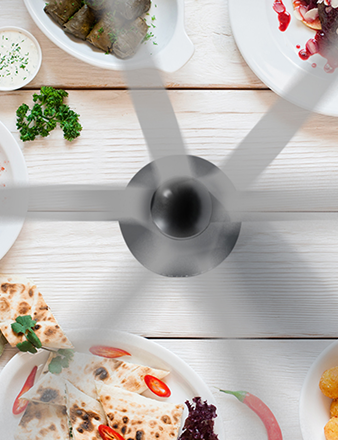
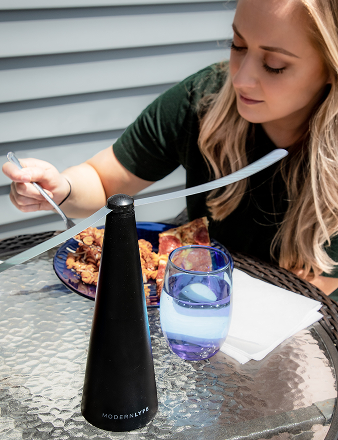
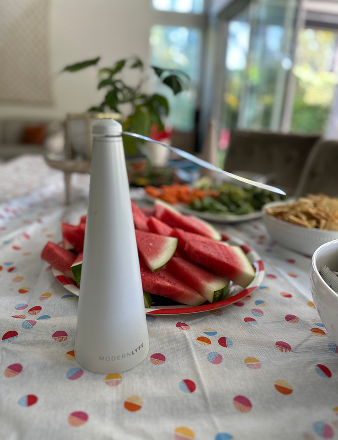
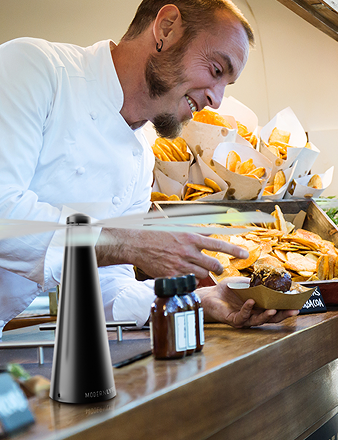
A fly fan works when it sits where fly pressure meets guest flow. That usually means a doorway, a buffet edge, a serving line, a bar pass-through, or a patio table cluster where food stays exposed long enough for flies to investigate. In those spots, the fan isn't trying to eliminate every insect in the venue, it's trying to keep them from settling on food and interrupting service.

A battery-operated, quiet unit makes sense in spaces where cords, noise, or appearance would get a harsher reaction than the flies themselves. Modern Lyfe's Fly Fan fits that kind of use case, especially for tables, buffet lines, pass-through windows, and patio service areas where a chemical-free barrier is preferable to visible spray or bulky equipment. That said, it still has to be placed correctly, because a sleek device in the wrong spot is just décor.
Placement rules that hold up in the field
Set the airflow so it crosses the access point, not the wall beside it. For a doorway, coverage has to match the whole opening, since a gap at the edge turns into a fly lane. For buffets, the fan should protect the approach side where guests hover and servers plate, not just the middle of the table where air looks strong.
A quick field checklist helps:
- Match height to the target zone: place the unit so the airflow intersects the area where flies would land.
- Cover the full opening: don't leave side gaps, especially at swinging doors or serving cutouts.
- Use it at flow points: entry doors, buffet ends, bar windows, and patio transitions matter more than unused corners.
- Treat it as exclusion, not cleanup: if flies are already established inside, the fan only reduces the pressure at the edge.
The video below is useful if your team needs a quick visual on how operators think about placement and service flow.
The common mistake is overestimating a fan's reach from a single point measurement. Another is placing the unit where it never intersects the approach path, which means the device looks active while the flies still land where guests can see them.
Stacking the IPM Layers for Real Venues
Integrated fly management works because each layer handles a different failure point. The World Health Organization's review of seven studies found a median 40% reduction in diarrhoea morbidity from fly control measures, with results ranging from 0% to 67%, which is a clean reminder that implementation quality and context decide whether control pays off or stalls out. A layered system also outperforms single tactics in field settings, one evaluation reported infestation at 0.32% to 0.49% with a combined management treatment, compared with 0.65% for pheromone traps and 0.94% for protein bait alone.
| IPM Layers and When to Escalate | |||
|---|---|---|---|
| Layer | Primary Function | Best Use Site | Escalation Signal |
| Sanitation | Remove breeding resources | Kitchens, waste areas, drains, prep zones | Recurrent flies despite visible cleaning |
| Exclusion | Block landing and entry | Doors, windows, pass-throughs, patios | Flies congregate at entrances or buffet edges |
| Traps and light traps | Reduce adult pressure | Back-of-house and peripheral zones | Adults remain active after sanitation and exclusion |
| Biological control | Target larvae where breeding persists | Calf areas, animal pens, persistent breeding sites | Open breeding source can't be fully removed |
| Targeted chemical control | Narrow, justified knockdown | Highly managed settings with persistent pressure | All other layers are active, but counts stay high |
Biological control has a real place when breeding sites stay active. A 2001 field demonstration on four organic dairy farms in central Maine found that releasing beneficial parasitic wasps produced a statistically significant level of fly control in 3 of 5 release barns compared with an untreated barn, and the strongest results came in calf hutches, where weekly fly control exceeded 80% from late July through August. The same study showed much weaker results in open barns with free-stalls or pens, which is why habitat matters so much.
Open housing changes the odds. A method that works in a confined calf area can underperform in a broad barn with more airflow and more surface area.
That is the same logic hospitality teams face. The tighter the flow point, the better the control layer performs. The more open the environment, the more important it becomes to stack sanitation, exclusion, and monitoring before reaching for the next intervention.
Monitoring, Maintenance, and Troubleshooting
A fly program fails when nobody measures it. The U.S. Department of Defense pest management handbook emphasizes surveillance, sustained monitoring, and action once thresholds are exceeded, which is the right mindset for restaurants, hotels, caterers, and outdoor venues. For sampling cadence, research on monitoring methods shows that activity estimates were tied to fly density when sampling periods were at least 24 hours for fly ribbons, at least 2 days for baited jug traps, or 7 days for spot cards, so rushed checks don't tell you much.

What to check and when
Fly fans and air curtains need physical verification, not just a glance. Confirm that airflow still crosses the doorway or serving line, check for blocked vents or shifted placement, and make sure door sweeps and closures still line up with the intended barrier. Traps should be moved if they're pulling flies toward guests instead of away from them, and sanitation supplies need to stay on schedule because missed trash rotation is one of the fastest ways to restart the cycle.
Use the next checklist as a same-day handoff for your team:
- Sample consistently: keep the same trap type and same cadence so trends are visible.
- Log changes: note when counts rise, when bins were rotated, and when drains were cleaned.
- Inspect access points: doors propped open, missing sweeps, and skipped closures are common failure points.
- Reset the source: if counts jump, check garbage, drains, condensate trays, and outdoor spill areas first.
If the problem still doesn't move, go back to placement before escalating the tool. The troubleshooting guides resource is useful if your operation wants a structured way to separate placement errors from sanitation misses and from true pressure spikes. The pattern is usually obvious once someone looks at the right layer.
Troubleshooting rule: when fly counts rise, assume a source or access failure until proven otherwise.
That mindset keeps teams from overreacting with the wrong fix. It also keeps the program honest, because the goal isn't to own more fly devices, it's to keep guests from noticing flies at all.
If you want a fly-control setup that fits real hospitality flow, not just a product photo, visit MODERN LYFE and see how their quiet, battery-operated fly fans can fit into buffet lines, patios, and event service points as one layer inside a broader control program. For operators planning seasonal service, that's the right way to buy, place, and maintain the tool so it supports the guest experience.