Most advice about an outdoor fan for mosquito control gets the mechanism backward. Fans don't create a magic wall that mosquitoes can't cross, they work by scrambling the odor plume that leads mosquitoes to people in the first place. If you're hosting dinner on a patio, running a buffet line at a wedding, or trying to make a backyard barbecue less miserable at dusk, that distinction matters.
Mosquito control around dining and event spaces also sits inside a much bigger public-health picture. The CDC reports that malaria caused nearly 249 million cases and about 608,000 deaths across 85 countries in 2022, with the African region carrying roughly 94% of cases and 95% of deaths, and about 80% of malaria deaths in Africa occurring in children under five. The CDC also says about 4 billion people live in areas at risk of dengue. Those numbers are why airflow is worth understanding, but also why airflow is only one layer of protection, not a replacement for repellents, screens, or source reduction. CDC malaria burden summary
Why Mosquitoes Find Your Patio in the First Place
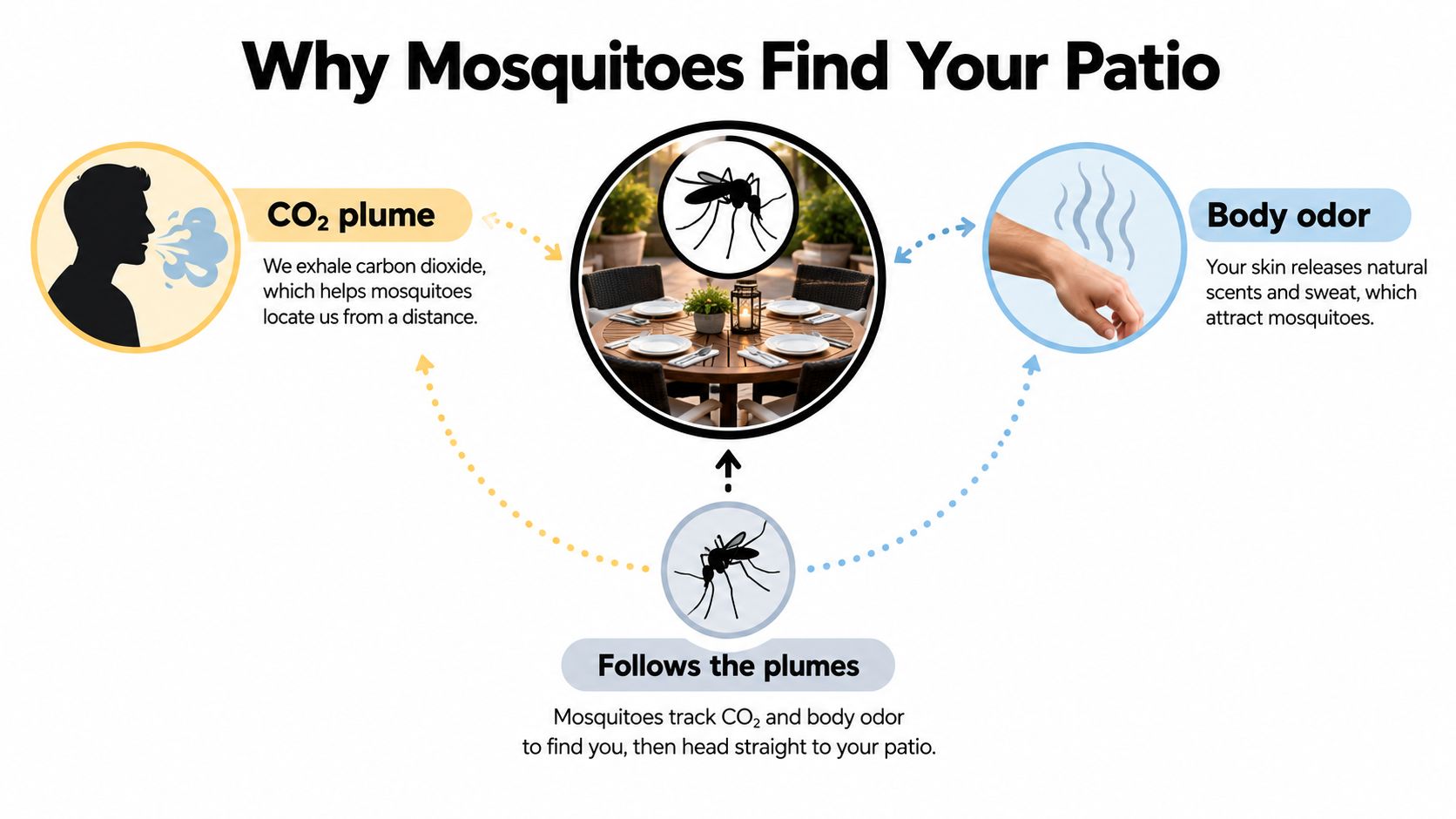
A patio usually turns into a mosquito magnet for the same reason a buffet line can. Someone opens a door, warm air moves, people exhale, and a thin trail of carbon dioxide and body odor drifts away from the table. Mosquitoes aren't looking for your chair or your plate, they're tracking that invisible trail.
A useful way to think about it is that mosquitoes are following a scent map, not a visual target. In a Central Michigan wetland study, tripling the carbon-dioxide release rate consistently doubled mosquito captures, which shows how strongly attraction depends on odor plumes. That doesn't mean more food or more lighting “causes” more mosquitoes, but it does explain why a crowded dining zone feels like a bigger target than an empty deck.
Practical rule: if the air around your guests is still, the odor trail stays coherent longer.
That's why outdoor airflow can help even before you get into fan models or speeds. It's not about trying to blast insects away from the yard. It's about making it harder for them to lock onto the human signal drifting downwind.
For hospitality operators, that framing is useful because it points to the exact places where airflow matters most, seated guests, buffet stations, reception clusters, and service corners. For homeowners, it explains why mosquitoes often seem worse around the table than near the fence. If you also care about patio layout and sheltered seating ideas, covered patio and sunroom inspiration can help you think about where airflow and seating work together instead of fighting each other.
How Fan Airflow Actually Disrupts Mosquitoes
A fan doesn't need to overpower a mosquito's flight to matter. It mainly works by diluting and scattering the carbon-dioxide and body-odor plume the insect uses to orient itself. Once that signal loses shape, the mosquito has a harder time deciding where to fly next.
What the wetland study actually showed
In a peer-reviewed 2003 field study in the Journal of Medical Entomology, researchers tested electric fans in a Central Michigan wetland with abundant mosquitoes. Across air velocities from 0 to 3.7 meters per second and roughly 0 to 8.3 miles per hour, mosquito captures in carbon-dioxide-baited traps fell in a negative logarithmic relationship as wind increased. The researchers linked the reduction mainly to dilution of human-like odor cues, not to wind knocking mosquitoes out of the air. Fan airflow and mosquito captures in the wetland study
That detail matters because it changes how you place the fan. A fan aimed across the occupied zone can break up the scent trail. A fan pointed into empty space may feel pleasant and still do little for mosquito control.
Fans are most useful when they move air through the guest area, not just near it.
The same study also found that tripling carbon-dioxide release doubled captures, which reinforces the odor-plume idea. For restaurant patios and outdoor receptions, the job is to keep that plume from staying intact long enough for mosquitoes to home in on the table. That is why a directed crossflow usually makes more sense than a single stream aimed at chair legs or the tabletop.
Placing the Fan So the Air Reaches Guests
Placement is where a mosquito setup usually succeeds or fails. The goal is to move air across the occupied zone, because that is where the odor plume from people collects and gives mosquitoes a path to follow. Aim the airflow across the occupied zone at guest height instead of down at the tabletop.
A good starting point for many patios is roughly 0.5 to 2 meters from the seating area, then adjusted until you feel steady movement where people sit. A commercially available 51-cm floor fan was enough to create biologically relevant wind in the airflow study cited earlier, so the equipment does not need to look specialized to matter. It does need to reach the guests.
A patio table with a fan aimed at the umbrella pole may feel cooler and still leave the scent trail intact. A fan set to move air across faces, shoulders, and the open space above the table does more useful work.
A simple placement checklist
- Aim across the zone: Send air through the seating area, not at the tabletop.
- Check for blockers: Umbrellas, booth backs, privacy screens, and walls can cut airflow quickly.
- Use crossflow when needed: On larger patios, two fans from different sides can keep air moving through the seating area instead of letting it stall.
- Keep the setup comfortable: Use the lowest setting that still creates consistent movement without scattering napkins or making candles hard to keep lit.
The trade-off is straightforward. You want enough air to disrupt the odor plume, but not so much that you disturb the setting or make guests uncomfortable. A light, steady crossflow usually works better than a harsh blast.
If you are testing different outdoor configurations or comparing how they hold up in daily use, this real-world performance guide is a useful reference for thinking about what happens when equipment moves from a product page to an actual seating area.
Judge the setup at the chairs, not at the fan housing. If the air is moving at guest level, you are in the right place.
Reading the Numbers Without Overpromising
The numbers help, but only if you treat them as context, not a promise. One Journal of the American Mosquito Control Association study found that mosquito trap catches fell by about 50% at 0.5 m/s and 71% at 1.0 m/s, with no minimum threshold below which wind had no effect. Wind speed and mosquito trap catches
That does not mean every fan needs to hit those exact speeds at the chair. It means even light airflow can matter, and a little more movement can matter more, depending on the setting. A separate peer-reviewed synthesis reports that some mosquito host-seeking flights drop sharply at wind speeds as low as 0.8 m/s, while other observations found no reduction at 3 to 8 m/s. Typical mosquito flight speed is about 1 m/s. Species and context change the outcome.
What operators should measure
Ask what airspeed reaches the people eating here, because furniture, umbrellas, walls, and distance all change the result. A fan that looks strong near the housing may leave a dead pocket at the table edge, while a lower setting placed well can move air where guests sit.
Use the lowest setting that creates consistent crossflow at the chair, not the setting that sounds strongest from across the patio.
A PLOS Computational Biology review also notes that airflow effects can vary by species, and separate behavioral work found strong responses in Aedes mosquitoes at 5 m/s. Taken together, there is no universal mosquito-proof fan speed. Start with the air guests feel at the table, then adjust from there.
A patio service line makes the trade-off clear. If air barely reaches the back booth, mosquitoes still track the odor plume. If the fan is aimed too hard, napkins move and guests notice the draft before they notice fewer bites. Measured airflow at the chair beats a guess based on fan size or a marketing label.
For a technical look at how fan specs do and do not translate into real conditions, the real-world performance guide gives useful context for field testing.
Where Fans Fit Among Other Mosquito Methods
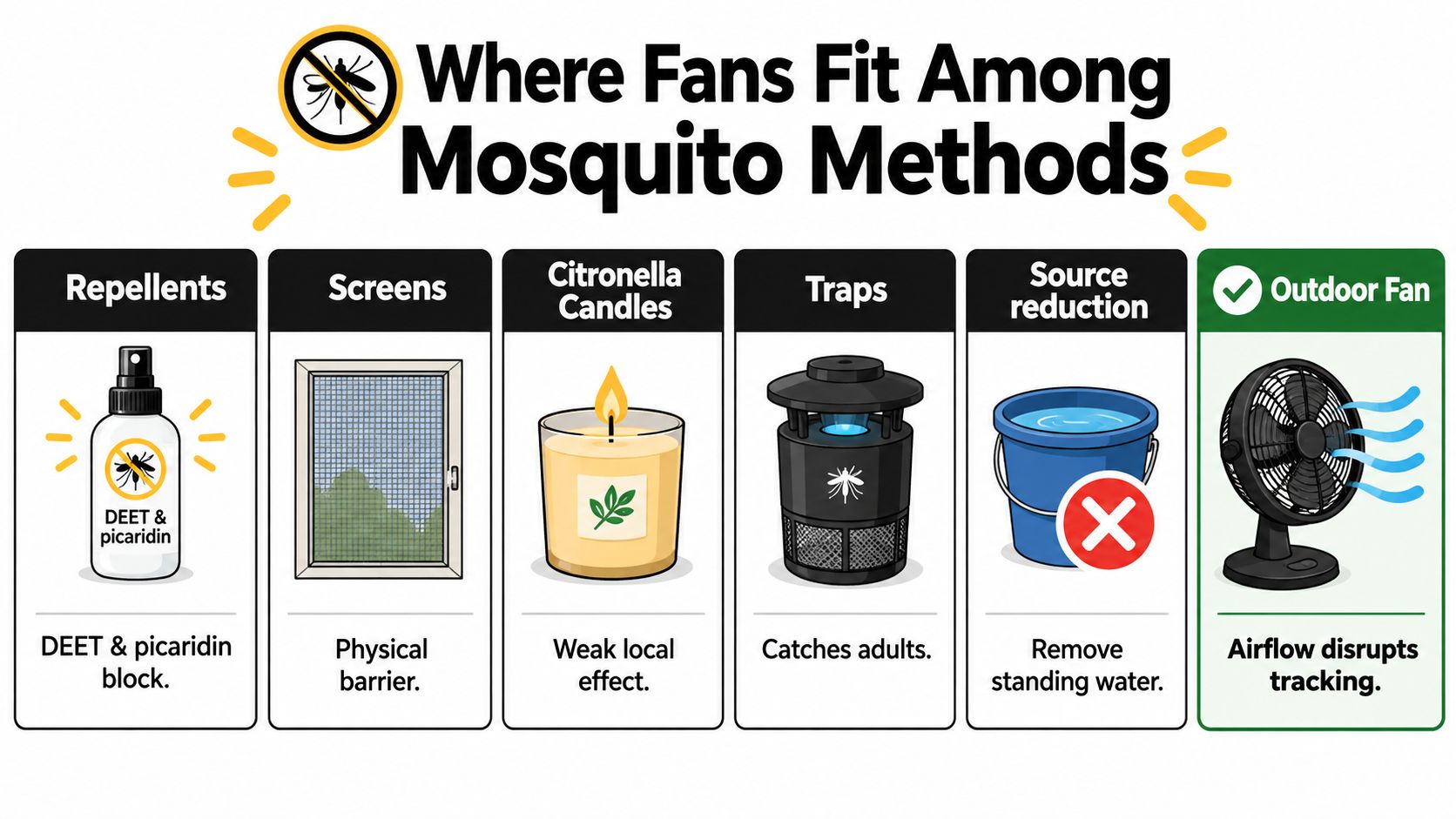
An outdoor fan belongs in a layered mosquito plan, but its job is narrower than many buyers expect. It helps most in a defined occupied zone, like a patio table, buffet line, or reception seating area, where the air around people can be kept moving. It helps less when the issue is a larger property-wide mosquito load or a nearby breeding site that keeps replenishing the area.
Repellents, screens, and source reduction still do the heavy lifting. DEET and picaridin protect the person. Screens block entry. Standing-water removal cuts breeding. Fans work differently, they interfere with the odor plume and make it harder for mosquitoes to keep tracking people while they are in the space.
A Central Michigan wetland study found that combined airflow and vapor-phase DEET reduced mosquito orientation by 74%, landing by 75%, and probing by 70% at a measured airflow of 1.6 m downwind. Combined airflow and DEET study That does not mean a fan alone will produce the same result, but it does show why airflow can make repellents work better in the occupied zone.
The comparison gets clearer when you line up the common tools:
- Repellents: Good for personal protection when guests are moving around.
- Screens: Better for enclosed or semi-enclosed spaces.
- Citronella candles: Limited local effect, useful more for atmosphere than serious control. For a reference point on the product type, Vitamin Planet's citronella oil listing shows how citronella is commonly sold for outdoor use.
- Traps: Useful on some properties, but they target adults and do not replace guest-level protection.
- Source reduction: The foundation, because fans do not stop mosquitoes from breeding.
For a buffet line that needs to stay usable after sunset, airflow can be a visible part of the solution. For a property-wide mosquito problem, it is only one layer. A good setup uses source reduction first, then screens and repellents, then airflow to protect the occupied zone. The mosquito and fly control guide gives a useful comparison of how these methods fit together.
Real-World Setups for Restaurants, Events, and Homes
A restaurant patio at dusk calls for airflow that crosses the guest area and carries out toward the open edge of the space. That matters because mosquitoes home in on the scent plume from people, food, and warm surfaces, and a fan works best when it breaks that trail where guests are seated. Keep lighting and seating calm, because people linger longer when the area feels organized and easy to use.
At a wedding reception buffet line, the fan should run along the queue direction so the plume never settles over the serving line. Place it near the food path, but not so close that it lifts napkins or place cards. For venue layouts that translate well to receptions, see this outdoor event setup guide. Battery-operated fans can fit where cords would clutter a clean layout or create a trip hazard.
A backyard barbecue near landscaping needs a different angle again. Aim the fan at the spot where guests gather, often a seating cluster away from the grill, and check for shrubs, planters, or hidden water sources nearby. Air movement can make that corner more comfortable, but it does not change what is breeding in the yard. A repellent station near the entrance to the seating area can still help guests who want another layer.
One practical rule holds across all three settings. Match the airflow to the path people use, not just to the place where equipment is easiest to set.
I would treat the fan as a comfort tool, not the whole answer. Used with timing, guest placement, and basic mosquito source control, it can support a patio, a buffet, or a backyard gathering without promising more than airflow can do.
Common Mistakes That Defeat the Strategy
The most common mistake is pointing the fan straight at the table surface. That feels active, but it misses the target, the air guests are breathing. Fix it by angling the fan so the airflow crosses faces and shoulders at seating height.
Another mistake is placing the fan too far away. By the time air reaches the table, it may already be too diffuse to break up the odor plume. Move it closer, then test whether you can feel steady movement where people sit.
People also assume a stronger motor always means better mosquito control. It doesn't. If the airflow misses the occupied zone, more power just makes more noise.
And no fan fixes standing water, dense vegetation, or nearby breeding sites. Those conditions keep replenishing mosquitoes no matter how pleasant the patio feels in the moment. Fans also don't replace repellents or screens, and they can't handle a heavy infestation zone on their own.
Your Outdoor Fan Playbook and When to Go Deeper
Start by aiming airflow across the guest area, not at the table itself. Check the seating zone, because that is where mosquitoes and people meet. In outdoor dining, the fan is doing more than making air feel cooler. It helps break up the odor plume that guides mosquitoes toward a target.
Use the fan with repellents, screens, and standing-water removal. A fan can make a patio or buffet line harder for mosquitoes to read, but it does not fix breeding sites or heavy local pressure.
If bites continue after a careful setup, the issue may be nearby habitat, a dense mosquito source, or a layout that needs professional review. That is where restaurants, hotels, and event teams need to think about guest comfort and liability together. An outdoor fan helps most when you treat it as an odor-plume disruptor and pair it with source reduction, screens, and repellents.