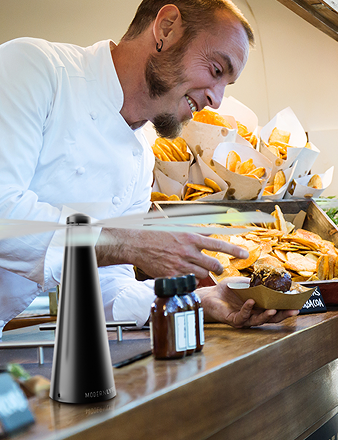
A patio can look perfect on paper and still fail in service. The umbrellas are up, the menu is tight, the buffet is dressed, and then the flies show up. Guests stop relaxing. Staff start swatting. Food that looked inviting five minutes ago suddenly looks exposed.
That's the gap between a product spec and real world performance.
When operators buy fly fans, many start with the wrong question. They compare motor claims, battery claims, or whatever sounds strongest in a listing. The better question is simpler: does this setup keep insects off the guest experience in your actual space, during actual service, without creating new problems like noise, clutter, or awkward table layouts?
Beyond the Buzz The True Cost of Pests
An outdoor dinner only needs one weak point to feel poorly run. Often it isn't the food. It's the moment guests start waving flies away from drinks, appetizers, or shared plates.
That moment changes how people judge the whole operation. Cleanliness feels questionable, even when the kitchen is spotless. Attention to detail feels weaker, even when the service team is doing everything right. A small pest issue becomes a credibility issue fast.

A 2025 hospitality survey found that 75% of diners are less likely to return to a restaurant after experiencing pest issues, with flies being the most commonly cited annoyance (hospitality pest survey findings). You don't need a bigger warning than that. A fly problem doesn't stay a fly problem. It becomes a repeat-business problem.
What operators usually miss
Many teams treat insect control as a background maintenance issue. For front-of-house service, that's too narrow. Guests don't separate pest activity into categories like sanitation, facilities, or ambiance. They experience it all at once.
The practical costs usually show up in three places:
- Guest comfort drops: People eat faster, cover plates, and stop lingering.
- Food presentation suffers: Buffets, bar garnishes, desserts, and shared platters lose appeal.
- Staff attention gets diverted: Servers and event teams end up managing annoyance instead of hospitality.
If your operation also has back-of-house or storage exposure, it helps to learn about warehouse pest control because the front-of-house problem often connects to broader site conditions, receiving areas, waste handling, and door management.
Why outcomes matter more than promises
Operators get buried in product language. Quiet. Powerful. Premium. Commercial grade. None of those words tell you what happens at table seven during a windy lunch rush.
Practical rule: Judge insect control by guest outcomes, not by adjectives on a box.
That's why real world performance matters. The goal isn't to own a fan with impressive claims. The goal is to protect food, preserve comfort, and keep the setting feeling clean and intentional.
For teams comparing options, this matters even more at the budget level. A lower-cost setup can still work if it's deployed correctly and tested in the right spot. This overview of affordable pest control approaches is useful because it pushes the same operational question operators should ask everywhere: what actually works in the environment you have?
What Real World Performance Means for Fly Fans
A race car is faster than a delivery van. That doesn't make it better for moving banquet supplies across town. Performance depends on the job.
Fly fans are the same. The “best” unit on a spec sheet may be the wrong choice for a quiet tasting patio, a wedding buffet, or a crowded brunch table where guests don't want a strong draft in their face.

The spec sheet trap
Many buyers assume more sophistication means better results. That's not always how practical performance works. In medical simulation research, low-fidelity and high-fidelity simulators produced no significant difference in some learning outcomes, which is a useful reminder that measurable results matter more than perceived sophistication (medical simulation findings).
That lesson transfers well to fly fans. A premium-looking unit with extra features doesn't automatically create better guest conditions. If it's too noisy, poorly placed, awkward on a table, or weak where it counts, those extra features don't rescue it.
A better definition of performance
For hospitality use, real world performance means a fan does four things well at the same time:
- It disrupts pest activity where food and guests are
- It fits the layout without cluttering service
- It runs consistently through the service window
- It doesn't create a new annoyance
This is why a small table fan can outperform a bigger, supposedly stronger option. If the smaller unit protects the plate zone, stays quiet, and blends into the setup, it's more effective where it counts.
The right fan is the one that solves the problem in the conditions you actually run, not the conditions used to market it.
What to stop prioritizing
Stop treating isolated claims as proof of success. On their own, these details don't tell you enough:
- Maximum speed claims: High output can still miss the exposed food zone.
- Big battery claims: Long runtime doesn't help if performance fades too much before service ends.
- Feature count: More settings often add complexity without improving protection.
A useful evaluation starts with the scene itself. Bistro tables behave differently than buffet lines. Host stands behave differently than patio rails. A fan that works on a still evening may struggle near an open corner with cross-breeze.
That's why the rest of the buying process should focus less on “what does the product say” and more on “what happens when it's deployed.”
The Five Key Metrics of Fan Performance
If you want a practical buying checklist, use five metrics. They're simple, observable, and they keep the conversation anchored in outcomes.
Airflow velocity
Airflow volume sounds impressive, but velocity at the protected edge matters more. Research on air curtains found that an air velocity of at least 1.5 m/s or 300 ft/min is required at the outer edge of the protected zone to effectively stop most flying insects (air curtain insect study).
That doesn't mean every table fan should be judged like an air curtain. It does give you a clear principle. Protection fails at the edges first. If the air movement is weak where flies approach the food zone, the setup won't hold.
Noise in context
A fan can be “quiet” in a warehouse and annoying at a candlelit table. What matters is how the sound feels in your service environment.
Listen for tonal problems, not just loudness. A soft low hum is easier for guests to ignore than a thin mechanical whine. In hospitality, sound character matters almost as much as sound level.
Effective coverage area
Coverage should be treated as a real shape, not a marketing circle. Most fans protect unevenly because airflow is directional and surrounding objects interrupt it. Plates, floral pieces, menu holders, ice buckets, and condiment caddies all create blind spots.
That's one reason operators also look at broader airflow strategy in other parts of a property. This guide on how facilities reduce heating costs with fans is about a different use case, but the lesson carries over well: fan performance depends on how air moves through an occupied space, not just on the hardware label.
Run-time consistency
A fresh charge at setup time isn't the same as stable output through service. Watch whether the fan still feels useful late in the shift, not just during the first part of operation.
A fan that fades too quickly often creates a false sense of protection. Staff assume the area is covered because the unit is still on, while actual deterrence has already weakened.
Pest reduction efficacy
This is the deciding metric. Does the fan reduce insect activity around food and guests in a noticeable, repeatable way?
Everything else is support. If a fan is elegant, quiet, and long-running but doesn't lower fly pressure where it matters, it isn't performing.
Fly Fan Performance Metrics At-a-Glance
| Metric | What It Measures | Why It Matters | Ideal Target |
|---|---|---|---|
| Airflow velocity | Strength of moving air at the exposed edge of the protected zone | Flies exploit weak edges first | Enough edge strength to disrupt approach paths |
| Noise level | Audible impact during service | Guests notice irritating sound quickly | Low and unobtrusive in the actual venue |
| Effective coverage area | Real protective footprint around food and guests | Marketing claims often overstate usable area | Stable protection over the specific table or station |
| Run-time consistency | Whether useful performance holds through service | A fan that weakens too much becomes decorative | Steady output for the full operating window |
| Pest reduction efficacy | Observable decrease in fly activity | This is the only outcome that counts | Clear reduction under normal conditions |
If you're comparing airflow claims and want a baseline on how airflow ratings are described, this primer on 100 CFM blower specifications helps separate directional airflow from raw output language.
How to Field Test a Fly Fan in Your Venue
The fastest way to cut through marketing is to test a fan where you'll use it. You don't need specialized equipment. You need a repeatable method, a little discipline, and notes that staff can compare.
Start with a single table, buffet section, or host stand where flies are a real annoyance. Test during a time window that reflects actual operating conditions, not an empty off-hour with no food present.

Test one with visible airflow
Use a safe visual marker such as incense smoke to see what the fan is really doing. The point isn't theatrics. The point is finding dead zones, drift, and overshoot.
Place the fan where you think it should go, then observe the smoke path around plate height and just beyond the table edge.
- Watch the edges: That's where weak protection usually shows up first.
- Check interruptions: Centerpieces, menus, bottles, and risers can split airflow.
- Notice spillover: If the stream blows too far past the target area, you may be wasting output.
A short technical reference like how to read technical specifications can help your team connect what they observe on site with the language vendors use.
Here's a practical visual demo worth watching before you run your own test:
Test two with your phone and your ears
Use a smartphone decibel app, but don't stop there. Meter readings help, yet guest perception matters more than a single number.
Run the fan in a quiet room and then again during live service. Staff should stand in normal guest positions and answer a simple question: would this sound feel noticeable over a full meal?
If guests notice the fan before they notice the food, the setup needs work.
Test three with a simple bait comparison
Set two comparable stations. One gets the fan. One does not. Use the same food attractor, the same timing, and the same placement style.
Keep notes on:
- Observed fly approaches
- Landings near or on the bait
- Staff interventions needed
- Whether guest-facing areas stayed comfortable
Run the comparison more than once if conditions change a lot between lunch and evening. Wind, heat, shade, nearby waste points, and foot traffic all affect outcomes.
A field test doesn't need to look scientific to be useful. It just needs to be fair, repeatable, and tied to the service conditions that count.
Strategic Deployment for Maximum Effect
Bad placement ruins good equipment. I've seen operators blame a fan when positioning was the problem. One fan dropped in the middle of a problem area rarely fixes anything on its own.
Real world performance is often a deployment issue. Audio-engineering research makes this point clearly: optimal coverage depends on geometry and distance, and choosing a speaker's nominal coverage angle isn't enough (audio coverage research). Airflow behaves differently than sound, but the planning lesson is the same. You have to match the device to the shape of the space.

Think in zones, not units
A fan should be part of a protective pattern. The useful question isn't “where do I put this fan?” It's “where is the exposed zone, and how do I keep air moving across it consistently?”
For common hospitality layouts, that usually means this:
- Two-person bistro table: Aim airflow across the food zone, not directly into faces or glassware.
- Long buffet line: Use multiple points of protection along the approach path, especially near open platters and garnish stations.
- Large round event table: Treat the table as several mini exposure points instead of one circular area.
Common placement mistakes
Most failures come from predictable errors:
- Central placement with no edge control: Air moves in the wrong place while flies approach from outside the protected zone.
- Fan blocked by decor: Flowers, signage, and serving pieces interrupt the working path.
- Ignoring ambient breeze: Even a light cross-current can distort table-level airflow.
A fan doesn't protect the area around it. It protects the area its airflow actually reaches.
What better deployment looks like
Good deployment creates overlap where exposure is highest. On a buffet, that might mean protecting the food line and the plate pickup area separately. On a patio table, it might mean angling the fan to cover the side guests can't see but flies use to approach.
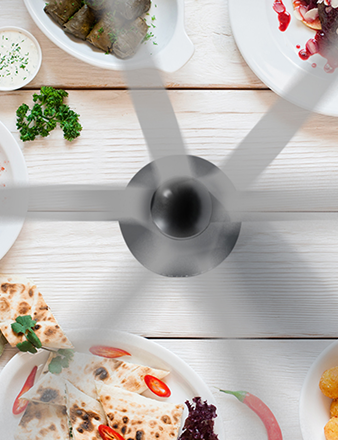
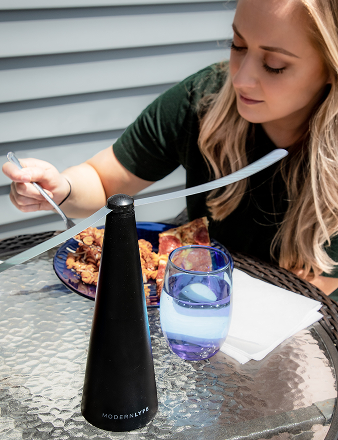
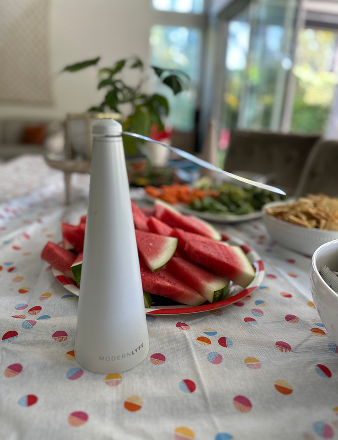
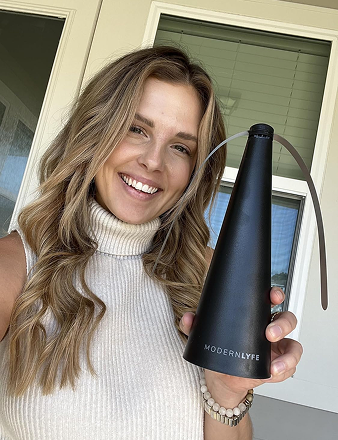
This is also where a product like MODERN LYFE fits logically for table and event use. It's a battery-operated fly fan format intended for dining surfaces and buffet setups, which makes it suitable for testing in the exact scenarios where placement and visual footprint matter. Whether you use that option or another one, the same rule applies: placement decides whether the hardware performs.
When teams get this right, they stop chasing “more power” and start building cleaner coverage. That shift usually improves results faster than swapping products.
Protecting Your Investment Through Proper Care
A fan that worked well in May can feel weak by August for simple reasons. Dust builds on blades. Food residue collects after events. Batteries get stored poorly. None of that shows up on the product page, but all of it affects daily reliability.
Care that actually preserves performance
Use a short maintenance routine and make it someone's job.
- Clean blades regularly: Wipe them gently so grease and dust don't change airflow or create imbalance.
- Check the intake and housing: Fine debris often gathers where staff don't look first.
- Store units dry and protected: Off-season damage usually starts with heat, moisture, or rough stacking.
Teams that already manage guest-room equipment know the value of simple upkeep. This guide to step-by-step PTAC maintenance is about another type of equipment, but it reinforces the same operational habit: small, consistent care prevents avoidable performance loss.
Battery habits that help
Modern Li-ion batteries in premium fly fans typically maintain over 80% of original capacity after 500 full charge-discharge cycles (Li-ion battery capacity guidance). In practical terms, that means a well-managed battery setup can deliver dependable runtime across several seasons of frequent use.
That doesn't mean every battery problem is a battery defect. Weak performance is often tied to charging routines, heat exposure, or long storage with no check-in.
Quick troubleshooting
If a fan seems worse than it used to be, start with the basics before replacing it.
- Weaker airflow: Clean the blades and confirm nothing is obstructing movement.
- New noise: Look for blade contamination, loosened parts, or damage from storage.
- Shorter runtime: Test after a full proper charge, then compare against another unit if you have one.
Maintenance isn't separate from performance. In hospitality equipment, maintenance is performance.
Frequently Asked Questions About Fly Fans
Do fly fans work on mosquitoes and bees, or mostly on flies
They're most useful against the insects that regularly interfere with food service at close range, especially flies. Results with other insects depend on behavior, approach pattern, and surrounding conditions. That's why operators should test around their own tables, bars, or buffet setups instead of assuming one device handles every pest the same way.
Is one large powerful fan better than several smaller table fans
Usually not in guest-facing dining environments. Several smaller units often give you better control because you can protect the exposed zones directly. A single larger fan may create uneven coverage, push air where you don't want it, or disrupt comfort.
Are soft blades safe around children and pets
Soft-blade table fly fans are designed for close-proximity use, which is why they're common on dining tables and serving stations. Even so, staff should place them intentionally, keep cords and chargers managed, and avoid casual placement where a child can repeatedly grab at the unit during service.
Should I use them indoors too
Yes, if the insect pressure is near doors, buffet stations, dessert displays, or service windows. Indoor use can work well, especially where the goal is local protection rather than whole-room air movement.
How do I know if a fan is actually working
Don't judge by whether it's spinning. Judge by whether fly activity around food and guests drops in the exact spot you're protecting. That's the only performance test that matters.
If you're choosing fly fans for a restaurant, event venue, patio, or home entertaining setup, start with placement and field testing, not hype. MODERN LYFE offers fly fan options built for dining and event use, and it's a practical place to compare formats that can be tested directly in your real service environment.