The advice you'll hear most about patio accessories is to start with a look. Build a mood board, buy the striped umbrella, layer the cushions, hang a run of lanterns. It produces a patio that photographs beautifully and gets used twice in June.
That's backwards. The accessory that earns a place at the table is the one that adds the least labor per meal while making food safer and guests more comfortable. Shade that lands on the seats at six in the evening. A cooler within arm's reach of the buffet. A fan that keeps flies off the platter so nobody swats between bites. None of that is styled. All of it works every single time.
The test is unforgiving: count the minutes a piece adds to setup and cleanup, then decide whether the comfort it buys is worth that labor. Most decorative purchases fail it. That's fine. Fewer, better-chosen items leave you with a patio that resets in fifteen minutes instead of eating an afternoon.
Patio Accessory Jobs and How to Choose
Patio gear fails when it's bought by category. Buy it by job instead. Seven accessories cover the six jobs that matter on a working patio, and most setups only have three or four of those jobs to solve.
| Accessory | Main job | Best for | Upkeep | Skip it when |
|---|---|---|---|---|
| Umbrella, sail, or canopy | Block direct sun over seats and food | Peak-hour dining | Seasonal storage and wind checks | The table already sits under a solid roof |
| Cushions and outdoor textiles | Seating comfort | Long seated meals | Covers, washing, and dry storage | Guests only stand at a buffet |
| Cooler, ice, and serving gear | Hold perishables until service | Barbecues, buffets, food trucks | Ice refresh and wipe-down | Food is plated indoors and carried out briefly |
| Path and table lighting | See food and routes after dusk | Evening parties | Bulb or battery checks | Use is daytime only |
| Tabletop fly fan or air barrier | Discourage flies at exposed plates | Open dining, cafes, catering | Charging and wiping the base | A fully screened room already excludes insects |
| Screens, sweeps, and door seals | Stop insect entry at the building | Restaurants with open doors | Repair tears and gaps | A temporary setup has no structure to seal |
| Waste and spill station | Remove what attracts flies | Any food service | Empty often and avoid standing water | The gathering is drinks only with no scraps |
Read the last two columns before the first two. An umbrella that has to be fought in a gust, cushions that stay damp for two days, or a light that needs a battery swap every week ends up in the garage, and its styling stops mattering. The skip it when column carries equal weight: a roofed terrace doesn't need another sail, a screened room doesn't need a tabletop fan, and a drinks-only gathering doesn't need a full waste station.
Decision rule: If a piece needs a special cover, a closet, or a daily routine you won't keep, it's décor, not equipment.
The category is deep enough to sell you three of everything. The global outdoor furniture market was valued at approximately USD 23.13 billion in 2024 and is projected to reach USD 32.65 billion by 2030, a compound annual growth rate of 5.95%. Demand isn't the constraint. In the U.S., 85% of households were reported to have some form of outdoor living space and nearly 70% had equipped it with at least one outdoor-living product. Selection is the constraint.
Buying intent runs just as hot. The International Casual Furnishings Association and American Home Furnishings Alliance's Wakefield Research survey of 1,000 adults found that 59% of U.S. consumers planned to purchase new outdoor furniture or accessories in 2025. Most of those purchases will be made without a job in mind, which is exactly how a patio fills up with things that never leave the storage bin.
A weeknight dinner is not a reception
Take a specific case. Six people for a weeknight meal at 6:30 on an open patio with no roof. Three rows do the work: shade over the table, a cooler for anything that needs to stay cold, and air movement across the plates. Everything else is optional that night, including lighting if you eat before dusk and cushions if the meal runs under an hour.
Now make it a standing reception for forty with passed food and a bar. Shade drops in priority after sunset, lighting and a buffet surface move up, and a spill and waste station becomes essential because that's where scraps and standing water collect. Same patio, different three rows.
Where the styling layer belongs is at the end, once the jobs are handled. If seating is your next project, backyard seating ideas for summer is a solid reference for arranging pieces so people can eat, talk, and reach a table without anyone dragging a chair mid-meal.
Mark one row per job on that table and buy those three items first. Ignore every other accessory until the three are in place and have survived a month of real use.
Food Timing Rules for Outdoor Dining
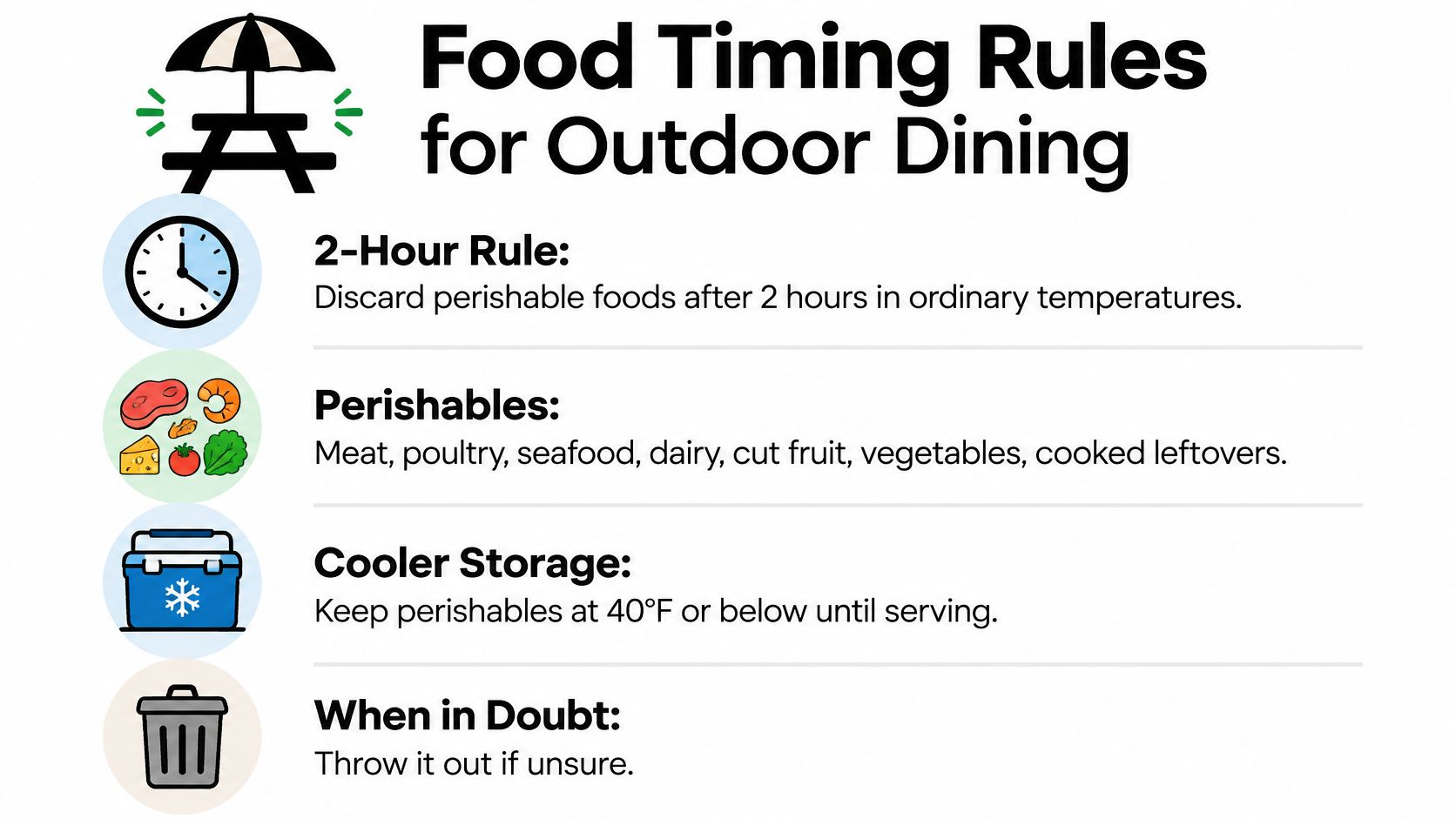
The clock decides more than the centerpiece does. Perishable food on a patio is a time-and-temperature problem, and the CDC's guidance on serving food safely draws the hard line. Meat, poultry, seafood, dairy, cut fruit, some vegetables, and cooked leftovers should be discarded after 2 hours at ordinary conditions. Once the surrounding temperature exceeds 90°F (32°C), that limit falls to 1 hour. Cold foods stay in a cooler with ice or frozen gel packs until immediately before serving, and leftovers go into refrigeration at 40°F (4°C) or below within 2 hours.
The whole system fits on one card. Keep it where the food is.
| Condition | Time limit | Action |
|---|---|---|
| Perishables in ordinary conditions | 2 hours | Discard meat, poultry, seafood, dairy, cut fruit, some vegetables, and cooked leftovers |
| Surrounding air above 90°F (32°C) | 1 hour | Shorten service and discard on the one-hour clock |
| Cold food waiting to be served | Until immediately before serving | Keep it in a cooler with ice or frozen gel packs |
| Leftovers | Within 2 hours | Refrigerate at 40°F (4°C) or below |
Write the clock into the service
A rule nobody tracks is a rule nobody follows. Build the timing into the way the meal runs.
- Set the cooler in shade and keep the lid closed. Every reach into an open cooler dumps cold air. Pull what you need and shut it.
- Bring out only what guests will finish inside the window. Two modest platters beat one groaning board that sits out for three hours.
- Note the time the first perishable platter is uncovered. That's your reference point, not the time the first guest arrived.
- Above 90°F, run a one-hour service. Serve in waves from the cooler rather than leaving a single long buffet in the heat.
- Clear, refrigerate, or discard on that clock. Even if the party is still going. Especially then.
A fan, a cover, and a patch of shade make food more pleasant to serve. None of them buys you a single extra minute on the clock.
Write the pull-out time on a card and lean it against the buffet next to the platter. It costs nothing and it's the only part of the setup that keeps the service honest when the conversation gets good and nobody wants to move.
Shade Placement That Changes Comfort
Two seats can sit at the same air temperature and feel like different seasons. Thermal comfort depends on air temperature, air speed, humidity, radiant conditions, clothing, and activity, not on the thermometer alone, and ASHRAE Standard 55 defines the acceptability conditions for occupied spaces. ASHRAE guidance also requires shaded and unshaded exterior areas to be accounted for separately when solar effects are evaluated. That's the technical version of something every server already knows: the sunny four-top is a harder table to work than the one under the umbrella.
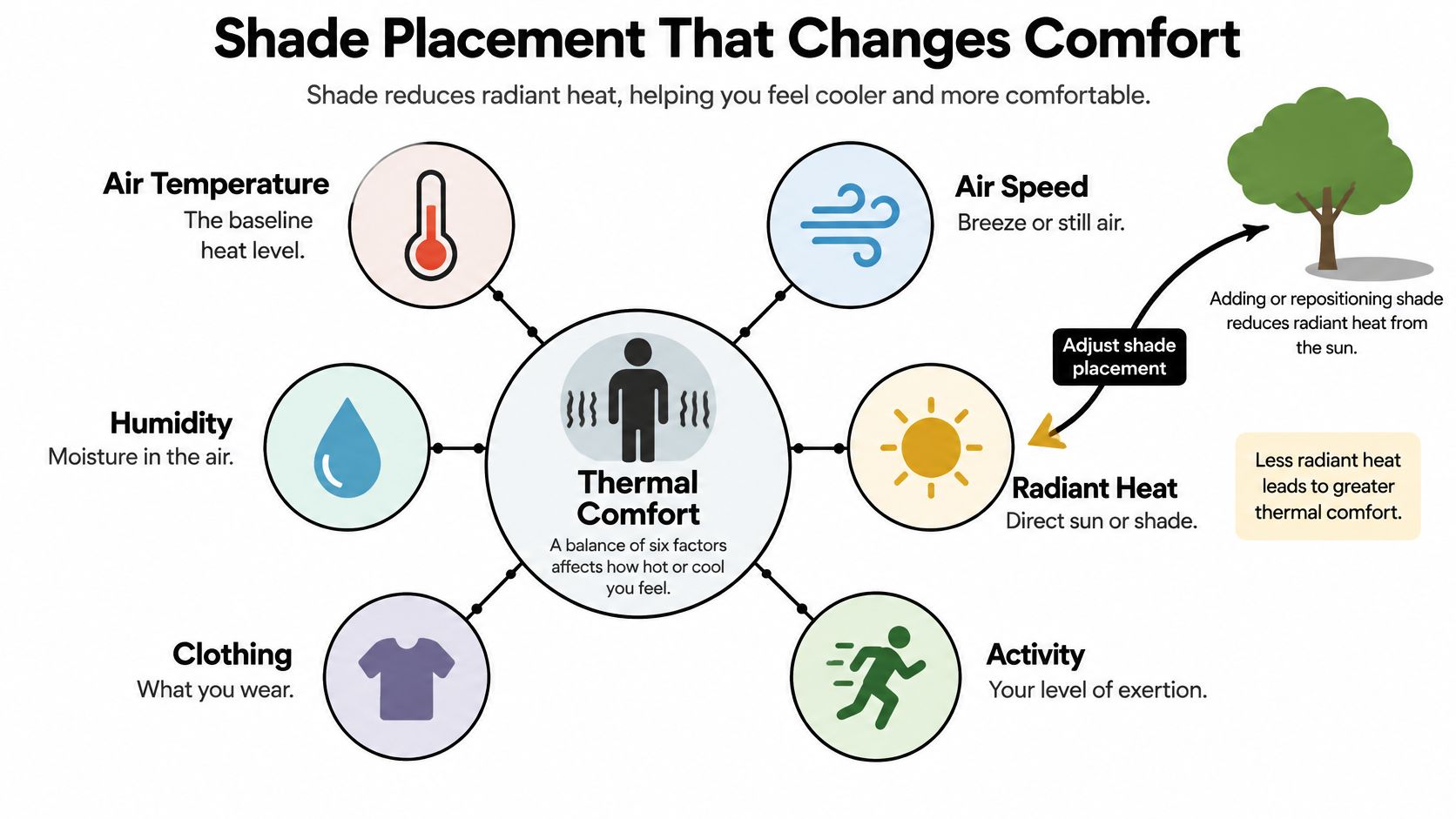
Radiant heat is the one factor you can change in an afternoon. Everything else on that list is weather, wardrobe, or guest behavior.
Place shade for the hour you use the patio
Most patios get shaded for the wrong hour. Noon looks like the obvious sun problem, but if the space fills at 6 p.m., noon placement is decoration.
- Pick the peak hour. Dinner service at 6 p.m., brunch at 11, a reception at 7. Measure the sun then, not at midday.
- Aim the shadow, not the canopy. The dark edge of the shade should fall across the chairs and the serving surface at that hour.
- Leave a gap for breeze. Boxing the table in fabric turns a warm evening into a still one. Airflow is part of comfort.
- Anchor for gusts on a commercial patio. A weighted base and a wind plan keep a cover from becoming a hazard on a busy service night.
- Sit in a guest seat at peak hour and adjust. Your plate and your shoulders should both be out of direct sun before you call it done.
Fixed shade and movable shade solve different problems. A patio used from lunch through dinner usually needs both, with awnings and fixed structures covering the long hours and something adjustable handling the swing. Shading for decks and patios covers the permanent end of that range well. For temporary setups, a 10 x 20 shade canopy gives you coverage you can reposition as the sun moves.
Keep shade and insect control separate in your head. A cover that blocks sun doesn't keep flies off food, and a fan doesn't cast a shadow.
Fly Protection That Keeps Food Safe
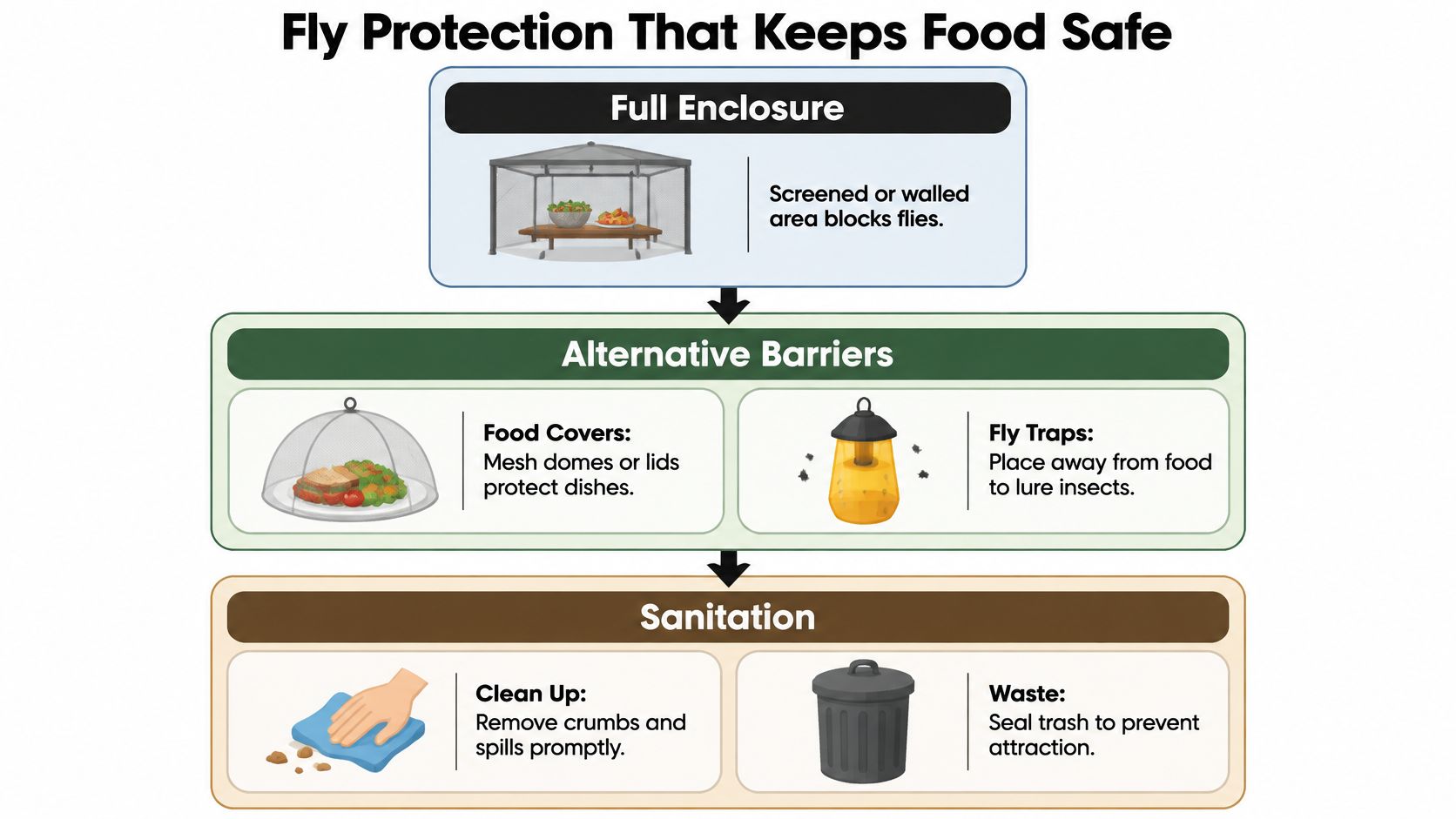
Fly control is a sanitation line item. It earns its place at the table by adding almost no labor per meal. The FDA Food Code treats insects as a contamination problem: outdoor areas that lack enclosure must protect food from rain, windblown debris, insects, rodents, and other environmental contaminants. Where doors or windows stay open, the Food Code permits screens of 16 mesh to the inch, with openings of roughly 1.2 mm, or another effective method of preventing insect and rodent entry. Devices designed to electrocute or stun flying insects must retain the insect inside the device and must not be installed over food-preparation areas.
Barriers at the building, air at the table
Protection works in layers that match the site. At a building, the job is entry control: repair torn screens, close gaps around frames, fit door sweeps and weather stripping. The EPA's Integrated Pest Management Toolkit lists exactly those structural repairs and recommends air curtains above exterior doors near cafeterias and food-storage areas. For outdoor sites it names filth flies among typical pests and pushes active monitoring of both the pests and the conditions that attract them.
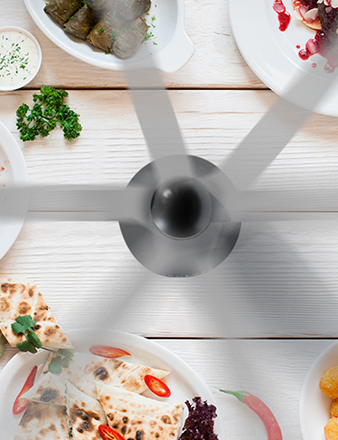
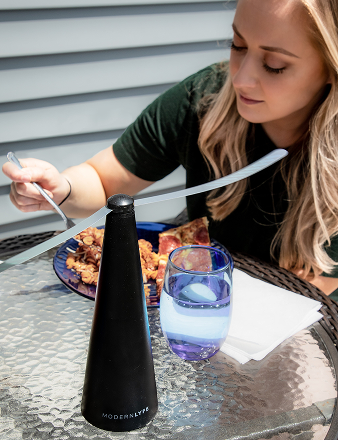
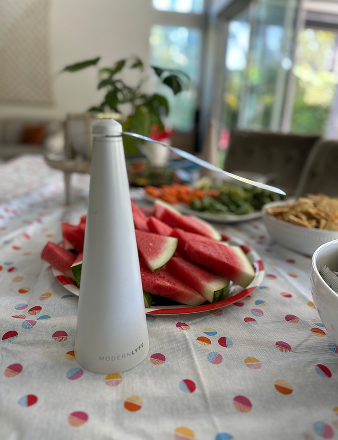
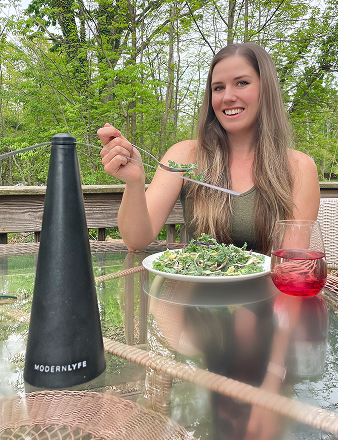
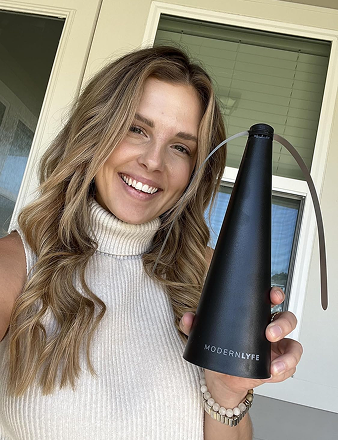
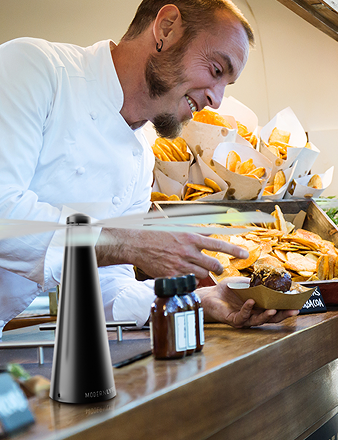
On an open patio with no walls, none of that applies. The work shrinks to three habits: keep scraps and standing water away from the table, cover food between reaches, and move air across the surface so flies are discouraged from landing on exposed plates. A rechargeable fly fan built for indoor and outdoor tables, such as the Modern LYFE Fly Fan, keeps air moving over the plates without a cord run to an outlet. A lidded waste bin at the edge of the space does more than any device hung overhead.
Each layer has a hard limit. A table fan does the job of a screen on a restaurant door about as well as a screen serves a food truck with no walls, and nothing on this list replaces refrigeration or a thermometer. Simple outdoor food covers handle the between-reaches gap for a few dollars and stack in a drawer.
Placement rule: Nothing that catches or kills insects belongs directly above food. Not above a buffet, not above a prep board, not above a table where children are eating.
Build the layers in cost order. Repair what already exists, then add covers, then add air movement at the table, then consider anything hung or mounted. Most patios stop needing the last step, and the ones that keep going usually skipped the first three.
One Patio Dinner From Setup to Reset
A Saturday in July, eight people at 6 p.m. on an open patio, drinks before dinner. The work runs as a sequence, and the sequence is what makes the evening feel calm instead of frantic.
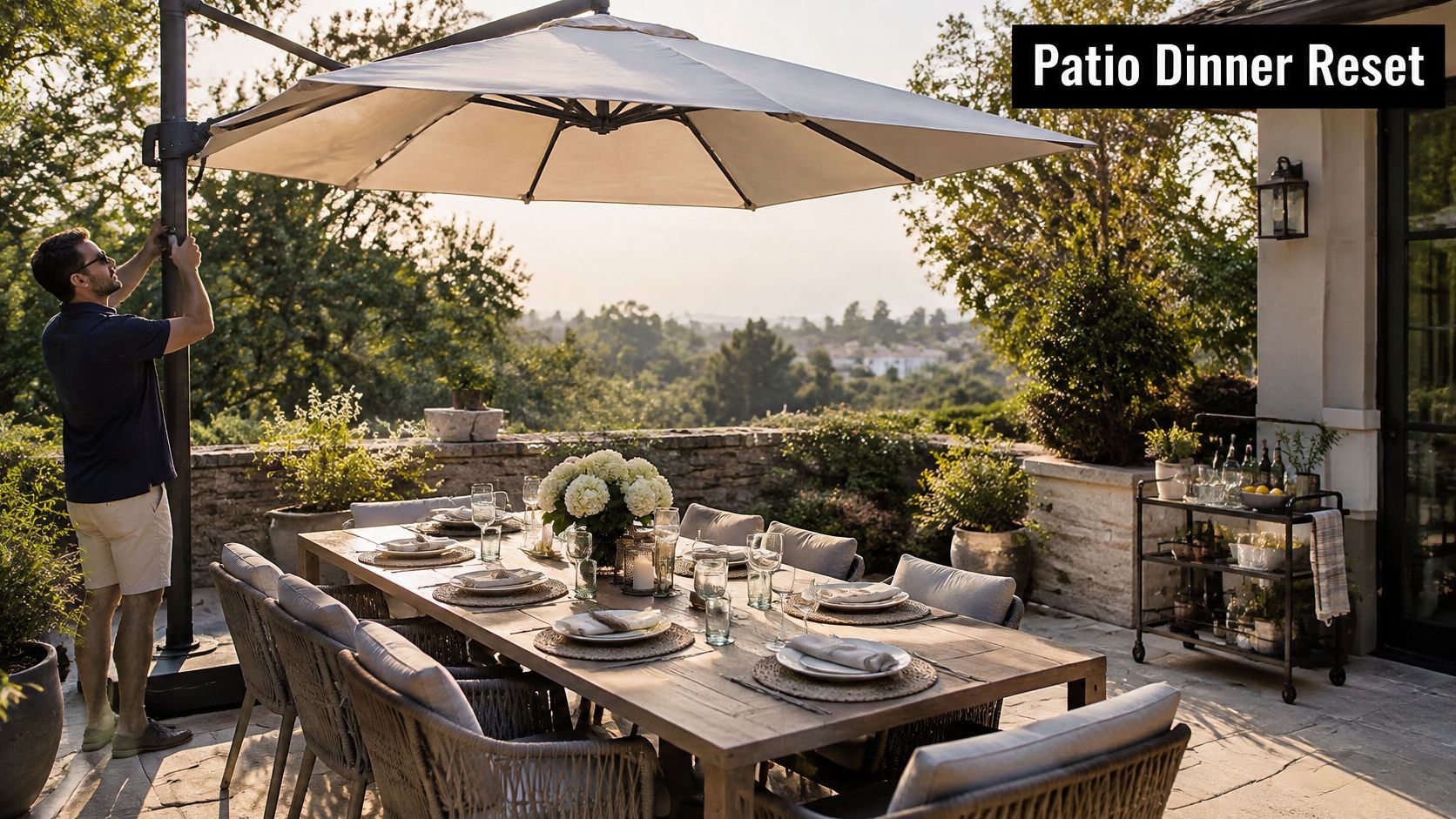
4:30 p.m. Move the umbrella so the table and serving cart sit in shadow at six, while the far side still lets a breeze through. Park the cooler in that same shade and keep cold salads closed inside it. Set a lidded waste bin at the patio edge, away from plates. Put two quiet table fans on the dining table, aimed across the surface, and switch them on before food appears. Keep them clear of the grill and the prep board.
See how the placement works in motion before planning your own setup:
6:00 p.m. Bring the first perishable dishes out and note the time on a card by the platter. Cushions should already be on chairs; lighting waits unless dinner runs past dusk. If the afternoon has run above 90°F, serve one wave and clear once instead of leaving a spread to sit.
Hot food has its own constraint. USDA food safety guidance puts the danger zone at 40°F to 140°F (4°C to 60°C), so perishables get a short runway on the table. The platter goes from grill to a hot-holding surface or straight onto plates. It does not wait on a side table for late arrivals.
After dessert. Leftovers still inside the window go to the refrigerator. Scraps go into the lidded bin, never a grocery bag by the door. Fans get wiped and set to charge. Reset takes about fifteen minutes when every piece has a home, and the patio is ready tomorrow rather than waiting for a free afternoon that never comes.
The order is the lesson: shade first, cold holding second, fly control third, fast clear last. Reverse it and dinner becomes furniture moving while food sits in sun. The best accessories here are boring: shade you can aim, a lid that stays shut, air over the plates, a timer by the platter. Pretty extras only earn space if they shorten one of those jobs.
Pick Low Upkeep Gear Before You Buy
Upkeep is what keeps a patio unused. A 2025 survey of 1,000 U.S. adults found that 77% of people with access to a patio, porch, balcony, or deck spend less time outdoors than they would like, and 42% named furniture upkeep and maintenance as a barrier to improving the space. That second number is the one to design around. Every accessory you add either shortens or lengthens the reset.
Score six lines before style
Run each candidate through these before you look at the finish.
- Minutes to clean after one meal. Wipe-down time on a fan base matters more than blade shape.
- Sun and rain exposure. Does it live outside, or does it need a cover every night?
- Storage footprint. Where does it go in November, and is that place available?
- Noise at the table. A fan nobody can hear gets left running. One that whines gets switched off.
- How it's powered. Rechargeable beats a drawer of disposable batteries every season.
- Layout fit. Buffet service and seated dining want different pieces, and a tool built for one usually fights the other.
For commercial patios, ask for evidence rather than assurance. The BIFMA outdoor furniture whitepaper separates ultraviolet radiation, heat, humidity, freezing, water, wind, and corrosion as distinct degradation mechanisms and describes accelerated-weathering programs that simulate them. Request test evidence for your climate, inspect coatings and fasteners on a schedule, and favor designs that drain water instead of trapping it in joints and hollow sections. Near a coastline or in a humid region, salt and moisture push coating failure faster than anything else on that list.
For open tables, parties, and food trucks, the practical layer is a rechargeable table fan. Our Fly Fan for Tables is built for outdoor tables, patios, parties, food trucks and al fresco cafes, and it comes in four colors. Whatever brand you choose, confirm charging time, cleaning method, and warranty terms before you commit.
Frames and textiles deserve the same scrutiny. A patio material guide for new homeowners helps you match material to climate before you fall for a finish. Ground cover counts as gear too, and a rug sized for the seating zone keeps chairs from sinking and walkways from wandering.
Then buy in this order: shade over the seats, a cooler and a clock for perishables, fly control matched to the site. Skip extra décor until those three jobs are covered, and when you do add it, buy one piece you'll maintain instead of five you won't.
MODERN LYFE builds rechargeable fly fans for tables that keep patio meals and buffet lines clear of insects without adding a chore to the end of the night. If fly control is the row you're still missing, our fans are made for outdoor tables, parties, food trucks and al fresco cafes, and they come in four colors to sit comfortably alongside your existing setup. Visit MODERN LYFE to see the lineup and pick the piece that finally earns its place at your table.