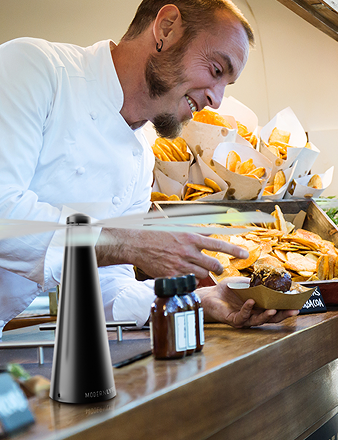
Friday night at a busy bistro. Candles are flickering on the patio, a couple is leaning across the table to hear each other, and a server is repeating the specials. Then someone wheels out a pedestal fan, switches it to speed three, and the conversation changes from relaxed to strained.
That's the hospitality problem with quiet fans. A fan can move plenty of air and still damage the experience if its motor whine, blade tone, or placement competes with guests. The best quiet pedestal fan for a restaurant, hotel, wedding, or event isn't the model with the lowest number on a box. It's the model that delivers usable airflow at the speed you'll run, from a position that keeps the sound away from the seating zone.
| Hospitality use | What to prioritize | Practical noise position | Placement decision |
|---|---|---|---|
| Restaurant dining room | DC motor, controlled oscillation, stable base | About 38–45 dB(A) at 1 m on medium as a buying target | Keep it off the table edge and circulate air across the room |
| Outdoor reception | Weather-resistant housing, weighted base, strong airflow | Ambient sound may mask some fan noise | Anchor it securely and avoid direct blasts at guests |
| Hotel suite or lobby lounge | Quiet high-speed operation, remote control, refined appearance | Aim for below 35 dB(A) at high speed | Use a corner or wall-parallel position |
| Home patio entertaining | Portability, battery or USB-C operation, simple controls | Accept a compromise on maximum output if needed | Move the fan close to the people who need airflow |
Why Quiet Airflow Matters in Hospitality Settings
The fan is rarely the first thing guests complain about. They complain that they can't hear the person opposite them, that a candle keeps going out, or that menus and napkins keep shifting. The fan caused the problem, but the venue experiences the result as a poor atmosphere.
A pedestal fan placed beside a table creates a concentrated sound source exactly where guests are trying to talk. A smooth air-moving sound can blend into the room, while a pulsing motor note or blade tone stays noticeable even when the measured level looks acceptable. That distinction matters in dining rooms, tasting rooms, hotel lounges, and wedding marquees, where ambience is part of what guests are paying for.
Protect the room's acoustic character
Quiet pedestal fans are generally associated with 20–30 dB, a range quieter than a quiet office or soft rainfall and close to bedroom-night targets of about 30 dB(A), according to the fan noise calculator and acoustic guidance from Longwell Fans. Broader household guidance commonly describes sound below 35 dB(A) at roughly 1.5–3 meters as quiet, while about 30 dB(A) is close to inaudible at night.
Hospitality buyers need a tougher test than bedroom buyers. Guests may tolerate a low, continuous hum in a large outdoor space, but they won't tolerate a fan that sounds sharp, rattly, or unstable beside their plate. The right question is whether the fan remains unobtrusive at medium speed, not whether it can whisper on its lowest setting.
Operational rule: Protect conversation first, then tune airflow around it. Maximum airflow is useless if guests avoid the seats nearest the fan.
Airflow starts with the whole environment
Patios also have cooking equipment, walls, awnings, wind exposure, and heat sources that affect circulation. A practical guide to how to ventilate an outdoor kitchen is useful when a fan is being added to a larger outdoor service plan, because a pedestal fan should support comfort rather than substitute for proper ventilation.
For restaurants and events, buy for the operating scene. If the fan needs speed three to make a difference, evaluate speed three. If it only works when aimed directly at guests, it's probably the wrong format or the wrong position.
Reading the Specs Without Getting Misled
Most fan noise claims describe the friendliest possible condition, usually the lowest speed and a measurement made under controlled circumstances. That figure can be useful, but it doesn't tell you what guests will hear when the patio fills, the air stills, and staff increase the fan to medium or high.
Start by identifying the measurement type. Sound pressure, often written as dB SPL or LpA, describes the sound reaching a listener at a stated position. Sound power, written as dB SWL or LwA, describes the acoustic energy radiated by the fan itself. They aren't interchangeable, and a product page that gives one without the other leaves out important context.
Ask four questions before trusting a number
- Which speed produced the reading? A low-speed figure doesn't represent medium or high operation.
- What was the measurement distance? Sound pressure falls by about 6 dB whenever distance doubles, as explained in independent testing from Bob Vila's quiet fan review.
- Was the result weighted as dB(A)? A-weighting better reflects how people perceive many everyday sounds.
- Is the result a single number or a full noise profile? Third-octave or full-spectrum data can reveal a tonal whine that an overall figure hides.
The distance rule changes placement decisions. A fan measured at a fixed position may sound much less prominent from the far side of a room, but only if the unit isn't producing a particularly irritating tone. Distance reduces level. It doesn't make a rattle pleasant.

Treat low-end claims as a starting point
A quiet pedestal fan can sit around 20–30 dB on its lowest setting, while models around 35–40 dB remain quiet for many users but become more noticeable in sleeping or hospitality environments. Independent guidance from Luftzug's quiet fan buying guide emphasizes why a 5–10 dB increase matters. Loudness doesn't rise in a simple linear way, so a small-looking change on paper can be clearly audible in the room.
The testing standard also matters. EN IEC 60704-2-7:2020 provides a test code for determining airborne acoustic noise from household and similar electrical fans, giving manufacturers and reviewers a standardized basis for comparison, as documented in the Longwell reference above. Use standardized results where available, but still match them to your operating speed and venue layout.
Motors, Blades, and Airflow Compared
Motor design is the strongest predictor of whether a pedestal fan feels refined or cheap. A brushless DC motor usually gives the buyer finer speed control, a smoother low-speed range, and better opportunities to balance airflow against noise. An AC induction motor is often simpler and more economical, but it may produce a more obvious tonal character as speed changes.
That doesn't mean every DC fan wins. Blade geometry, grille design, bearings, assembly quality, and the control system all affect the result. The useful comparison is the complete fan, not the motor label alone.
DC and AC side by side
| Attribute | DC brushless | AC induction |
|---|---|---|
| Low-speed control | Fine adjustment and smoother modulation | More limited speed steps are common |
| Acoustic character | Often smoother when well designed | Can produce a more noticeable hum or tone |
| Energy use | Strong efficiency potential, especially at reduced speeds | Generally less flexible for low-power operation |
| Airflow control | Better suited to gradual changes | Effective, but often less finely adjustable |
| Purchase position | Usually a premium specification | Often chosen for straightforward, lower-cost operation |
| Hospitality fit | Better for rooms where ambience matters | Suitable where durability and budget dominate |
Product engineering details can vary widely, so buyers should compare the published performance rather than assume a motor type guarantees silence. The quiet fan technology overview from Modern Lyfe is useful background when assessing why motor control, blade balance, and airflow design belong in the same decision.
Blade size changes the equation
Blade diameter affects how much air a fan can move. Neutral buying guidance places pedestal and floor fans broadly around 1,000–2,500 CFM, and notes that larger blades, including 16-inch models, generally move more air than smaller blades because blade size directly affects airflow, as described by Argos support's fan specification guide.
For a hospitality floor plan, a larger blade running smoothly at a moderate speed can be preferable to a smaller blade pushed hard. Don't compare CFM alone. Ask for airflow at the setting you'll use and consider airflow per watt, the efficiency measure that connects output to electricity. ENERGY STAR criteria for ventilating fans, for example, specify minimum efficacy from 2.8 CFM/W for lower-capacity units to 4.0 CFM/W for models in the 201–500 CFM range at maximum speed, as shown in its ventilating-fan criteria.
Blade noise also has a mechanical signature. AMCA explains that blade-passing frequency equals the number of blades multiplied by RPM, divided by 60, so changing blade count or speed changes the fan's tonal noise profile, according to its fan noise reference guide.
Real-World Noise at Every Speed
A published low-speed number is only useful if low speed produces enough air for the room. Hospitality teams often need medium operation, especially when guests occupy a patio or when a marquee has limited natural movement. That's where the quietest pedestal fan on a product page can become an ordinary, intrusive machine.
Independent comparisons have recorded quiet pedestal fans at about 30 dB on low and 59 dB on high, while another DC-motor model measured roughly 27 dB on low and 55 dB on high, as reported in Bob Vila's best quiet fan testing. Those figures show the trade-off clearly. A fan can be exceptionally discreet at low speed and still provide useful high-speed output, but you must inspect the entire range.
Use distance as part of the specification
The following operating map applies the approximately 6 dB reduction per doubling of distance to a representative 40 dB(A) reading at one meter. It's a placement model, not a promise for every product.
| Operating speed | Noise at 1 m | Noise at 2 m | Noise at 4 m | Guest verdict |
|---|---|---|---|---|
| Low | 30 dB(A) | 24 dB(A) | 18 dB(A) | Suitable near sleeping or quiet seating areas |
| Medium | 40 dB(A) | 34 dB(A) | 28 dB(A) | Usually acceptable when positioned away from tables |
| High | 50 dB(A) | 44 dB(A) | 38 dB(A) | Noticeable nearby, workable with careful placement |
The underlying distance principle is supported by the real-world fan performance guidance from Modern Lyfe. A diner seated one meter from a high-speed fan will hear it clearly. Move that fan to a corner and create two meters or more between the motor and the closest table, and the same output becomes much easier to accept.
Judge sound at the speed you need
A bedroom guest may value a low setting overnight. A hotel lobby needs a fan that stays composed while moving air across a larger open space. An outdoor reception may accept a higher reading if the fan is stable, distant, and producing a smooth sound rather than a pulsing mechanical note.
One-metre test: If you can't hold a normal conversation over the fan at your target operating speed from one metre, don't specify it for a guest-facing position.
Independent buying guidance places quiet models as low as 26 dB and louder units around 61 dB at maximum setting, a spread that runs from whisper-level sound toward normal-conversation territory, according to CHOICE's pedestal fan buying guide. Test before deployment whenever possible.
Placement and Installation in Commercial Spaces
A good fan in the wrong position is still a bad hospitality purchase. Place a pedestal fan beside a table, aim it directly at diners, and you'll create noise, napkin movement, cold spots, and complaints. Place the same unit in a corner, direct the stream parallel to a wall, and use oscillation selectively, and it can circulate air without dominating the room.
Start with stability and clearance
Uneven patio slabs need a weighted base, an anti-slip mat, or both. Outdoor events may require sandbags or ground anchors, especially under marquees where gusts can catch the fan head. Keep blades clear of guest traffic by at least 90 cm, and route every cable away from walkways using rubber cable covers rather than loose extension leads.
Head-height placement can improve the distribution of moving air, but it also increases the consequences of instability. A fan positioned around 1.2–1.8 m should have a secure base and no opportunity for guests or children to reach the grille. For a fixed direction, aim the fan parallel to a wall so the airflow travels through the room instead of striking one table.

Match oscillation to the floor plan
Use a wider arc in an open dining room where tables are spread across the room. Reduce the arc when seating is dense, because sweeping air across plates, candles, or paper menus creates more disruption than comfort. A fixed-direction fan often works better along a wall, through a corridor, or across a standing reception area.
Weather exposure deserves a separate decision. Most household pedestal fans are IP20, which doesn't provide splash protection. A covered terrace and a fully exposed wedding lawn aren't equivalent environments, so involve the same practical thinking used in design build vs design bid build CMAR discussions when a temporary setup becomes a permanent commercial installation. Plan power, drainage, anchoring, storage, and service access together.
Commercial placement checklist
- Restaurant: Keep the fan out of the direct sightline, use controlled oscillation, and maintain clear space around the base.
- Hotel lobby: Favor a corner position that supports broad circulation without sending air directly into a seating cluster.
- Outdoor event: Add ballast, protect cables, check the surface, and remove the fan when weather exceeds the equipment's rating.
- All venues: Test the fan with chairs occupied, menus on tables, candles lit, and normal service activity underway.
Durability, Safety, and Ongoing Maintenance
Hospitality fans fail through neglect before they fail through design. Dust loads the grille, grease reaches the blades, bolts loosen on uneven floors, and cables get dragged across service routes. A quiet fan that develops a bearing noise or grille rattle quickly loses its main advantage.
Commercial buyers should separate weather resistance from general durability. An IP rating tells you how an enclosure handles intrusion from solids and water under defined test conditions. It doesn't make a consumer pedestal fan suitable for rain, pressure washing, or permanent outdoor exposure.
Build maintenance into the operating rhythm
Outdoor or dusty installations deserve weekly blade and grille cleaning. Indoor units can often follow a fortnightly cleaning schedule, but the correct interval depends on the room, the kitchen proximity, and visible buildup. Use the manufacturer's cleaning method and disconnect power before opening any guard.
The fan blade cleaning guide from Modern Lyfe provides a practical reference for removing accumulated dust without damaging the fan. Don't spray liquid into the motor housing, and don't return a fan to service if the grille, guard, cable, or base is damaged.

Use a quarterly manager's checklist
- Visual inspection: Look for cracks, missing fasteners, bent grilles, exposed wiring, and corrosion.
- Base and bolts: Confirm the base sits flat and tighten accessible fasteners to the manufacturer's guidance.
- Cable check: Inspect the plug, insulation, cable path, and any protective floor cover.
- Deep clean: Remove dust from blades and guards, then check that the fan rotates without rubbing.
- Bearing listen-test: Run the fan through its operating range and listen for scraping, clicking, pulsing, or a new tonal whine.
- Storage rotation: Tag units taken out of service, keep them dry, and rotate stored equipment so one neglected fan doesn't return during a busy event.
Never rely on a lightweight base on an uneven patio. Don't daisy-chain extension leads, leave a damaged fan running overnight in a guest room, or use an indoor-rated unit where splashes are likely. Daily hospitality service is demanding, and replacement planning should be realistic. Most pedestal fans used this way need replacement around 3–5 years, rather than the longer lifespan sometimes suggested in residential marketing.
When a Pedestal Fan Is the Wrong Tool
A pedestal fan circulates air across a room. It doesn't solve every comfort or insect problem at a table.
At a wedding reception, four tables may need airflow within centimeters of each guest, not a breeze sent across several meters of floor. Bodies, tablecloths, floral arrangements, menus, and centerpieces interrupt that stream. A pedestal fan can create a strong sensation near its outlet while leaving the far side of the table still.
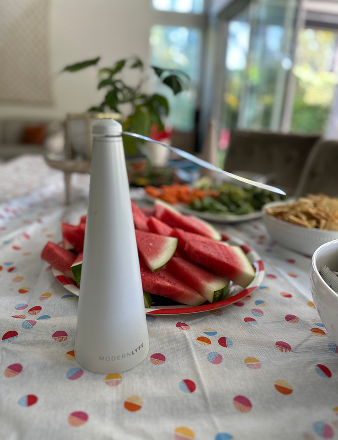
Fly control creates another limitation. Flies respond to directed airflow around food, and a tall pedestal fan usually can't deliver that stream without blowing candles, hair, place cards, or paper programs across the table. Aim it downward and you risk an uncomfortable blast. Aim it across the table and you may disturb service.
Solve the problem at the table
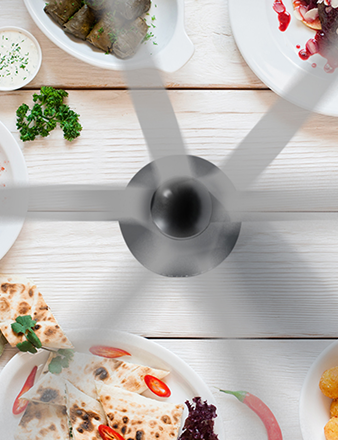
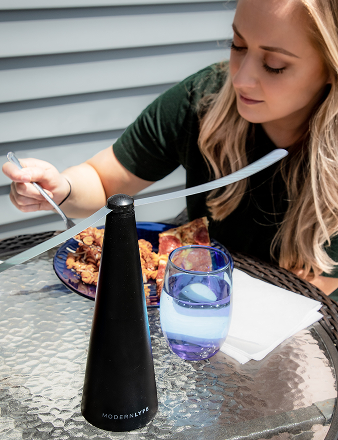
A table-integrated fly fan is a low-profile, battery-powered fan mounted inside or beneath a table center. It works close to the food and guests, where a room-scale pedestal fan can't concentrate airflow without becoming intrusive. These units can address flies, smoke drift, and individual comfort while leaving the main room circulation strategy unchanged.
The acoustic target is also different. A table fly fan operating at under 20 dB(A) at the listener can sit close to diners without competing with conversation, according to the provided product background. That makes it a complementary tool for buffets, outdoor receptions, barbecues, and tightly arranged dining layouts.
The decision isn't pedestal fan versus table fan in every venue. A restaurant patio may use a quiet pedestal fan in a corner for broad circulation and a table-integrated unit where food protection matters most. An event planner may skip the pedestal entirely when guests need localized airflow rather than room movement.
Buy the airflow outcome, not the fan category. If the problem happens at the table, solve it at the table.
Matching the Right Fan to Your Setting
The best quiet pedestal fan depends on where guests sit, how much air the room needs, and whether the fan must operate above its lowest setting. Use these four recommendations as a practical shortlist rather than chasing a universal winner.
Restaurant dining room
For a dining room with 40–80 covers, hard floors, and a ceiling below 3 m, choose a DC motor with controllable oscillation and a base weighing more than 4 kg. Target 38–45 dB(A) at 1 m on medium speed, not merely an impressive low-speed reading. Keep the fan near a wall or corner, aim airflow across the room, and avoid direct streams over open plates or candles.
Outdoor reception
A tented reception with 50–150 guests needs stability before silence. Prioritize an IP44-rated motor housing, a weighted base or ground anchors, and a battery or long-cable DC option. Ambient sound may mask some fan noise, so prioritize reliable airflow while keeping the unit away from the nearest table and securing every cable.
Hotel suite or lobby lounge
Choose appearance, control, and high-speed composure. Remote or app control lets staff adjust the fan without crossing a guest area, while low standby draw helps when units remain available for long periods. Target below 35 dB(A) at high speed, then place the fan in a corner or along a wall so the air circulates without hitting a bed or lounge directly.
Home entertaining on a patio
Portability wins. Look for a grab-and-go handle, USB-C or battery operation, and controls that guests can understand without assistance. Accept a trade-off on maximum airflow if the fan is easy to reposition and quiet enough to leave near conversation.

Buy the quietest fan that delivers the airflow your layout actually distributes, not the quietest fan the spec sheet advertises.
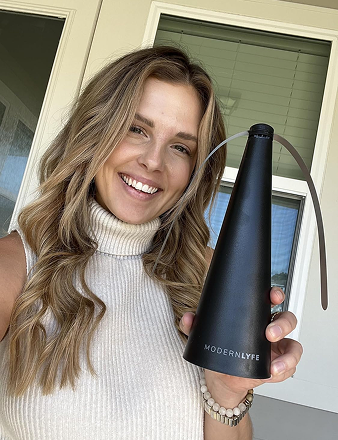
If your real problem is flies or localized table comfort, MODERN LYFE offers battery-operated fly fans designed for tables, buffets, restaurants, hotels, catering events, and outdoor gatherings. Visit MODERN LYFE to compare table-focused airflow options and choose a quieter way to protect food and guest comfort without turning up a room fan.