The most popular advice about flies at an outdoor meal is simple. Buy a stronger spray, light a scented candle, and carry on serving. That advice gets the order backwards.
A Fly Repellent Outdoor product can help at the edge of a table. It can't clean a drain, cool warm food, cover a platter, or stop flies breeding in a wet bin behind the tent. If you run a patio, cater events, sell food outdoors, or host barbecues at home, you need layered exposure control first. Remove what attracts and breeds flies, block their route to food, then add a local deterrent where guests eat. A scent is the last layer, never the plan.
Why a Spray Alone Fails Outdoors
A caterer sprays a railing, then sets out uncovered canapés. The smell may linger near the tables, but flies can still follow food odors to the buffet. A treated surface does not protect a platter, just as a repellent does not make uncovered food safe.
The scale of foodborne illness explains why exposed food needs careful handling. The World Health Organization's overview of foodborne diseases estimates that nearly 1 in 10 people worldwide become ill each year after eating contaminated food, resulting in more than 420,000 deaths annually, including approximately 125,000 children under five. It also estimates 550 million cases of diarrheal disease and 230,000 related deaths each year.
Those figures cover foodborne illness broadly, not illness caused by flies. They are not a reason to panic over one fly on one plate. They do show why a single deterrent cannot stand in for safe food handling.
Flies can carry germs from refuse or excrement to food. They may contaminate food while feeding, including by regurgitating partially digested material onto its surface. A brief landing can be enough to make exposed food a concern.
Food-service operators and home cooks already use sanitation, temperature control, covered storage, and hand hygiene to protect food. Fly control supports those practices; it does not replace them.
A repellent that leaves residue or perfume beside open food may create a guest problem while trying to solve an insect problem.
Before choosing any repellent method, sort each option by place. For example, a fly-away spray should not be treated as a solution for exposed food. What belongs near a table, doorway, or waste area depends on where it will be used.
Match Each Method to Its Zone
A method can work well in one place and create problems in another. A baited trap belongs near waste, not beside a buffet. A spray may suit a permitted treatment area, but residue and odor make it a poor choice beside uncovered food.
Outdoor fly methods by food fit and place
| Method | How it works | Near open food | Typical duration | Put it |
|---|---|---|---|---|
| Residual chemical spray | Kills or repels on treated surfaces | Poor, residue and odor risk | Hours to days if the label allows | Structure and waste areas, not the buffet |
| Space aerosol | Knocks insects down in the air | No, not while people eat | Minutes | Empty the area before service |
| Baited trap | Attracts, then captures | Risky, can pull flies toward food | Days until bait dries | Well away from guests, near waste |
| Citronella or essential oil | Scent may repel, sometimes attract | Unproven outdoors, can scent food | Often under an hour in wind | Trial only, never the sole control |
| Vinegar or herb bowl | Weak odor cue | Little outdoor evidence | Short | Not a control method |
| Screen or mesh | Physical block | Excellent at openings | Continuous if the mesh stays intact | Doors, windows, tent walls |
| Air curtain | Fast air at an opening | Yes at a properly designed opening | While it runs | Doorway, with a clear air path |
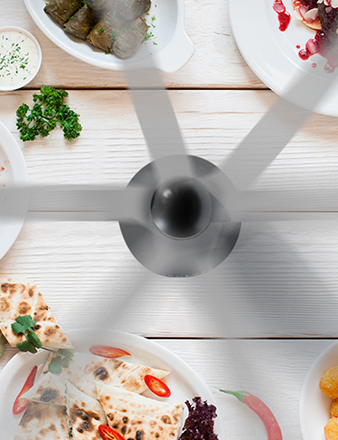
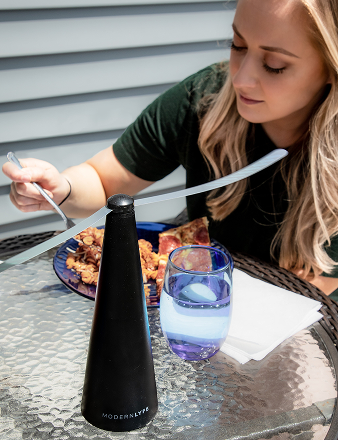
| Table fly fan | Moving air, sometimes reflective blades, at plate level | Yes, no spray residue on food | While powered, for the service | Table or buffet edge, not blocked by decor |
The Zone Rule Beside Food
Covers come first. A lid, cloche, or intact screen prevents flies from landing on food. Airflow can then disrupt their approach without putting spray or scent on the dish. Scented products are less dependable outdoors because wind disperses them, and strong odors can affect the dining experience.
Sprays and baited traps have a different role. Keep them at structures and waste areas, away from plates. A trap that draws flies across a buffet may increase activity where guests are eating.
Judge a method by more than whether it kills flies. Consider where insects travel and fall, what guests smell, and whether anything can reach food-contact surfaces. A busy trap beside clean glassware is in the wrong zone, even if it catches flies.
Placement Steps That Apply to Every Row
- Cover and repair first: Cover prepared food promptly and fix torn screens before adding a device. A fan cannot compensate for an open door beside uncovered trays.
- Use mesh that excludes flies: The University of Arizona Extension guidance on fly exclusion says mesh with 22 openings per linear inch and openings no larger than 0.038 inches, or 0.965 millimeters, will prevent most flies from entering from outside. Fit it tightly at doors, windows, and tent walls.
- Put fast air at the opening: The FDA Food Code permits properly designed air curtains as one method of protecting openings from flying insects. Set the airflow across a kitchen or service doorway, where it can help block entry, rather than directing it over plates.
- Keep the air path clear: Move signs, florals, menus, drapes, and stacked boxes out of the stream. Obstructions create still pockets where flies can settle.
- Keep fallout away from clean items: Position insect-control devices so insects or fragments cannot fall onto exposed food, clean utensils, linens, or single-use articles. Never mount a killing device directly above a pass or buffet.
- Act when a fly lands: Remove the exposed portion if a fly lands on it. Don't wave the fly away and serve the same piece to a guest.
- Move traps away and downwind: Place baited traps near waste management areas, not at the buffet edge. Give flies a destination that does not require crossing the dining space.
What Changes the Result
Wind can disperse a scent or disrupt an airflow barrier. Strong food odors also compete with repellents, especially when meat, seafood, cut fruit, and sugary drinks remain uncovered. Species matters too: a method that discourages house flies around a bin may do little for smaller flies breeding in a drain.
Read the pesticide label and follow local rules for food premises. The label specifies where the product can be applied, which surfaces it can touch, and when people can return. If it does not allow use around serving food, do not improvise because service starts soon.
Placement rule: Protect the opening with mesh or air, protect the dish with a cover, and keep attractants where waste is handled.
At an open patio with no doorway, mesh may help only at a tent wall or screen panel. Covers and plate-level airflow do the table work. At a restaurant door that stays open, an air curtain and intact screens address the opening. At a dumpster corner, sanitation and a distant trap fit the zone. No single method does all three jobs.
Stop Breeding Before You Repel
Think of flies as a pipeline. The adult at the plate is the end of a process that began in wet scraps, a drain film, spilled soda, or produce trim. If you only chase adults, new ones keep arriving.
This short flow shows how quickly a neglected waste spot becomes next week's table problem.
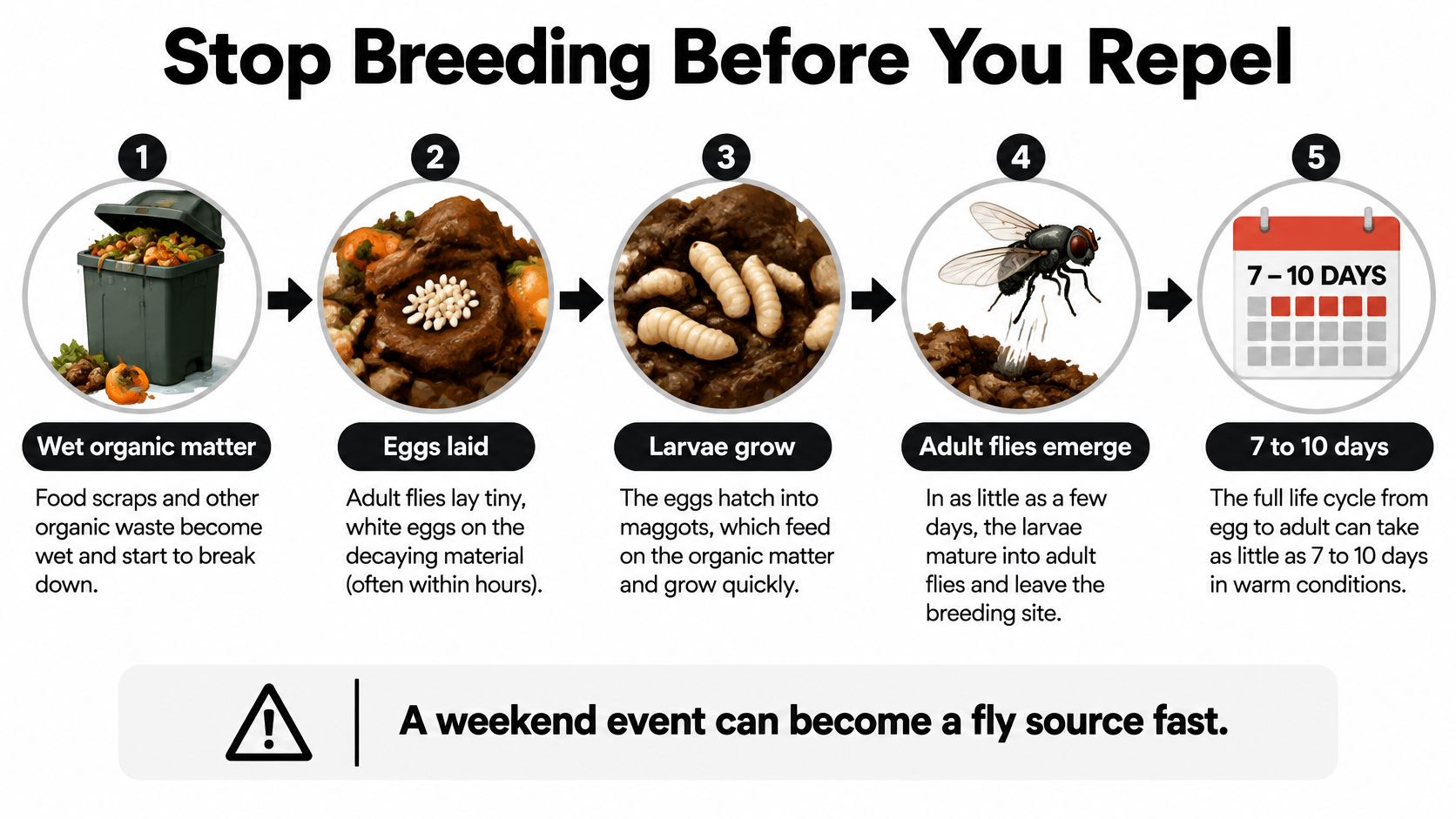
Purdue Extension notes in its house fly control publication that house flies can complete a generation in as little as 7–10 days when they have access to wet, decaying organic matter. A Saturday wedding can inherit flies that started in a midweek bin. A restaurant can clean the patio each morning and still lose ground if the dumpster pad stays wet.
Adults then feed on manure, decaying material, and human food. The University of Minnesota Extension guide to flies reports that house flies can fly up to 20 miles, although they usually remain within about two miles of the larval food source. Check the bin behind the tent before blaming a distant farm.
That same guide explains the feeding route clearly. A house fly regurgitates liquid from its stomach to dissolve solid food, absorbs it through sponging mouthparts, and may leave fecal spots where it walks. Guests can't see that transfer, which is why prevention has to happen before landing.
The Operating Order
- Remove breeding material: Clear manure, food waste, spilled drinks, rotting vegetation, grease, and produce scraps. Dry the area after cleaning.
- Close and empty waste: Use tight-fitting lids, service outdoor trash daily, and don't leave waste sitting overnight beside the patio.
- Clean wet hidden spots: The EPA Integrated Pest Management Toolkit says floor drains should be cleaned weekly to remove grease and accumulated food waste. Fix dripping faucets and leaks at the same time.
- Separate waste from service: Stage bins away from the pass, buffet, and guest seating, preferably downwind. Keep the route for dirty plates away from clean food where the layout allows.
- Add the local barrier last: After cleanup, use covers, mesh, or plate-level airflow at the table. This sequence follows the logic explained in this overview of integrated pest management.
Home hosts face the same pipeline in flower beds, compost, pet areas, and fallen fruit. If the problem starts across the whole garden rather than at one bin, you can find help managing garden pests and still keep the food table controls separate.
This video walk-through is useful for training staff to spot breeding material before they reach for a spray.
A fan or spray can't outrun an active breeding site a few steps away. Cut off eggs and larvae first, then the adults you see become a smaller, manageable problem.
Natural Oils and Thin Outdoor Proof
A stronger scent is not a stronger food-safety plan. Citronella, vinegar, basil, and peppermint may smell promising, but scent alone does not show that a method will keep flies away on a windy patio.
Reporting on USDA essential-oil research in controlled tubes says promising candidates still require semi-field outdoor testing. It also reports that 13 oils produced mixed outcomes, with some causing mortality while others acted as attractants or repellents.
The same oil can have different effects depending on its concentration and conditions. A result in a tube does not establish that it will protect a buffet from flies drawn to nearby food.
Variables a Jar on the Table Can't Control
- Species: House flies, blow flies, and small drain flies may respond differently.
- Wind and temperature: Moving air dilutes scent and changes how quickly oils evaporate.
- Competing food odor: Ripe fruit, meat juices, desserts, and sweet drinks can draw flies toward the table.
- Distance: A candle may affect the air nearby without protecting the far end of a buffet.
- Action: A product may repel, attract, or kill flies. Those effects are not interchangeable.
- Behavior change: Flies may avoid bait ingredients over time, so an approach that seems effective once may lose effect.
Household essential oils should not be used as a food-service control. Concentrated oils can bother children, pets, and guests with fragrance sensitivities or allergies. Keep them off food, rims, utensils, and table surfaces where hands and plates move. For background on peppermint oil and its household uses, remember that a household scent use does not establish protection around food.
Ultrasonic gadgets promise silent, invisible protection, but they do not remove breeding material, cover food, or create a physical barrier. They are not a substitute for practical controls at a buffet, food truck window, or patio table.
A Simple Evidence Test
Before spending money, ask six questions. Was the method tested outdoors, not only in a lab? Is it suitable beside food? How long does it last in wind? Will guests notice odor or noise? How often must staff refill, relight, clean, or replace it? Does it attract flies before it captures them?
If a seller cannot answer clearly, treat the claim as unproven. A scent may add a small nudge in calm conditions, but sanitation and covers come first. A repellent never makes uncovered food safe.
Safety and Environmental Limits
A repellent can solve one exposure and create another. Weigh that tradeoff before you spray a patio where children lean on railings, servers carry open plates, and guests set cutlery on bare tables.
Pesticide labels come first. Read the approved site, allowed surfaces, application method, and wait time before people return. Keep products off food-contact surfaces, serving ware, linens in active use, and children's high chairs. Store them away from ingredients and clean utensils, never in an unlabeled spray bottle.
Space aerosols need the most caution. Clear the area, apply only as directed, let the product settle, and ventilate before service. Don't use one to knock flies down over a buffet while guests queue.
Keep Drift and Residue in Bounds
Don't spray toward garden beds, beehives, ponds, bird baths, or storm drains. Wind carries droplets beyond the target, and wash water can carry residue off a patio. Wipe or wash treated hand-contact surfaces when the label requires it. A fine film on a railing can move to hands, napkins, and plates.
Natural oils avoid some pesticide rules, but they still need checks for allergens and sensitivities. Ask about fragrance concerns at private events and keep concentrated oils away from food and pet bowls. Strong scent can also make a fresh dish taste perfumed.
Fans and battery devices carry a different load. Follow charging instructions, don't leave damaged lithium packs in heat, and recycle dead batteries and electronics through local programs instead of household trash. Replace frayed cables and keep charging equipment away from sinks and drink spills.
Quiet, odor-free airflow is a low-impact layer because it adds no spray film to the eating area. Removing breeding material is lower impact still. It reduces the need for refills, aerosols, bait, and repeat applications across the whole season.
Plans by Setting and the Last Layer
A repellent cannot make uncovered food safe. Keep perishable dishes chilled or hot as required, cover them between servings, and bring them in when their safe holding time is up. A fan can discourage flies from approaching food, but it does not sterilize a platter or extend its holding time.
For make-ahead dishes such as easy pasta salads for entertaining, keep the bowl chilled and lidded between servings. The cover limits access; the temperature controls food safety.
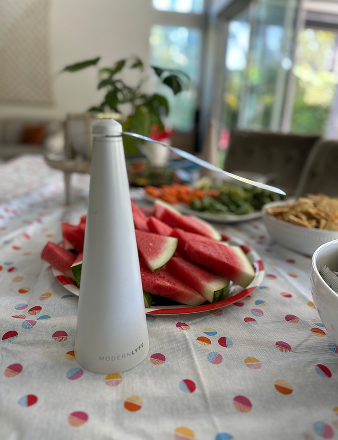
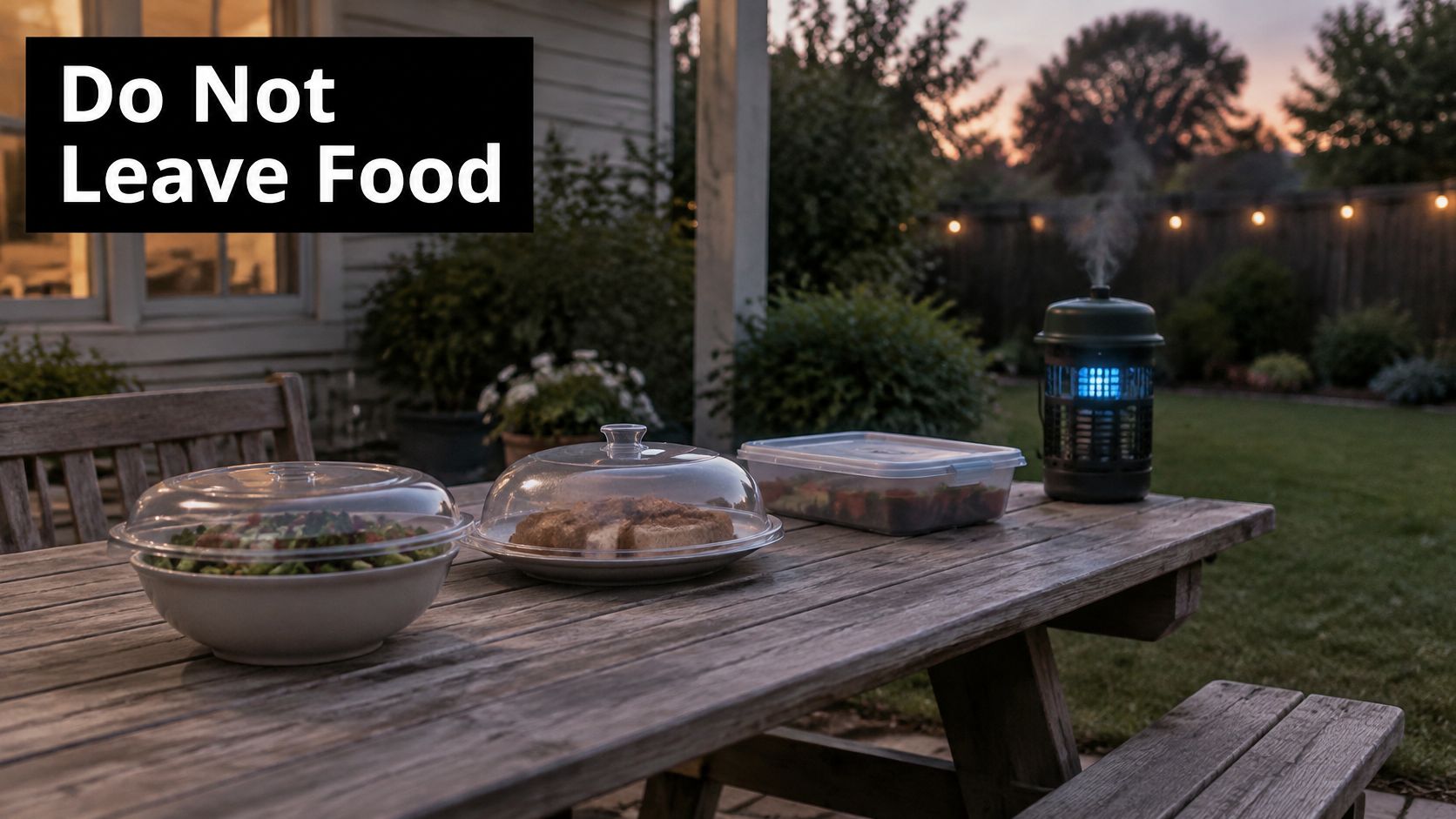
The photo shows covered food on the table, which is the right starting point, but keep any electric zapper well away from serving food.
Three Working Setups
Restaurant patio: Service outdoor trash daily and clean drains weekly. Keep food covered at the pass, screen or use an air curtain at kitchen openings, and place airflow near dishes waiting to be served. Assign someone to wipe spills and check the bin area during service.
Wedding or catering buffet: Keep waste well away from the tent and chafers lidded between servings. Place fans at the table edge, clear the airflow around dishes, and keep baited traps away from food and cake tables.
Home barbecue: Keep coolers closed and bag scraps as you cook. Serve food from covered dishes, clean sticky drink spills promptly, and use a rechargeable table fan near the serving area. Bring perishable food inside when its safe holding time is up, even if guests are still eating.
Food-safety checklist by service stage
| Stage | Do | Avoid |
|---|---|---|
| Before setup | Fix screens, clean drains, place waste well away from food | Traps beside the buffet or cake table |
| During buffet service | Keep food covered, place airflow at the table edge, check for spills | Spraying over open food |
| After spills | Clean promptly and discard food exposed to contamination | Wiping and serving food that was exposed |
| Closing | Empty outdoor bins, remove waste from the patio, refrigerate perishables promptly | Leaving perishable food out past its safe holding time |
Choose the Last Layer by Situation
Start with sanitation and covers. Add mesh or an air curtain where doors or tent openings allow flies in. A quiet table fan can then help protect food while covered dishes are briefly open for service, without adding scent or spray around plates.
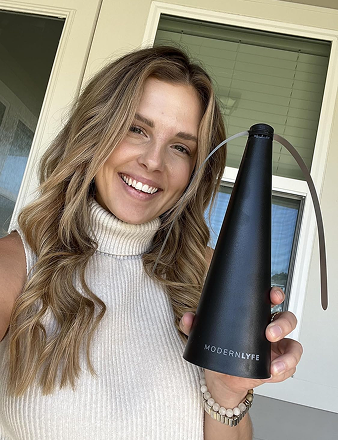
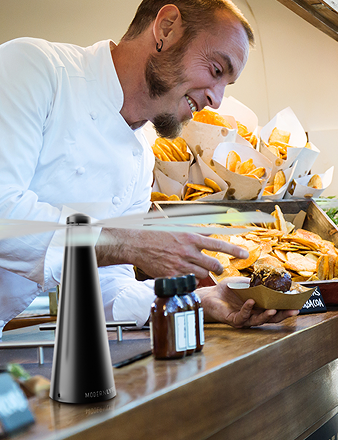
The MODERN LYFE Fly Fan for Tables is a rechargeable, indoor-and-outdoor option intended for patios, parties, food trucks, and al fresco cafes. Its reflective blade pattern disrupts light, and it runs for over 8 hours per charge. It powers on with the included USB cable or two AA batteries, which are not included.
Choose a single, two-, four-, or eight-pack to suit the table or serving area. Keep the job clear: the fan helps keep flies and pests away from food, but it cannot fix an unsanitary waste area or make food safe after it has been left out too long. Use it as the final layer after covers, sanitation, and temperature control are in place.