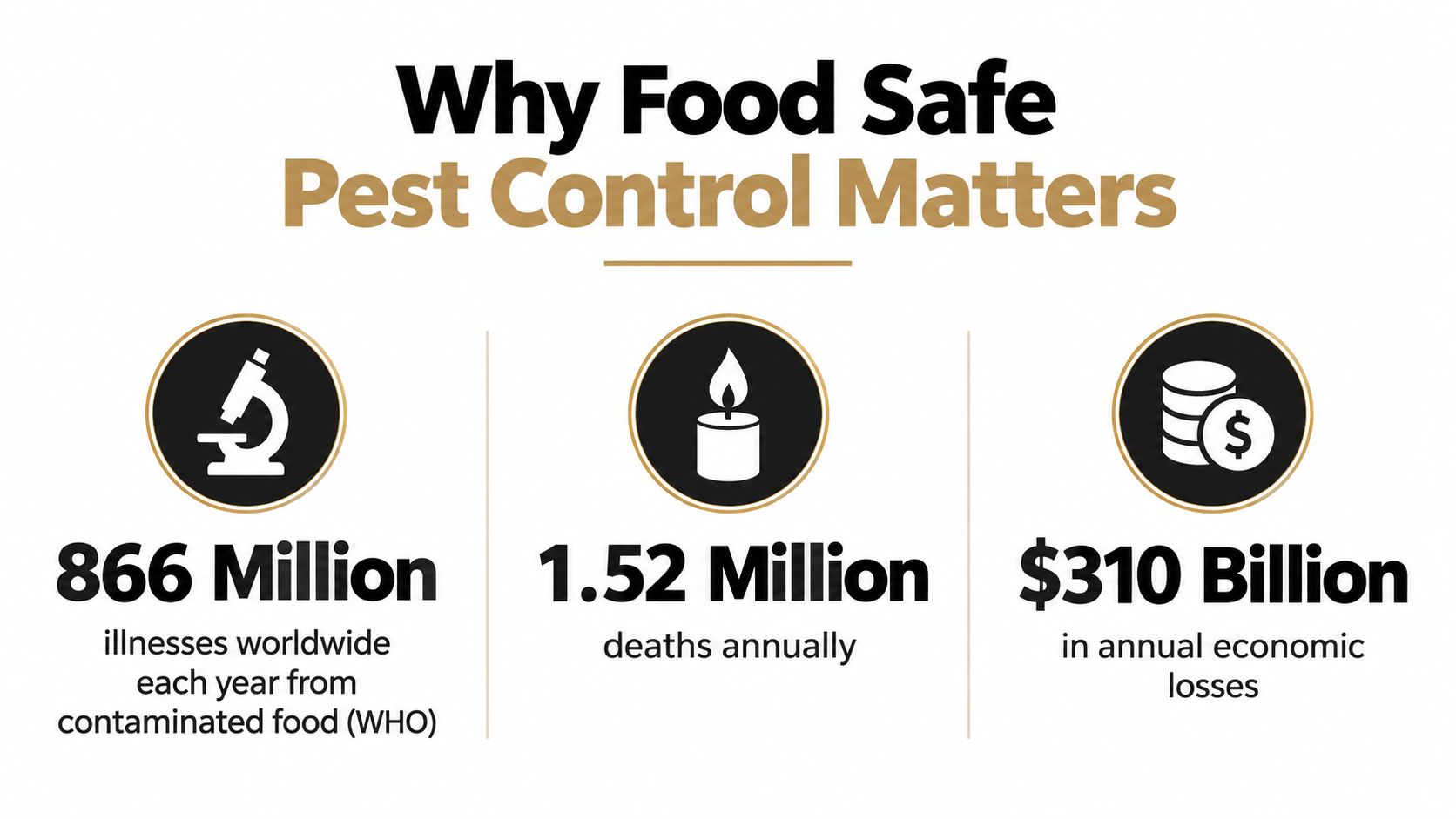
Approximately 866 million people become ill from contaminated food each year, while about 1.52 million people die. Food-safe pest control helps prevent contamination before it reaches a guest, customer, or family member.
That makes pest management a food-safety duty, not a cosmetic housekeeping task. Flies can travel between waste, drains, animal matter, and exposed food. Rodents and other pests can enter through structural gaps, damage packaging, and leave behind evidence that signals a wider sanitation problem.
A compliant program doesn't begin with spraying. It begins with exclusion, inspection, sanitation, targeted controls, and records that show what happened and what the team corrected. The practical question isn't whether a pest-control product kills insects. It's whether the complete system protects food, food-contact surfaces, staff, and guests without creating a second contamination route.
Why Food Safe Pest Control Matters
The World Health Organization estimates that contaminated food causes approximately 866 million illnesses worldwide each year, nearly one in nine people. About 1.52 million people die, unsafe food causes an estimated 57.1 million disability-adjusted life years, and the global economic impact reached approximately US$310 billion in productivity losses and medical expenses in 2021. WHO's food-safety estimates show why pest management belongs inside the food-safety system.
A restaurant may first notice a problem as one fly near a pass, droppings behind a refrigerator, or damaged packaging in dry storage. The visible sign is often only the point at which an existing condition becomes detectable. Waste left uncovered, a leaking drain, a poorly sealed loading door, or a delivery that arrived with compromised packaging can give pests access to food and shelter.
Children under five carry a disproportionate share of the global burden, accounting for roughly 30% of foodborne-disease impacts and about 143,000 deaths in 2021, according to the World Health Organization's food-safety information. Food operators therefore need controls that protect vulnerable guests without relying on alarmist assumptions about every individual pest sighting.
Practical rule: Treat every pest sighting as a signal to inspect the surrounding conditions, not as an isolated insect to eliminate.
For an operator, compliance means being able to show how the business prevents entry, identifies activity, protects exposed food, and corrects the source. A useful overview of the wider hygiene context is this guide to what food safety means in daily operations. For more detailed facility practices, operators can also review guidance on how to keep your kitchen compliant with pest control.
The strongest programs make pest prevention routine. Staff inspect deliveries, close waste containers, maintain screens, report evidence early, and record corrective actions. That approach protects guests and gives managers a defensible process during inspections, rather than leaving them to explain why treatment occurred only after pests became visible.
The Four-Step Preventive Sequence
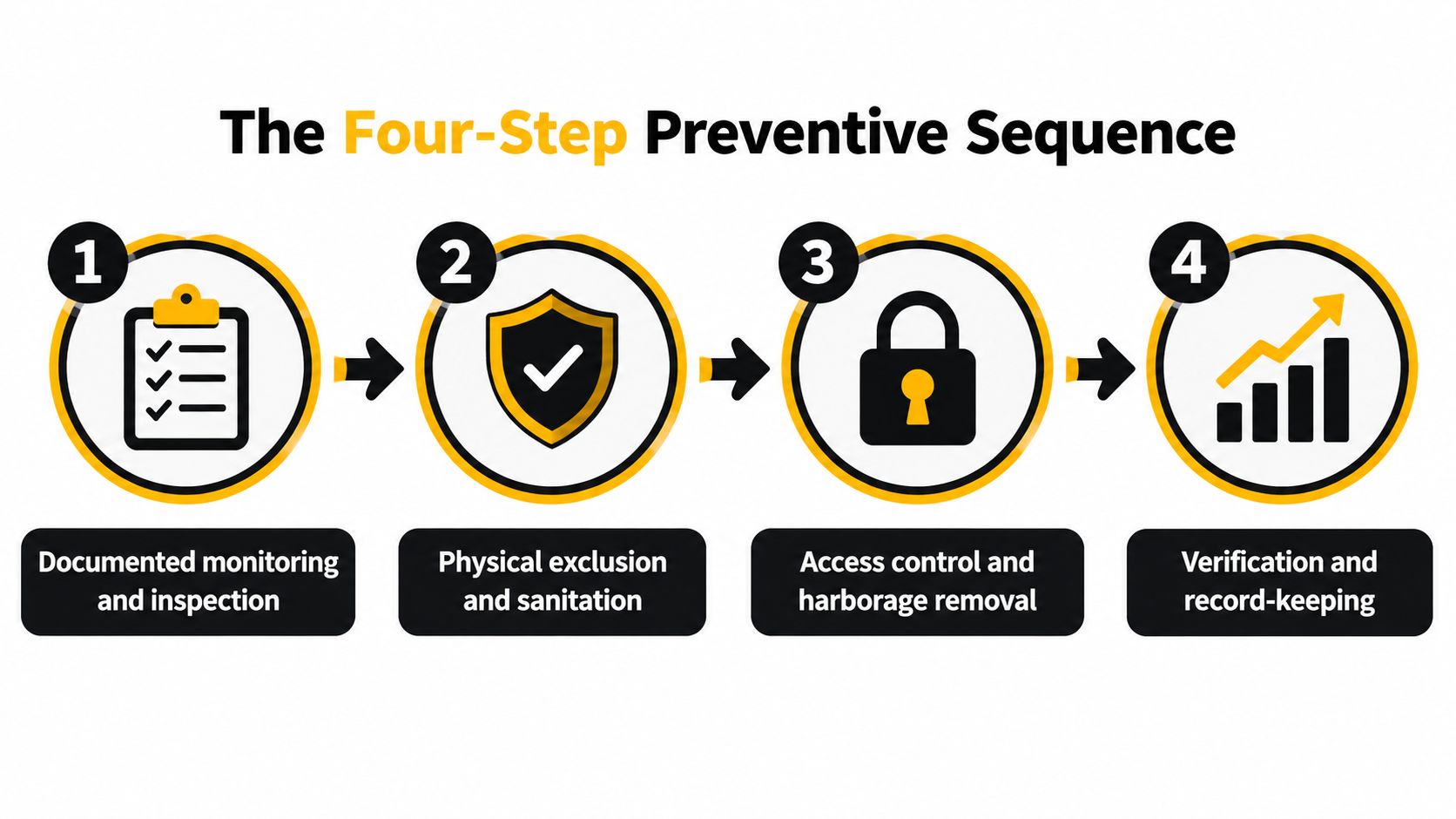
A food-safe pest-control program works best as a documented sequence. The FDA Food Code identifies four core controls: inspect incoming shipments, inspect the premises, intervene where activity is found, and remove harborage. The FDA Food Code provisions on pest control support a prevention-first system instead of pesticide application as the default response.
1. Inspect incoming food and supplies
Receiving is the first opportunity to stop a pest problem from entering the building. Before acceptance, staff should examine cartons, cases, pallets, and containers for damaged packaging, droppings, live pests, webbing, holes, or signs that a package has been opened.
A delivery shouldn't move straight from the dock to storage without a quick condition check. If packaging is compromised, isolate it according to the site's procedure and escalate the decision to the responsible manager. Accepting a questionable shipment can move pests into dry storage, coolers, preparation areas, or waste zones.
2. Inspect the premises
Routine inspections should cover more than the kitchen floor. Check receiving areas, storage rooms, preparation spaces, dishwashing areas, waste zones, dining rooms, service stations, exterior walls, doors, drains, and perimeter conditions.
Look for live insects, droppings, gnaw marks, damaged packages, grease buildup, standing water, leaking pipes, gaps, and clutter. Record the exact location and date. “Kitchen” is too vague to reveal a pattern. “Behind the beverage refrigerator near the rear service door” gives the team a place to investigate and verify.
3. Intervene only where evidence supports it
Traps and other approved controls should respond to observed activity or a documented risk, not be scattered without a plan. Placement matters because a control located in the wrong position may miss the pest, interfere with staff movement, or create a contamination hazard.
Managers should review observations by location and date. Repeated activity in one area suggests an unresolved source, such as a drain, leak, entry gap, or waste-handling issue. The appropriate response is escalation and investigation, not adding more devices.
4. Remove harborage and verify the correction
Pests stay where they find food, moisture, shelter, or access. Correct leaks, standing water, refuse accumulation, structural gaps, and clutter. Clean behind and beneath equipment where residue can collect, and maintain the exterior so vegetation, waste, and damaged structures don't create shelter.
At the next inspection, verify that the correction worked. The record should show the original finding, the action taken, the person responsible, and the follow-up result. This is the practical foundation of integrated pest management, which combines compatible preventive and control methods while limiting unnecessary pesticide use.
Physical, Chemical, and Technological Controls
Control methods aren't interchangeable. The safest choice depends on where the pest is found, whether food is exposed, and whether the method can contain insects and residues. A useful hierarchy is physical exclusion first, targeted technology next, and chemical intervention only when justified.
Physical exclusion
Screens, sealed openings, maintained doors, clean drains, and sound building fabric prevent a problem instead of treating it after entry. The FDA Food Code recognizes screening as a pest-control measure and specifies applicable screens with openings of 16 mesh to 25.4 millimeters, equivalent to 16 mesh per inch. The FDA requirements for screens and insect-control devices also address the placement of devices near exposed food.
Air curtains can help manage flying insects at suitable entrances, provided they're properly designed, installed, and maintained. They don't replace closed doors, clean surroundings, or repairs to gaps. A barrier that staff routinely bypass or leave damaged has little preventive value.
Technology without chemical residue
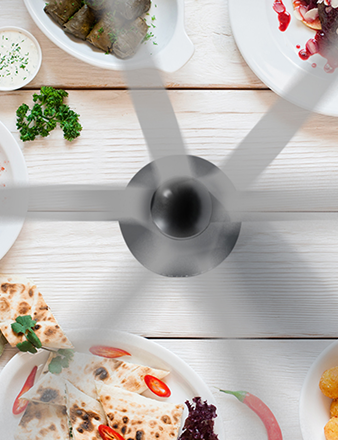
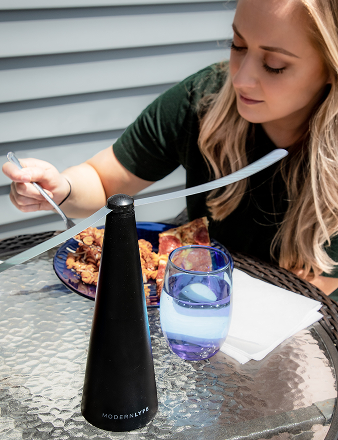
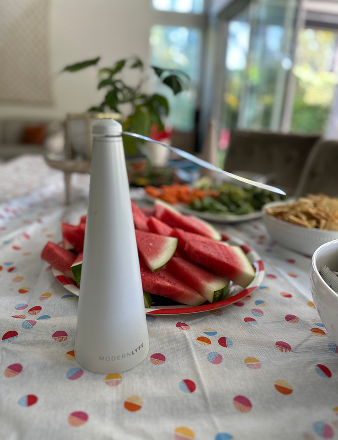
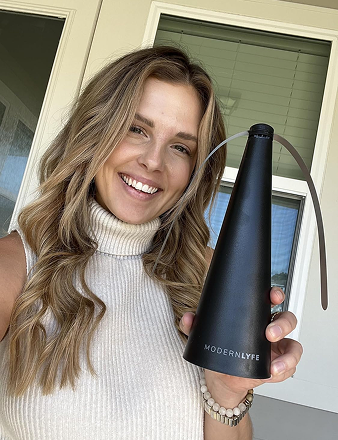
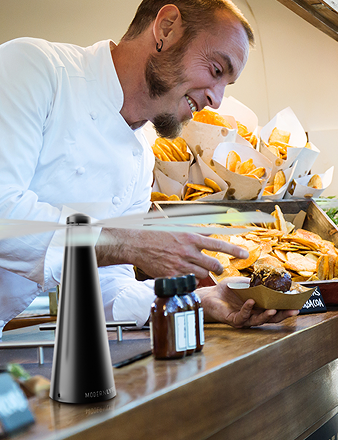
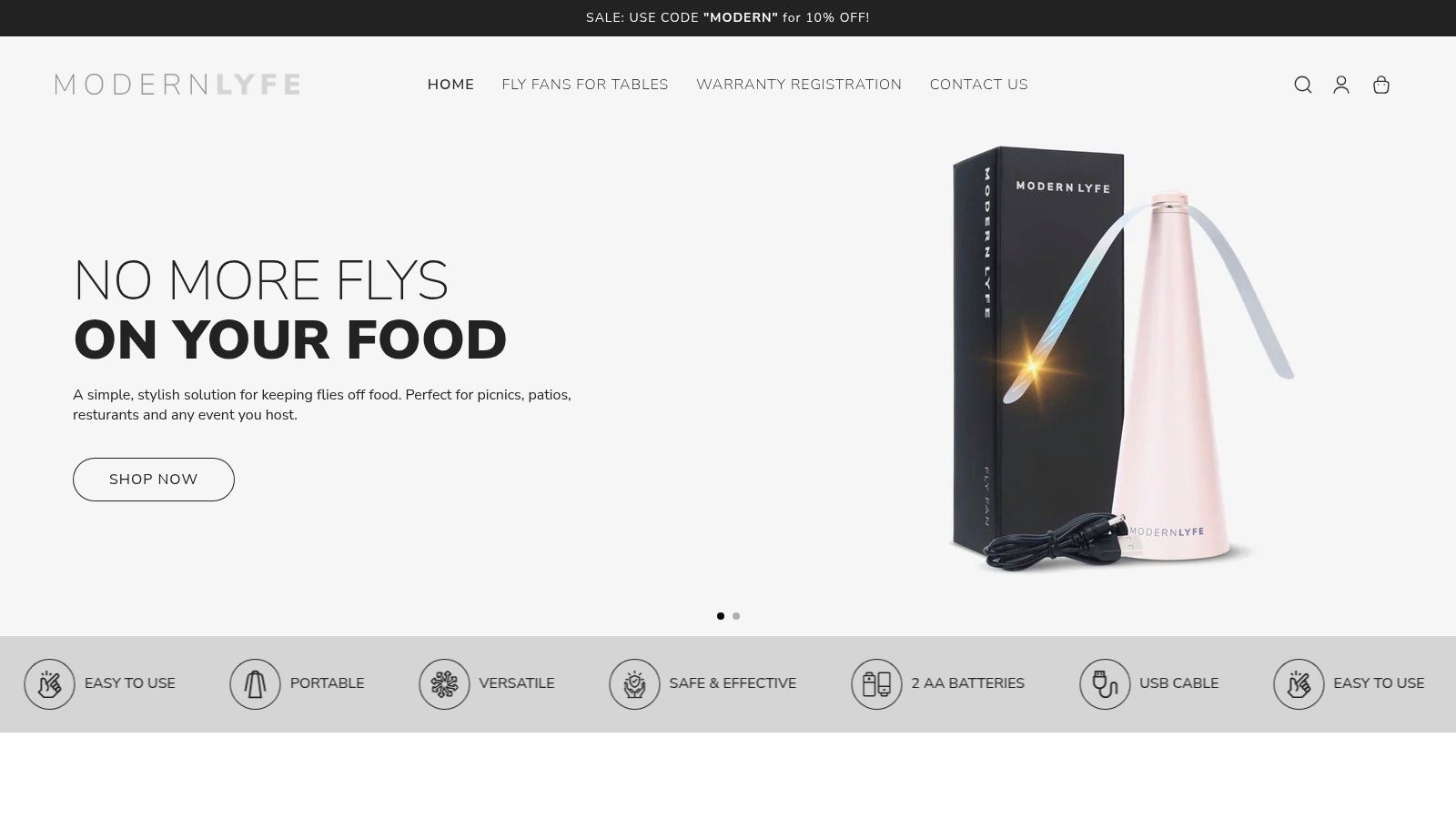
Mechanical airflow devices can deter flies around dining tables, buffet lines, outdoor receptions, and service areas without applying a spray to the surrounding environment. A battery-operated fly fan, such as the option shown by MODERN LYFE, can be positioned near a table or food-service setup where quiet, unobtrusive airflow is useful. It supports exclusion, but it doesn't correct a waste, drain, or structural problem.
That distinction matters. A fan can reduce fly access around a protected service point, while sanitation and maintenance remove the conditions attracting flies in the first place. Operators considering food-service applications for fly-control tools should assess placement, charging or battery management, cleaning, and whether airflow covers the exposed-food zone.
This video illustrates the type of device used for mechanical fly deterrence:
Chemical and electrocution controls
Chemical products may be necessary in some situations, but USDA food-defense guidance treats pesticide and rodenticide use as a last resort because chemicals can contaminate food. Products must be regulated, stored correctly, and used by certified personnel where required. The USDA sanitation handbook reinforces the priority of screening, exclusion, and maintenance.
Electrocution or stunning devices create a separate placement issue. USDA guidance says these devices must retain insects, stay away from food-preparation areas, and prevent dead insects or fragments from falling onto exposed food, clean equipment, utensils, linens, or unwrapped single-use articles. The device may work technically while still being unsuitable if its location creates a contamination route.
Understanding Fly-Borne Disease Risk
A fly landing on food creates a plausible contamination hazard, but it doesn't prove that illness will occur. That distinction is important for sound decision-making. WHO's review found that flies can pick up, harbor, and transmit enteric pathogens to food, while also concluding that the extent of transmission and the importance of flies as a major route of diarrhoeal disease remained uncertain. Across seven studies, fly-control measures were associated with a median 40% reduction in diarrhoea morbidity, with results ranging from 0% to 67%. These figures are reported in the WHO review of flies and disease transmission.
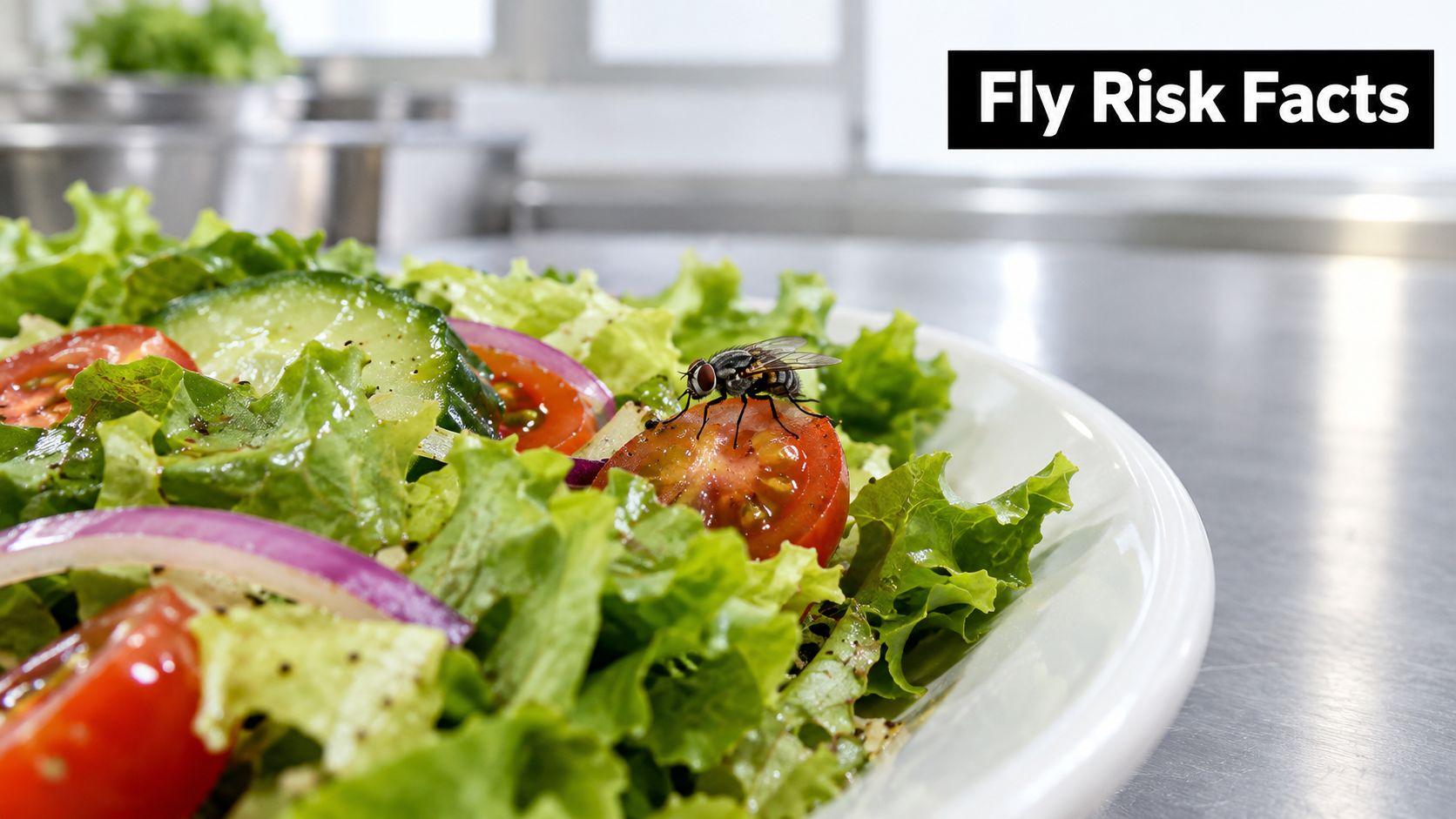
The operational mistake is choosing between panic and dismissal. Some viruses and protozoa can present risk at low infectious doses, and bacteria may multiply under suitable conditions. At the same time, the presence of one fly doesn't establish that a guest will become ill. The correct response depends on the food, the exposure, local policy, and the surrounding sanitation conditions.
A tiered response to contact
First, protect the food. Stop service of the exposed ready-to-eat item while a manager assesses the incident. Follow local policy for protecting or discarding food that may have been contacted by a pest. Don't mix the item back into a buffet, garnish tray, or service container.
Second, protect the area. Clean and sanitize affected food-contact surfaces according to the site's approved procedure. Remove nearby exposed ingredients from service until staff can confirm that they weren't affected. Check utensils, containers, and service equipment rather than focusing only on the visible insect.
Third, investigate the source. Inspect waste, drains, doors, screens, standing water, and nearby food storage. If flies keep appearing, repellence alone isn't enough. The team needs to remove the attraction or entry route.
Fourth, document recurring activity. Record the location, time, food involved, immediate disposition, cleaning performed, and corrective action. Repeated incidents should trigger management review and, where appropriate, professional assessment.
The FDA also distinguishes pests by context, including vectors, indicators of insanitary conditions, and incidental pests. That classification supports a measured response. Every incident deserves action, but not every incident carries the same regulatory meaning or requires the same intervention.
Monitoring, Documentation, and Staff Training
Pest control fails in many kitchens because responsibility is assumed rather than assigned. A manager may expect the closing team to report evidence, while closing staff assume a contractor will notice it. The result is a gap in the system, even when the business has traps, service visits, and written policies.
The FDA Food Code requires food establishments to maintain premises free of insects, rodents, and other pests. It identifies routine inspection of incoming food and supplies, premises inspection, and approved trapping or other controls when pests are found as practical measures. The FDA's food-establishment pest-control guidance makes clear that prevention is an ongoing duty, not a one-time treatment.
Build records that support decisions
A useful log is simple enough for staff to complete during a busy shift. Include:
- Location: Name the room, equipment, door, drain, or storage zone precisely.
- Observation: Record the evidence, such as a live insect, droppings, damaged packaging, or an entry gap.
- Immediate action: Note whether food was isolated, a surface was cleaned, or a control was placed.
- Corrective owner: Assign the repair, sanitation task, inspection, or escalation to a named role.
- Verification: Confirm at the next check whether the condition was corrected.
Trend the information by location and date. A single observation may need prompt attention, but recurring observations reveal where the program is failing. A service report that says “no activity” provides limited operational value if staff continue finding insects near the same receiving door.
Train the people closest to the problem
Every employee should know what to report and why it matters. Training should cover signs of activity, delivery checks, waste handling, door and screen discipline, food isolation, cleaning after contact, and the placement rules for approved devices.
Staff also need permission to stop a questionable process. A prep worker who sees a fly near an uncovered ready-to-eat item should know whom to contact and what to do immediately. If reporting creates blame or delay, employees may ignore early signs until the problem becomes obvious.
Staff don't need to identify every pest species. They need to recognize evidence, protect food, report the location, and preserve the facts.
Training should include a practical walk-through of receiving, storage, waste, preparation, and service areas. Show employees where records are kept, how to describe a finding, and which controls they may use. Chemical products require additional controls and should not be handled casually by untrained staff.
Verify the system, not just the paperwork
A completed checklist isn't proof that the control worked. Managers should compare records with the physical condition of the site, inspect corrective actions, review recurring locations, and confirm that devices remain clean, intact, and correctly positioned. Dead insects must be removed frequently enough to prevent accumulation, decomposition, or attraction of additional pests.
USDA sanitation guidance also expects meat and poultry establishments to address grounds maintenance, entry prevention, and the safe use of products so food doesn't become adulterated. Records are valuable because they connect an observation to a decision and then to verification. Without that chain, the business can't tell whether it solved the cause or merely recorded the symptom.
Putting It All Together - Your Action Plan
A workable food-safe pest-control program has a clear order:
- Prevent entry. Maintain screens, doors, seals, air curtains, and building surfaces. Keep waste areas controlled and correct leaks or standing water before they become pest habitat.
- Inspect consistently. Check incoming shipments before acceptance, then inspect receiving, storage, preparation, waste, dining, service, and exterior areas. Look for pests, droppings, damaged packaging, and access points.
- Protect exposed food. If a pest contacts ready-to-eat food, stop service, follow local policy for protection or disposal, clean affected surfaces, and assess nearby items. Don't assume that killing the insect resolves the food-safety issue.
- Use targeted controls. Place traps and approved devices where evidence supports them. Keep insect-control devices away from food-preparation areas and ensure they can't release dead insects or fragments onto food or clean service items.
- Reserve chemicals for justified needs. Use approved products according to label and site procedures, store them safely, and use certified personnel where required. A chemical application shouldn't compensate for an open door, leaking drain, or unsanitary waste area.
- Document and verify. Record findings, actions, responsible staff, and follow-up results. Escalate recurring activity because repetition usually points to an unresolved source.
The trade-off is straightforward. Prevention and maintenance require daily attention, but reactive treatment leaves operators with less control and more risk around exposed food. Technology can support a dining area, traps can confirm activity, and professional services can provide expertise, but none of them replace sanitation, exclusion, and accountable staff behavior.
Some businesses also use outsourced health and safety support to strengthen documentation, training, and compliance oversight. That can be useful when managers lack time or specialist knowledge, provided the external support is integrated into the site's daily responsibilities rather than treated as a substitute for them.
Start today by walking the full route from delivery entrance to waste exit. Note every gap, leak, standing-water source, damaged package, exposed food point, and poorly placed device, then assign a correction and schedule verification. That single exercise turns food-safe pest control from a vague maintenance goal into a managed operational system.
MODERN LYFE offers quiet, battery-operated fly fans that use mechanical airflow around dining tables, buffet lines, outdoor receptions, and other food-service setups without chemical sprays. Visit MODERN LYFE to review practical fly-deterrence options for protecting exposed food and improving guest comfort.