“Just tip a percentage” is incomplete advice. Before you calculate wedding catering gratuity, check the contract label and ask who receives the money. A generous payment doesn't accomplish what you intend if you mistake a business fee for staff compensation or overlook the people working behind the scenes.
My recommendation is simple: settle the paperwork first, establish the calculation base, then agree on distribution. You should arrive at your reception knowing what's already paid, what's still due, and who will handle it. Nobody should be negotiating staff appreciation beside the cake table.
Why Wedding Catering Gratuity Follows the Food Bill
Wedding catering gratuity usually follows the food-and-beverage charge, not your entire wedding budget. Think of a restaurant meal: you connect the tip to the meal and hospitality, not to the flowers on the table or the band playing nearby. Your reception deserves the same clear boundary.
In the United States, the customary benchmark is 15% to 20% when gratuity isn't already included. That makes the gratuity $1,500 to $2,000 on a $10,000 catering bill, or $3,000 to $4,000 on a $20,000 bill, according to Minted's wedding-vendor tipping guidance. Its guidance treats the payment as compensation for the catering team collectively, including servers, bartenders, chefs, and kitchen staff.
Review the food-and-beverage charges together before deciding what to set aside.

Separate hospitality from the rest of the celebration
A bundled venue invoice can make unrelated expenses look like a single tipping base. Don't let the grand total make that decision for you. Ask the caterer to identify the relevant subtotal instead of applying a percentage to every line.
- Food and beverages: Locate the meal and drink charges, including any separately listed bar package.
- Other purchases: Flag venue rental, décor, entertainment, and equipment rather than automatically including them.
- Staff coverage: Ask which catering employees the proposed gratuity is intended to recognize.
This isn't an argument for tipping less. It's an argument for directing your budget deliberately, so the amount reflects the hospitality you're paying to acknowledge.
Practical rule: Find the correct subtotal before choosing the percentage.
For hosts, that distinction also makes proposals easier to compare. I recommend keeping the catering subtotal, business fees, and staff gratuity on separate lines in your planning spreadsheet. You'll be able to see the complete expense without confusing the purpose of each payment.
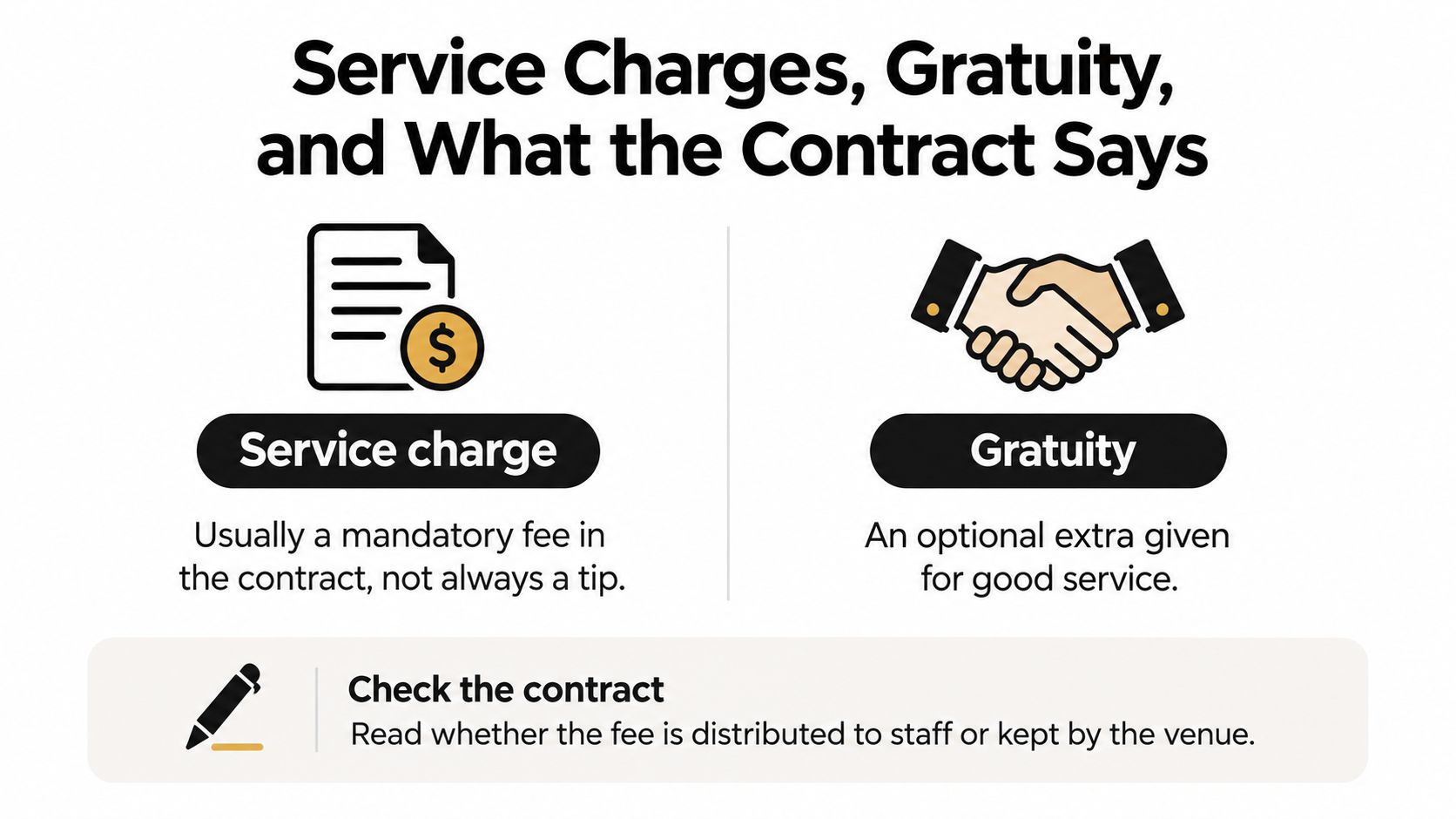
Service Charges, Gratuity, and What the Contract Says
A mandatory service charge is not automatically a staff tip. Brides reports that many wedding catering contracts include a service charge of approximately 24% to 26%, which may cover overhead, administration, or staffing infrastructure rather than a gratuity for servers. Ask where it goes before treating it as employee compensation, as Brides' vendor-gratuity guide advises.
The terminology matters more than whether the fee looks substantial. Put the relevant invoice language beside this comparison.
| Invoice term | What you're looking at | What to establish |
|---|---|---|
| Voluntary gratuity | An optional payment you choose | Recipient and delivery method |
| Mandatory gratuity | A gratuity required by the agreement | Employee coverage and distribution |
| Service charge | A required business charge that isn't necessarily a tip | What the company retains and what staff receive |
Why labels need written explanations
New York provides a concrete example of why these distinctions aren't interchangeable. Its catering tax guidance says a mandatory gratuity is generally excluded from taxable receipts only when it's separately stated, explicitly labeled as gratuity, and distributed entirely to employees. The same guidance illustrates an 8% taxable service charge alongside a separately stated 15% gratuity passed to servers, which isn't taxable under those conditions, in its caterers and catering services tax bulletin.
That's a New York rule, not a nationwide tax shortcut. Use it as a reason to request precise documentation, and have the caterer explain the treatment that applies to your event.
Before authorizing another payment, get clear answers:
- Purpose: What does each mandatory charge pay for?
- Recipients: Is any portion distributed to employees, and which employees?
- Obligation: Does the agreement require a separate gratuity?
- Documentation: Will the final invoice distinguish company fees from staff payments?
Add these to your wedding reception questions, alongside service timing and venue responsibilities. An answer such as “that's our standard fee” doesn't resolve the issue. Ask the catering manager to explain the allocation in writing, using the same terms that appear in your contract.
How to Calculate Gratuity on the Right Base
Start with the itemized proposal, not the payment screen. Your task is to identify the agreed base and then apply the chosen rate only if a separate gratuity remains appropriate.
The Knot's catering-team benchmark is 15% to 20%, while Zola reports that couples tipping separately commonly choose 16% to 20%. These are planning references, not permission to multiply an unexplained invoice total, so follow the contract-defined base and Zola's advice to check included catering gratuities.
Establish the subtotal before doing the math
Use this sequence with your caterer:
- Identify the food-and-beverage subtotal: Ask for the amount before applying gratuity, with food and drinks clearly identified.
- Check the boundaries: Confirm whether bar service is included and whether rentals, taxes, or other charges are inside or outside the calculation.
- Clarify taxable items: Have the vendor show which charges are taxable. Don't assume the taxable subtotal and gratuity base are identical.
- Record the calculation: Keep the agreed base and chosen rate beside the resulting gratuity in your budget.
The formula is straightforward: agreed calculation base × selected gratuity rate = gratuity amount. The difficult part isn't multiplication. It's making sure both parties mean the same thing by “catering bill.”
A worked example and the included-gratuity test
On a $12,000 food-and-beverage subtotal, the customary benchmark produces $1,800 to $2,400. If the agreement already includes an 18% gratuity, adding another full percentage-based tip would generally duplicate the intended compensation, unless you deliberately choose a supplement for exceptional service, as illustrated in Paperlust's wedding-vendor gratuity guidance.
Notice the word gratuity in that example. An included charge only resolves the staff-payment question once you've established its purpose.
An exceptional-service supplement should be a deliberate thank-you, not an automatic second calculation.
My preference is to decide on any optional supplement separately from the contractual payment. That lets you recognize a captain who handled a difficult change or a team that provided especially thoughtful service without reopening the whole budget. You can be generous and still insist on a calculation you understand.
Who Gets Tipped and How the Pool Is Shared
The person who serves your entrée isn't the only person who made dinner happen. Captains, bartenders, kitchen staff, setup crews, and drivers may all contribute, but you shouldn't assume they all participate in the same gratuity pool. Ask for a role-by-role explanation.
This matters beyond weddings. Hospitality reporting says 54% of full-service operators sometimes add a service charge or automatic gratuity; among those operators, 88% apply it only to larger parties, banquets, private events, or catering events, according to CNBC's reporting on hospitality service fees and gratuities. Those figures aren't a wedding-only survey, but they reinforce why hosts need to examine how event charges are allocated.
Gratuity Guidance by Role
| Role | Common Guidance | Confirm in Writing |
|---|---|---|
| Servers | Establish whether they're included in the team pool | Eligible workers and allocation method |
| Bartenders | Check catering coverage before arranging a separate payment | Whether bar staff belong to another vendor |
| Chefs and kitchen staff | Ask explicitly about behind-the-scenes participation | Which culinary roles receive a share |
| Banquet captain | May receive the team payment for distribution | Whether the envelope is pooled or personal |
| Catering manager | Distinguish management recognition from staff funds | Responsibility for distributing and acknowledging payment |
| Setup and breakdown crews | Don't assume reception-service coverage extends to them | Which shifts and duties qualify |
| Delivery drivers | Check the relevant supplier's agreement | Whether they're covered by catering or another contract |
Request a distribution plan, not a vague assurance
Ask whether the caterer divides the pool by role, hours, or another stated method. Also ask how setup hours and overtime affect participation. You're not trying to manage payroll, you're making sure your payment reaches the group you intend to recognize.
Give the banquet captain or catering manager written distribution instructions consistent with the agreed policy. A team envelope should say it's for the team; a personal thank-you should identify the individual.
Keep transportation separate from catering delivery. For passenger vehicles, Hamptons Leisure Limo's explanation of when limo gratuity is already included is a useful contract-review resource. Don't assume an arrangement with the caterer settles an unrelated driver's payment.
Flat Gratuities for Managers and Key Staff
A flat payment can be a thoughtful way to recognize the person coordinating service. It shouldn't become another automatic add-on just because a manager has a prominent title. First establish whether that person already participates in the team gratuity and whether the contract calls for a separate payment.
Wedding Society lists $200 to $500 as a possible gratuity for a wedding venue coordinator or catering manager. Its guidance also explains that gratuity may be due with the final bill when the contract specifies it, while payment after the reception is acceptable when prepayment isn't required, in its wedding-vendor tipping recommendations.
Separate an obligation from a personal thank-you
| Payment type | How to handle it |
|---|---|
| Contract-required gratuity | Budget it as an agreed expense and follow the payment deadline |
| Optional personal payment | Decide deliberately after considering the individual's contribution |
| Catering-team pool | Keep it distinct from any manager-only recognition |
My advice is to resist the instinct to reward only the person you've emailed throughout planning. That person may deserve recognition, but visibility isn't the same as contribution. Resolve the team's arrangement before deciding whether to make an individual gesture.
A flat gratuity offers a clear budget limit and a named recipient. The trade-off is that it doesn't automatically acknowledge everyone who worked the event. Be explicit about whether you're choosing an alternative team arrangement or adding a personal thank-you, rather than treating those purposes as interchangeable.
Make the handoff unambiguous
If you're using an envelope, label it with the recipient's name and purpose. Don't hand a manager an unlabeled payment and expect them to know whether it's personal or intended for distribution.
- Verify the recipient: Use the correct name and job title, especially if staffing changes.
- Choose the method: Confirm whether the vendor wants payment through the invoice or another agreed channel.
- Keep a record: Ask for written acknowledgment without turning the exchange into a public presentation.
A short note explaining what you appreciated makes the gesture personal. The payment record serves a different purpose: it prevents your planner, partner, or family member from unknowingly paying the same item again.
Etiquette for Couples and Hosts on the Big Day
Consider a hypothetical reception where the couple assumes the invoice covered every staff payment. During dinner, the captain asks their planner about a separate gratuity envelope. Nobody has the agreement available, and the couple must choose between interrupting their evening and authorizing a payment they don't understand.
That awkward exchange is avoidable. Appreciation should feel calm and intentional, not like an unresolved invoice handed to you between courses.
A discreet handoff keeps the focus on thanking the people who served your guests.

Treat survey results as context, not an obligation
In a wedding-spend survey, 73% of couples tipped their caterer; among those who tipped, 87% used a percentage-based method, the most common range was 16% to 20%, and the reported average flat gratuity was $262, according to the wedding-vendor gratuity guide summarizing those findings. These results describe different payment choices. They don't establish that the flat average replaces a team gratuity under your particular agreement.
For smaller celebrations, keep the same discipline without making the exchange ceremonial. Thank staff directly, speak respectfully, and handle payment away from guests. Don't ask workers to explain company compensation policy while they're carrying plates.
Host's reminder: Resolve payment questions with management before service, then let staff focus on your guests.
Give your lead contact clear authority
Name a planner or trusted host to manage the agreed handoff. Put the recipient, payment status, timing, and escalation contact into your event coordinator checklist template. Make clear whether that person may authorize anything beyond the recorded amount.
Keep guest generosity separate from staff compensation. If relatives ask about what to spend on wedding gifts, EasyRegistry offers a separate resource for that conversation. Your catering payment shouldn't depend on what guests choose to give.
Keep this video alongside your event-planning notes.
Coordinate the handoff with the final-invoice schedule and the vendor's agreed deadline. In the hypothetical reception, a named contact with written confirmation could have answered the captain without involving the couple. Good etiquette starts with that preparation, then finishes with a sincere thank-you.
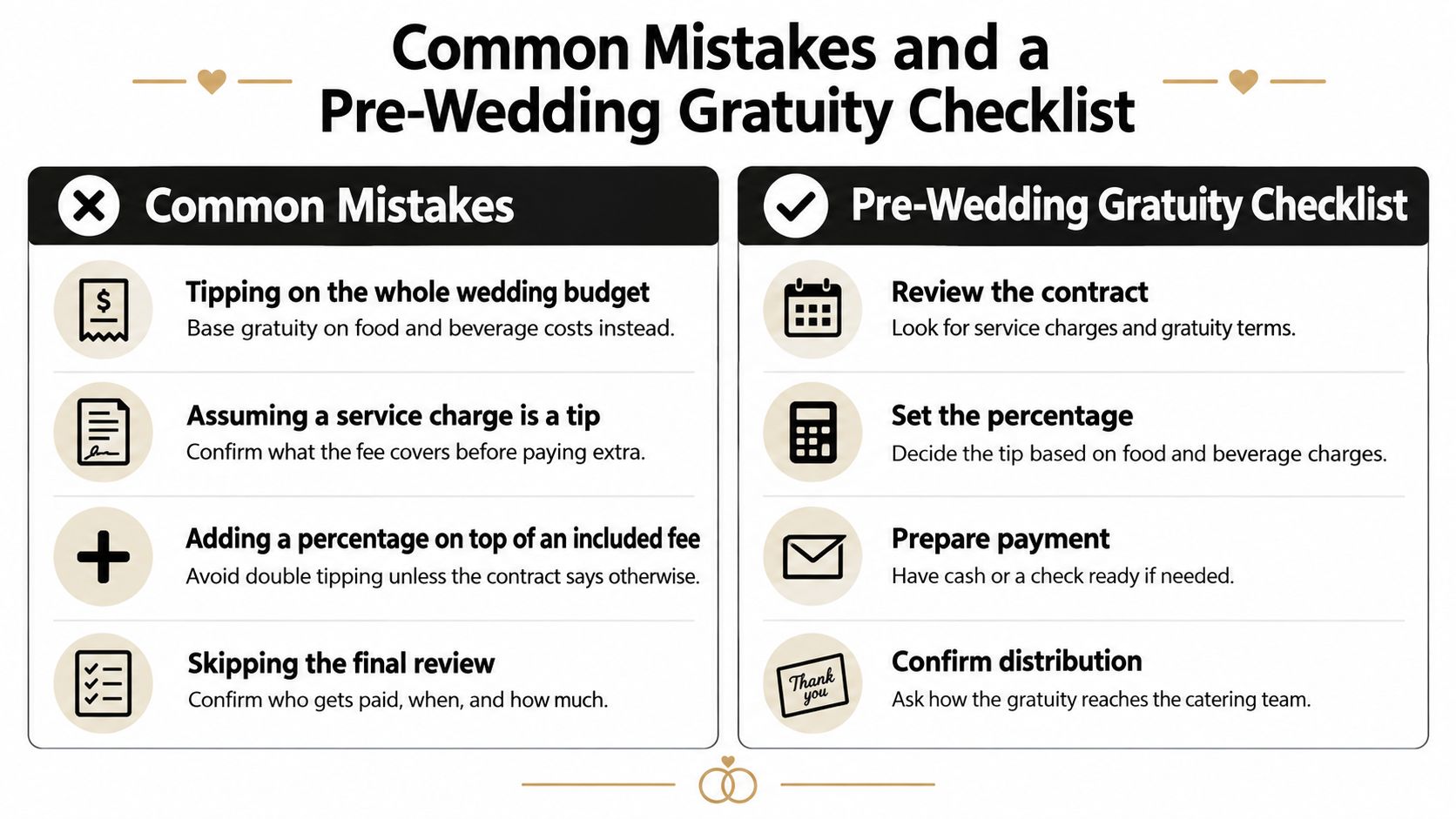
Common Mistakes and a Pre-Wedding Gratuity Checklist
The expensive mistake isn't always choosing the wrong amount. It's authorizing payment without understanding the purpose. Before signing off, pair each familiar error with a specific check.
| Common mistake | Prevention check |
|---|---|
| Tipping on the whole wedding budget | Highlight the agreed catering calculation base |
| Assuming a service charge is a tip | Obtain a written explanation of the fee's purpose |
| Adding a percentage above included gratuity | Mark contractual staff payments as already covered |
| Never checking pool distribution | Record eligible roles and the person responsible |
Use a final review to catch mismatches between the proposal, your budget, and the invoice.
Put the agreement into a usable payment record
Your checklist should let someone handle the payment without reconstructing your conversations. Add it to your wedding reception planning checklist, and keep the supporting email with the contract.
- Confirm the subtotal: Record food-and-beverage charges, taxable items, and the agreed gratuity base separately.
- Identify included payments: Distinguish company service fees from employee gratuity.
- Choose the amount: Record your percentage or flat-payment decision and its intended purpose.
- Name the recipient: Identify who receives the payment and who distributes it.
- Set the deadline: Note when payment is due, the accepted method, and who will confirm receipt.
- Control changes: Require approval before anyone increases or duplicates a planned payment.
If the complete cost exceeds your budget, revisit event choices before finalizing commitments. EventUploader's ideas to save on wedding catering and entertainment offer a separate place to explore those trade-offs. Don't rely on an unresolved gratuity line to make a proposal appear affordable.
Send the caterer a written question before the final invoice arrives: ask them to confirm which charges reach employees, which roles participate, and whether any separate gratuity remains due. Save the answer with your agreed payment amount and delivery instructions. That's how you turn wedding catering gratuity from an anxious guess into a clear commitment to the people serving your celebration.
MODERN LYFE offers quiet, battery-operated fly fans designed for dining tables, buffet lines, and event setups. As you finalize catering payments and reception details, visit MODERN LYFE to explore unobtrusive options for helping keep flies away from food and guests.